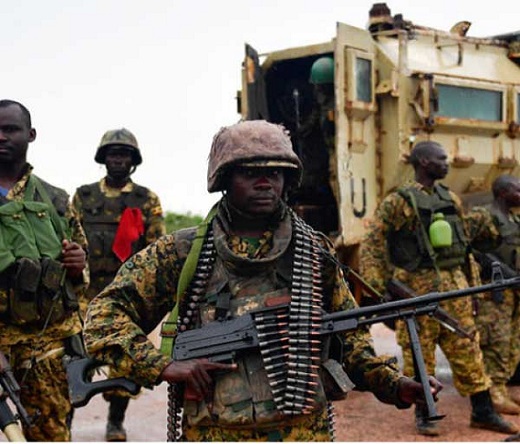
A member of he UPDF on guard duty in Somalia
HABARI DAILY I Kampala, Uganda I The first contingent of Uganda People’s Defence Forces (UPDF) soldiers has left Somalia, marking the beginning of Uganda’s phased military withdrawal from the troubled Horn of Africa country after nearly 20 years of involvement in peacekeeping and stabilisation operations.
The exit was accelerated by a 25% budget reduction from the United Nations Support Office in Somalia (UNSOS) and severe cutbacks in logistical and operational support from international partners, including the European Union.
The United States signaled a wind-down of financial backing for UN-supported logistics tied to the African Union mission, declining to endorse mandate extensions without a clear exit or burden-sharing shift.
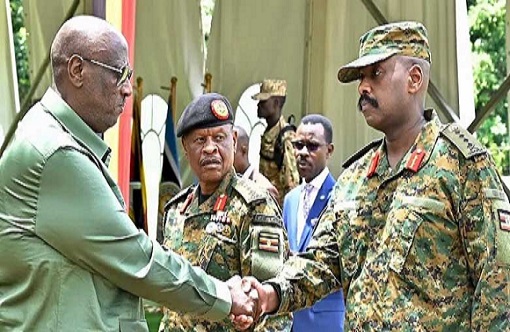
The withdrawal, announced by Chief of Defence Forces Gen Muhoozi Kainerugaba, follows the adoption of an exit strategy that will see Ugandan troops serving under the African Union Support and Stabilization Mission in Somalia (AUSSOM) gradually leave the country, with the process expected to be completed by the end of 2027.
The first group, comprising 109 soldiers, reportedly departed Mogadishu on Friday, marking the start of the implementation of the military drawdown.
Gen Muhoozi confirmed the development in a statement posted on X, saying Uganda had begun withdrawing its troops and would hand over security responsibilities to Somali forces.
“As we promised, we have started withdrawing UPDF from Somalia. After 20 years of a lot of blood and sacrifice, we are handing over security to our Somali brothers,” he wrote.
The withdrawal is expected to take place in phases, with troops deployed under the African Union mission gradually reducing their presence over the coming months as Somalia assumes greater responsibility for its national security.
Two withdrawal arrangements
Under the exit strategy, the withdrawal involves two separate categories of Ugandan military deployments in Somalia.
The first concerns troops deployed under direct bilateral security arrangements between Uganda and the Federal Government of Somalia. The drawdown of these forces has already commenced, with the initial contingent having returned home.
The second category involves Ugandan soldiers serving under AUSSOM, the African Union-led mission supporting Somalia’s security institutions and efforts to combat Islamist militants.
These troops will be withdrawn gradually as the mission implements its transition arrangements, with Uganda’s overall military presence expected to end by the close of 2027.
The distinction is important because Uganda is not immediately ending all its military involvement in Somalia. Forces serving under the bilateral arrangement are subject to a separate withdrawal process from those operating under the African Union mission.
The exit strategy is intended to ensure that the withdrawal does not create a security vacuum that could be exploited by al-Shabaab, the al-Qaeda-linked militant organisation that has waged a prolonged insurgency against the Somali government.
Why Uganda is leaving Somalia
Uganda’s withdrawal comes amid growing financial uncertainty surrounding the African Union’s security operations in Somalia.
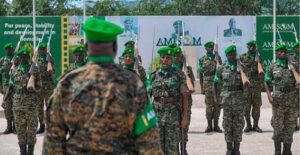
Uganda’s contingent in the African Union troops
The mission has faced mounting international funding pressures, including a decision by the United States not to support renewal of the mission’s mandate and a 25% funding reduction by the United Nations Support Office in Somalia (UNSOS).
These developments have raised concerns about the sustainability of maintaining thousands of African Union troops in Somalia without reliable financial support.
The funding difficulties have also complicated efforts to sustain AUSSOM, which replaced the African Union Transition Mission in Somalia (ATMIS) in January 2025.
AUSSOM was established to support Somalia in strengthening its security institutions, combating al-Shabaab and progressively transferring security responsibilities to the Somali National Army.
The funding uncertainty has therefore increased pressure on troop-contributing countries, including Uganda, to reconsider the scale and duration of their military commitments.
20-year military sacrifice
Uganda was the first African country to deploy troops to Somalia under the African Union Mission in Somalia (AMISOM), which was established in 2007 to protect the country’s transitional government against attacks by Islamist militants.
Since then, UPDF soldiers have played a central role in military operations to drive al-Shabaab out of Mogadishu and other strategic urban centres.
Working alongside the Somali National Army, Ugandan troops helped recapture important territory, secure government installations and protect key institutions.
The mission, however, came at a considerable human cost, with Ugandan soldiers losing their lives in attacks and confrontations with al-Shabaab militants.
Uganda subsequently maintained its involvement under successive African Union missions, including AMISOM, ATMIS and now AUSSOM.
The military engagement made Uganda one of the most important contributors to international efforts to stabilise Somalia.
Somalia’s responsibility for its security
The withdrawal will place greater responsibility on the Somali National Army to protect the country’s territory, government institutions and population.
For nearly two decades, Somalia has depended heavily on foreign military support to contain al-Shabaab, which continues to carry out deadly attacks against security forces, government officials and civilians.







About the Author