
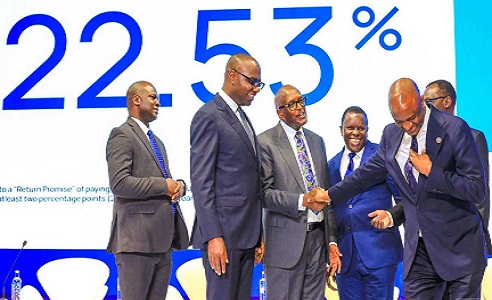
The big boys who decide on Uganda’s economic trajectory: Henry Musasizi, the finance minister (2nd L), Henry Tumukunde, the Gender minister (3rd L), Patrick Ayota, the NSSF ED (R) and Ramathan Ggoobi, the PSST (2nd R), engage in a chat after the big payout announcement last week
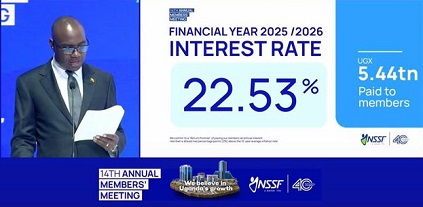
HABARI DAILY I Kampala, Uganda I Members with big holdings in the National Social Security Fund (NSSF) smiled all the way to the bank after the Fund credited a record Shs5.44 trillion in interest to members’ accounts, with the biggest individual beneficiary receiving Shs2.14 billion.
The payout followed the declaration of a 22.53 percent interest rate for the 2025/2026 financial year—the highest rate in NSSF’s 40-year history.
But while the interest rate was the same for every member, the amount credited to each account varied sharply because interest was calculated on the individual balances held by savers.
This means that members with billions of shillings saved received hundreds of millions or billions in interest, while those with smaller balances received proportionately smaller amounts.
Shs2.14 billion for the biggest saver
The largest single payout went to an unidentified NSSF member whose account received Shs2.14 billion in interest.
At the 22.53 percent rate, that payment implies that the member had an accumulated balance of approximately Shs9.5 billion.
NSSF has not disclosed the identity, occupation or contribution history of the individual. The calculation illustrates how the Fund’s uniform interest rate translates into vastly different payouts.
For example, while 22.53 percent of Shs9.5 billion produces approximately Shs2.14 billion, the same rate applied to a balance of Shs500,000 generates only about Shs112,650.
The difference, therefore, was not that some members were given preferential interest rates. Rather, it reflected the size of their accumulated savings.
Top savers took Shs4.7 trillion
The concentration of NSSF savings also meant that a relatively small proportion of members received a large share of the total payout.
According to figures reported by the Fund, about 12 percent of savers—roughly 324,000 people—held Shs10 million or more, collectively controlling about 87 percent of NSSF’s funds.
Consequently, this group received approximately Shs4.7 trillion of the Shs5.44 trillion credited to members.
Each of these members received the same 22.53 percent rate on their respective qualifying balances, with the resulting interest depending on how much they had accumulated. The reported minimum interest for this group was about Shs2.25 million.
This is an important distinction in understanding what NSSF means by distributing the interest equally.
The Fund did not distribute Shs5.44 trillion equally in cash amounts among all members. Instead, every eligible member’s balance was credited using the same interest rate.
Thus, a member with a large balance received more money in absolute terms, while a member with a small balance received less, but both were treated using the same percentage.
Millions shared the remaining payout
NSSF has about 3.6 million registered members, although approximately 2.7 million currently have money in their accounts.
The remaining members shared the portion of the Shs5.44 trillion not received by the high-balance savers.
The payout was almost twice the amount distributed in the previous financial year, when NSSF declared a 13.5 percent interest rate and credited about Shs2.8 trillion to members.
The dramatic increase therefore benefited savers across the membership, although the monetary impact differed according to individual account balances.
The principle is similar to how interest compounds in a savings account: the larger the amount saved, the larger the return generated at the same percentage.
Where the money came from
The record payout was supported by an equally remarkable improvement in NSSF’s financial performance.
The Fund’s total income rose by 85 percent, from about Shs3.5 trillion in 2024/25 to Shs6.51 trillion in 2025/26.
Of this amount, Shs3.88 trillion was realised income—actual cash generated from investments. This included about Shs3.49 trillion in bond interest, Shs369 billion in dividends and Shs16 billion from real estate.
Another Shs2.62 trillion represented unrealised gains, largely reflecting increases in the value of investments that had not yet been sold.
NSSF’s investment portfolio remained heavily weighted towards fixed-income assets, with government bonds accounting for about 76.5 percent of its Shs32.8 trillion asset base at the end of June 2026. Shares accounted for about 18.4 percent and real estate 5.1 percent.
A windfall built on members’ savings
The record interest payment comes as NSSF’s assets expanded to Shs32.8 trillion, making it the largest pension fund in East Africa, according to the Fund’s reported 2025/26 figures.
For ordinary savers, however, the most important figure is the amount appearing against their individual accounts.
The 22.53 percent rate means that, regardless of whether a member had Shs500,000, Shs10 million or several billion shillings, the same percentage was applied to the qualifying balance.
That is why the largest saver received Shs2.14 billion while smaller savers received much smaller amounts.
The payout therefore demonstrates both sides of NSSF’s savings model: equal treatment through a common interest rate, but unequal monetary returns because members have accumulated different amounts of savings.