
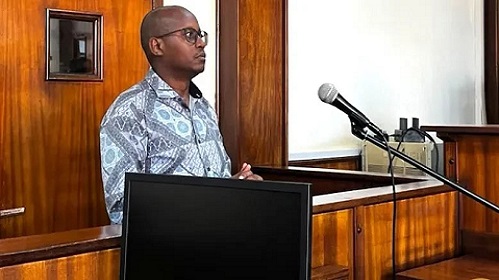
Michael Katungi Mpeirwe
HABARI DAILY I Kampala, Uganda I With life imprisonment hanging around his neck, Ugandan national Michael Katungi Mpeirwe faces a difficult legal battle after appearing before a United States federal court following his extradition from Uganda over an alleged international cocaine-trafficking and military weapons conspiracy linked to a Mexican drug cartel.
Katungi, 45, appeared before the District Court for the Eastern District of Virginia in Alexandria on October 8, 2026, where he faces three conspiracy charges that could see him spend the rest of his life behind bars if convicted.
The US Department of Justice said Katungi faces a mandatory minimum sentence of 10 years in prison and a maximum of life imprisonment upon conviction.
However, his immediate future will depend on how he responds to the charges, the strength of the prosecution’s evidence, the legal arguments presented by his defence team and the eventual determination of the court.
Katungi has not been convicted, and prosecutors must prove the allegations against him beyond reasonable doubt.
Building a defence against the charges
Katungi’s first major task will be to challenge the prosecution’s allegations through a carefully prepared defence. He faces conspiracy to distribute cocaine, conspiracy to possess firearms, including machine guns and destructive devices, in furtherance of drug trafficking, and conspiracy to provide material support or resources to a designated foreign terrorist organisation.
US prosecutors allege that, from at least September 2022, Katungi worked with Bulgarian national Peter Dimitrov Mirchev, Kenyan national Elisha Odhiambo Asumo and Tanzanian national Subiro Osmund Mwapinga to supply military-grade weapons to the Cartel de Jalisco Nueva Generación (CJNG).
The alleged arsenal included AK-47 rifles, machine guns, rocket launchers, grenades, sniper rifles, anti-personnel mines, night-vision equipment and anti-aircraft systems.
The prosecution further alleges that the weapons were intended to help the cartel facilitate large cocaine shipments into the United States.
Katungi’s lawyers will need to scrutinise the evidence linking him to the alleged transactions, including communications, financial records, travel information, arms procurement documents and testimony from other accused persons.
They may also examine whether the prosecution can establish that Katungi knowingly participated in the alleged conspiracy and understood its intended purpose.
The distinction between being associated with individuals implicated in criminal activity and knowingly joining a criminal conspiracy could become central to the proceedings.
Co-accused persons could shape his fate
The legal positions of Katungi’s alleged co-conspirators could also influence the direction of his case.
Asumo and Mwapinga have pleaded guilty to conspiracy charges involving cocaine distribution and possession with intent to distribute. Asumo is scheduled to be sentenced on November 4, 2026, while Mwapinga’s sentencing is set for January 13, 2027.
Their cooperation with prosecutors, if any, could provide investigators with additional evidence about the alleged weapons transactions and the respective roles of those implicated.
Katungi’s defence team will therefore need to examine any statements, agreements or testimony that could be used against him, including the circumstances under which such evidence was obtained.
A guilty plea by another defendant does not automatically establish Katungi’s guilt. His lawyers can challenge the reliability and relevance of evidence presented against him and question witnesses where permitted by the court.
Mirchev, who was arrested in Madrid in April 2025 and extradited to the United States on March 19, 2026, is another central figure in the case.
Prosecutors allege that he negotiated with people claiming to represent the cartel and helped organise the weapons transactions.
The alleged $58 million weapons deal
The prosecution’s case includes allegations that the group secured a Tanzanian end-user certificate, a document intended to identify the authorised recipient of controlled weapons.
Using the document, the accused allegedly arranged a test consignment of 50 AK-47 automatic rifles, magazines and ammunition from Bulgaria, with the weapons ultimately intended for the Mexican cartel.
Investigators further allege that the group pursued a much larger weapons package valued at approximately €53.7 million, equivalent to about $58 million or Shs216 billion.
The proposed consignment allegedly included surface-to-air missiles, anti-aircraft drones and ZU-23 anti-aircraft weapons.
The United States designated CJNG a foreign terrorist organisation and a specially designated global terrorist entity on February 20, 2025.
These allegations raise the stakes for Katungi because the prosecution is presenting the case not merely as an arms-smuggling operation but as a conspiracy allegedly connecting weapons procurement, international drug trafficking and a designated terrorist organisation.
His defence will need to address the specific legal elements of each charge rather than rely solely on challenging the broader narrative.
Extradition battle offers limited relief
Before his transfer, Katungi fought his extradition in Uganda, challenging the legality of the proceedings and claiming diplomatic immunity arising from his previous service in Nigeria.
On August 28, Buganda Road Chief Magistrate Ritah Neumbe Kidasa ruled that the legal requirements for extradition had been met and committed him to prison pending a decision by Justice and Constitutional Affairs Minister Norbert Mao.
The court rejected his objections, including challenges concerning the authority of officials handling the request and the involvement of the Director of Public Prosecutions.
Mao subsequently issued a surrender warrant on September 1, authorising Katungi’s transfer to the United States for the offences covered by the extradition request.
The extradition proceedings determined whether he could be surrendered to face trial abroad, not whether he was guilty of the alleged offences.
Consequently, the rejection of his objections in Uganda does not settle the criminal case against him in the United States.
What lies ahead?
Katungi’s immediate priority will be to secure experienced US federal criminal defence counsel, obtain the indictment and supporting evidence, and prepare for the next stages of the proceedings.
His lawyers may challenge the admissibility of evidence, contest the prosecution’s interpretation of the alleged transactions and negotiate with prosecutors if doing so serves his interests. Any plea agreement would be voluntary and subject to applicable legal procedures.
If the case proceeds to trial, the prosecution will have to establish his guilt beyond reasonable doubt. If convicted, sentencing would depend on the offences proved, applicable statutory requirements, federal sentencing guidelines and other relevant factors.
The United States Drug Enforcement Administration investigated the case with assistance from authorities in Uganda, Spain, Morocco and Ghana, underscoring its international scope.







About the Author