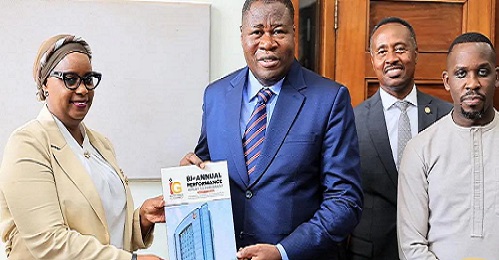

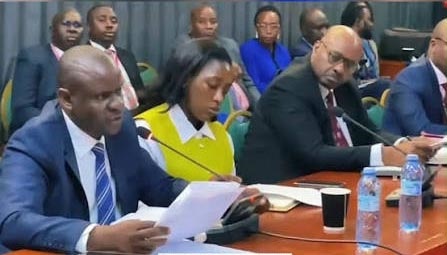
Local Government minister, Balaam Barugahara and his unior minister Justine Nameere facing MPs to expain the funding gaps
FHABARI DAILY I Kampala, Uganda I For many years, Uganda’s government has strived to fund local governments through a combination of central government transfers, locally generated revenues, and donor or development partner support.
Although this is all anchored by the 1995 Constitution and the Local Governments Act (Cap. 243), the burden has been heavy and load tough to carry.
For instance, the Government has allocated Shs8.214 trillion to local governments for the 2026/2027 financial year, up from Shs7.167 trillion in the previous financial year.
This underscores the central government’s dominant role in financing service delivery across districts, cities and municipalities.
According to the Ministry of Finance, Planning and Economic Development’s Draft Budget Estimates for Local Governments, the allocation is intended to support recurrent expenditure, development activities and government programmes implemented at the local level.
The proposed funding represents an increase of about Shs1.047 trillion from the Shs7.167 trillion allocated in the 2025/2026 financial year.
“Of the total allocation, Shs6.826 trillion will be transferred directly to local government votes. This includes Shs6.133 trillion in recurrent grants covering wage and non-wage expenditure, and Shs693.095 billion in development grants,” said Lugolobi.
He added that a further Shs1.049 trillion has been allocated to the Parish Development Model (PDM), through which approximately Shs100 million is provided per parish to support household wealth creation and economic transformation.
The figures highlight the importance of central government transfers in keeping local administrations operational and enabling them to implement public programmes.
The finance ministry in a statement says that local governments depend heavily on national funding because their capacity to generate revenue from local sources remains limited.
“Income from property taxes, trading licences and market dues has historically accounted for only about 2% to 3% of district budgets, leaving many authorities reliant on transfers from the national Treasury,” says the ministry.
Annual budgets
The Ministry of Finance’s budget estimates provide the basis for the proposed allocations and outline the resources expected to support local government activities in the coming financial year.
“However, the composition of the funding also presents challenges for local administrations. About 90% of central government transfers are distributed as conditional grants, meaning the money is earmarked for specific purposes, including education, health, infrastructure and salaries,” revealed the Ministry of Finance officials.
They added that although these grants finance essential services, they leave local councils with limited flexibility to redirect funds towards emerging community needs.
“The funding arrangement therefore places local governments in a position where they administer public services but have limited independent financial resources to respond to competing priorities,” said one of the officials on condition of anonymity.
He added that the Shs8.214 trillion allocation reflects the scale of the central government’s financial responsibility in supporting local service delivery. Improving local revenue mobilisation, alongside predictable national transfers, remains important for strengthening the ability of districts, cities and municipalities to address community needs and sustain development programmes.
IRAS tool launched to collect Shs1 Trillion
Revenue collected by local Government has been singled out as the way Government will bridge the funding gap, with the newly launched Integrated Revenue Administration System (IRAS) expected to help authorities increase collections to Shs1 trillion in the 2026/27 financial year.
Lugoloobi further disclosed that the digital revenue management system, now rolled out to all 176 local governments, would improve taxpayer registration, revenue assessment, collection and accountability, helping districts and cities mobilise more resources to finance public services.
He said local governments collected Shs442.64 billion in locally generated revenue in the financial year that ended recently, representing a 15 per cent increase from the previous year.
However, the collections remain insufficient compared with the resources local governments need to deliver services.
“The budget Parliament passed in April gives Local Governments Shs8.2 trillion this financial year, including the Parish Development Model. Local Governments raised Shs442.64b of their own in the year just ended. That is about five shillings in every hundred that a Local Government spends,” Lugoloobi said.
He noted that locally generated revenue accounts for only 0.18 per cent of Uganda’s Gross Domestic Product (GDP), compared with an East African average of approximately 1.27 per cent.
The disparity, he said, demonstrates the need to strengthen local revenue mobilisation if local governments are to reduce their dependence on central government transfers and finance essential services.
The 2026/27 national budget lists Shs339 billion in local government revenue among its financing sources, while the Local Government Finance Commission has set a more ambitious target of Shs1 trillion for the financial year.
“I would like to see the budget proved too modest,” Lugoloobi said, urging local governments to exploit the opportunities available to increase collections.
The target builds on a proposal the commission presented to Parliament’s Committee on Public Service and Local Government in July 2023, indicating that local governments could collect Shs1 trillion within two years if appropriate measures were implemented.
Although several of the proposed interventions have since been introduced, Lugoloobi said revenue collection had yet to reach the expected levels, with performance standing at about 44 per cent of the target.
IRAS is expected to help close this gap by providing a centralised platform for identifying taxpayers, assessing liabilities, monitoring payments and following up on defaulters.
3 million taxpayers
According to Lugoloobi, the system currently contains 3,101,290 registered taxpayers and provides local governments with a common database for managing their revenue operations.
He cited Gulu City, which collected 108 per cent of its budgeted local revenue last financial year, and Mbarara City, whose collections increased from Shs2.4 billion to Shs10.76 billion following the adoption of the system.
The 176 local governments increased their own collections by nearly 18 per cent to Shs303 billion, while Kampala Capital City Authority collected Shs139.6 billion. Collection against budget also improved from 80.6 per cent in the 2023/24 financial year to 91.6 per cent last year.
Property rates shine
Property rates emerged as the largest single source of local government revenue, generating Shs126 billion.
Despite the progress, Lugoloobi identified significant weaknesses that could undermine the Shs1 trillion target if they are not addressed.
He said local governments assessed Shs306 billion through IRAS last year but collected only Shs208 billion, leaving a substantial gap between the amounts billed and the money received.
The system’s arrears register also contains Shs10.86 billion in known debts, while 83 local governments collected no property rates during the year.
Local Service Tax collections fell by 18 per cent despite agricultural sector growth of 6.5 per cent, partly because commercial farmers liable to pay the tax were not being adequately assessed. Market dues also reached only 37 per cent of their budgeted target.
Lugoloobi attributed the shortfalls partly to inadequate enforcement personnel, limited enforcement budgets, failure to apply existing legal sanctions and political interference in revenue collection.
He urged political leaders to stop obstructing revenue officers, warning that shielding traders, landlords and transporters from lawful taxes undermines the financing of roads, health centres, markets and other public services.
“When a Chairperson, a Mayor or a Member of Parliament stops a revenue officer from collecting what the law provides, we are not protecting the voter,” he said.
“We are deciding that the health centre does without drugs, that the road stays impassable, and that the garbage stays in the market.”
How IRAS works
IRAS is a digital web and mobile application that helps Uganda’s local governments, municipalities and cities automate revenue collection and taxpayer administration.
The system begins by registering individual and corporate taxpayers, creating databases that local authorities use to identify revenue sources and monitor tax obligations. It then assesses liabilities and generates bills for property rates, business licences, market dues, ground rent and other local government charges.
Through IRAS, taxpayers can make digital payments, reducing reliance on cash transactions and minimising opportunities for revenue leakages.
The system automatically issues electronic receipts, reconciles payments and provides real-time financial reports to accounting officers, enabling them to track collections against targets and identify outstanding arrears.
IRAS also integrates with other government platforms, including the National Building Review Board’s Building Information Management System, allowing building permit payments to synchronise with local revenue records.
By improving taxpayer access, transparency and accountability, IRAS enables local governments to strengthen revenue mobilisation and plan public services more effectively.
Improved service delivery
Justine Nameere, the State Minister for Local Government, who spoke on the same function, said that government’s Fourth National Development Plan targets Shs805 billion in local revenue by the 2029/30 financial year, requiring sustained annual growth of approximately 16 per cent over the next four years.
“Improved revenue mobilisation would also support the government’s Tenfold Growth Strategy, which seeks to expand Uganda’s economy to $500 billion by 2040,”
Adam Babaale, the LGFC Secretary said that stronger collections must go hand in hand with better service delivery, arguing that taxpayers are more likely to comply when they see their contributions reflected in cleaner markets, improved roads and better public services.
“Revenue and service delivery are one contract,” he said, urging local governments to use IRAS to improve collections while ensuring public funds benefit the communities from which they are raised.
LGFC appeals
Isaac Musumba, the Chairperson of the Local Government Finance Commisison (LGFC) noted that the government itself must lead by example, noting that ministries, departments and agencies owe local governments Shs30.4 billion in property rates. “The Treasury has directed that the arrears be provided for in the current financial year’s budgets,” he said.
Musumba said the next phase would focus on institutionalising IRAS rather than merely completing its rollout. “This will require local governments to prepare budgets using taxpayer registers, allocate funds for system maintenance and integrate the platform with the Integrated Financial Management Information System and other government systems.”
He also called for quarterly reporting on revenue assessed and collected by each local government to strengthen oversight by Parliament, the LGFC and the Auditor General.
As the resource envelope narrows due to the withdrawal of development partner’f funding, the central Government need to rework the Resource Allocation Formula.
Resources are currently jointly calculated by the Ministry of Finance, Planning and Economic Development, Ministry of Health (or relevant sector ministries), and Ministry of Local Government based on metrics like population size, child mortality, poverty rates, and topography. This is not practical in the long run.







About the Author