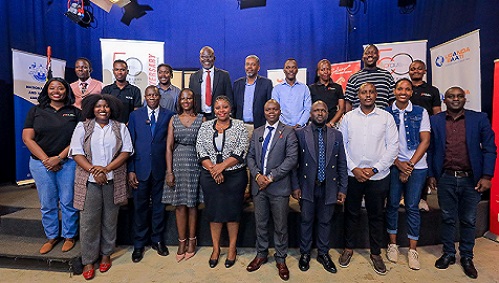


UBOS officials and their counterparts from the Danish embassy display the signed agreement
HABARI DAILY I Kampala, Uganda I Uganda will benefit immensely from a new cooperation agreement with Denmark aimed at modernising the country’s statistical systems, improving the quality of official data and strengthening evidence-based decision-making across government, business and other sectors of the economy.
The agreement, signed by the Uganda Bureau of Statistics (UBOS), Statistics Denmark and the Embassy of Denmark in Uganda, is expected to enhance Uganda’s capacity to produce reliable, timely and accessible statistics to guide national development planning, economic management and climate action.
The Memorandum of Understanding (MoU) was signed during the second day of the Uganda-European Union Business Forum at Kampala Serena Hotel. The ceremony was witnessed by representatives of the Ministry of Foreign Affairs and the State Minister for Trade, Gen Wilson Mbasu Mbadi.
The partnership establishes a framework for technical cooperation, knowledge-sharing and institutional capacity-building, with official statistics positioned as a critical resource for Uganda’s economic transformation.
Better planning and policymaking
One of the major benefits of the agreement will be improved coordination in the production, management and dissemination of national statistics.
Through collaboration with Statistics Denmark, UBOS is expected to strengthen its technical capacity and adopt improved approaches to collecting, analysing and communicating statistical information.
“Reliable data is essential for determining the country’s population needs, identifying investment opportunities, measuring poverty, monitoring employment trends and evaluating the performance of government programmes,” reads part of a staement from UBOS.
It further noted that improved statistical production will enable government ministries, departments and agencies to make better-informed decisions when allocating public resources and designing development interventions.
“Businesses and investors are also expected to benefit from more accessible and dependable information to guide investment decisions, assess market demand and identify emerging economic opportunities.”
The agreement will further support the dissemination of statistics to users within Uganda and internationally, potentially improving transparency and strengthening confidence in the country’s official data.
Boost to economic management
The partnership will also involve technical cooperation with the Ministry of Finance, Planning and Economic Development to improve the availability, accessibility and application of official statistics in macroeconomic modelling and analysis.
This is expected to strengthen the government’s ability to forecast economic trends, assess fiscal risks and formulate policies based on reliable evidence.
Better statistical information can help policymakers understand developments in inflation, economic growth, public expenditure, employment and other indicators that influence the national economy.
For Uganda, which is implementing long-term development programmes and seeking to attract more private investment, accurate data is particularly important in determining whether public policies are delivering the intended results.
The agreement provides for technical assistance, staff exchanges and joint activities involving government institutions, development partners, private sector organisations and civil society.
These arrangements are expected to encourage the exchange of expertise and improve the capacity of institutions involved in producing and using official statistics.
Supporting the green transition
Another significant benefit is the agreement’s focus on generating statistics needed to support Uganda’s green transition and climate-related economic policies.
The cooperation will cover the production, management, analysis and dissemination of data relevant to environmental sustainability and climate action.
Such information can help policymakers assess climate-related economic risks, monitor environmental changes and evaluate the impact of interventions intended to promote sustainable development.
It will also support Uganda’s participation and co-chair role in the Coalition of Finance Ministers for Climate Action, an international initiative that encourages finance ministries to integrate climate considerations into economic and fiscal policies.
Access to better climate and economic data could help Uganda improve the design of climate-responsive budgets and strengthen the evidence underpinning investments in sustainable infrastructure, agriculture and other vulnerable sectors.
The agreement references Uganda’s updated Nationally Determined Contribution and the National Climate Change Act, 2021, which provide important policy foundations for the country’s climate commitments.
Financing and implementation
The Danish Ministry of Foreign Affairs is financing the cooperation through the Strategic Sector Cooperation Programme with Statistics Denmark.
Under the implementation arrangements, the Danish Embassy will support coordination, communication and engagement with relevant Ugandan institutions, while Statistics Denmark will provide technical expertise for activities agreed upon by the parties.
UBOS will retain institutional ownership of the initiative and designate a focal point or project manager to coordinate implementation.
The parties will jointly determine specific programmes and activities and periodically assess their effectiveness, with priorities reviewed over medium-term periods of three to five years.
The partnership aligns with Denmark’s Strategic Framework for Uganda 2023–2028, Uganda Vision 2040, the Fourth National Development Plan for financial years 2025/26 to 2029/30 and the Fourth Plan for National Statistical Development.







About the Author