
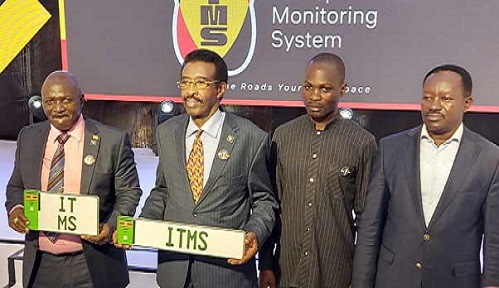
L-R Ministers, Edward Katumba Wamala, Jim Muhweezi, Byamukama and another official during the unveiling of the digital number plates in Kampala recently
HABARI DAILY I Kampala, Uganda I Legal brains, led by Uganda’s Attorney General, Mayanja, have called on Government to cancel the controversial digital number plate contract, citing alleged legal irregularities, questionable financial arrangements and failure to demonstrate value for money in a project intended to improve road safety and combat crime.
The project, awarded to Russian firm M/S Joint Stock Company Global Security (JSCGS), working alongside its local subsidiary, Virtus Global Security Company Ltd, has attracted growing criticism from public officials, legislators, motorists and local manufacturers over its cost, implementation and the benefits it is expected to deliver to Ugandans.
Attorney General Dr. Sam Mayanja has reportedly questioned the legality of the agreement, describing it as null, void and unenforceable. His position has intensified calls for Government to reconsider the arrangement and establish whether the country is receiving sufficient benefits from the project.
The controversy raises questions about the due diligence undertaken before the agreement was signed, the financial obligations imposed on motorists and the extent to which public institutions are protecting national interests.
Questions over value for money
Documents and parliamentary investigations into the project have reportedly identified significant gaps in its preparation and oversight, including the absence of a comprehensive feasibility study, a transparent financial model and regular quarterly audits.
These omissions have fuelled concerns about how Government assessed the project’s viability before committing motorists to a system involving substantial payments for digital number plates.
Critics argue that a project of this financial magnitude should have been supported by independent assessments demonstrating its economic benefits, operational feasibility and long-term sustainability.
The Attorney General’s reported position that the contract is legally unenforceable also raises questions about whether the agreement satisfies the legal requirements governing public procurement and the management of public resources.
However, the ultimate fate of the contract depends on the applicable legal procedures and the decisions of the competent government authorities. A legal opinion alone should not be confused with a final court judgment formally setting aside the agreement.
Unbalanced Revenue-sharing arrangement
One of the most contentious aspects of the agreement is the reported revenue-sharing arrangement under the Automated Express Penalty System (AutoEPS), through which traffic offenders are expected to pay penalties.
Under the arrangement outlined in the investigations, JSCGS is entitled to retain 80 per cent of the fees collected, while Government receives only 20 per cent.
Critics contend that this arrangement is inconsistent with the Road Fund Act and raises concerns about whether public revenue is being distributed in accordance with the law.
The financial projections have also attracted scrutiny. JSCGS is reportedly expected to invest $257 million, while the agreement could allow the company to extract an estimated $889 million, equivalent to approximately Shs3.3 trillion, over the project’s lifetime.
The disparity has prompted questions about the basis on which the contract was negotiated and whether Government adequately assessed the returns to the private investor against the financial burden on Ugandan motorists.
Those demanding cancellation argue that the figures warrant an independent financial audit and a comprehensive review of the agreement before further public money is committed or additional charges imposed.
Motorists question the cost
The cost of acquiring digital number plates has emerged as another major source of public discontent. Official information published by the Ministry of Works and Transport and the Intelligent Transport Monitoring System (ITMS) portal places the fee for a new set at Shs714,300, while replacement plates cost Shs150,000 for vehicles and Shs50,000 for motorcycles.
However, motorists and legislators have questioned the basis for the charges, demanding a transparent breakdown of the costs.
The controversy has been compounded by complaints of delays, shortages and alleged exploitation by intermediaries, with some dealers reportedly charging motorists more than the official fee.
The Uganda Manufacturers Association (UMA) has also urged Parliament to review the foreign company’s monopoly, arguing that the arrangement has sidelined local manufacturers, disrupted businesses and increased costs.
Motorcycle dealers have reported instances in which imported motorcycles remained in bonded warehouses because digital plates were unavailable, resulting in additional storage costs and delayed sales.
Technology transfer concerns
The failure to transfer technology and adequately train Ugandan personnel has further weakened the project’s defence.
Appearing before Parliament’s Committee on Physical Infrastructure, Defence Minister Kiryowa Kiwanuka reportedly told lawmakers that the National Enterprise Corporation (NEC) had not been effectively integrated into the project despite its anticipated role in implementation and operations.
The company has disputed allegations of non-performance, with its representative, Damir Makhmutov, telling the committee that training had started and that full technology transfer was scheduled to begin in 2031.
Meanwhile, lawmakers have questioned whether the system’s security benefits justify the financial burden on motorists. Although the government has defended the project as a tool for vehicle identification, tracking and crime prevention, the parliamentary inquiry has sought evidence of its effectiveness.
Parliament’s Committee on Physical Infrastructure has directed Auditor General Edward Akol to conduct a preliminary audit of the project, examining its operations, ownership and financial arrangements. The committee said the audit was necessary amid concerns that the project had not been audited since its inception in 2021.
The review is expected to inform Parliament’s assessment of the contract and the measures Government should take.
For critics, cancellation would provide an opportunity to reconsider the project under a legally sound, transparent and economically defensible framework. Others argue that any decision should be informed by an independent assessment of the system’s security benefits, contractual obligations and the cost of terminating the agreement.







About the Author