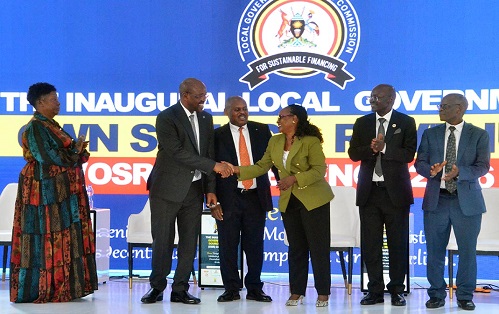


Government recently gave farmers 50 tractors to boost mechanisation and promote commercial agriculture
HABARI DAILY I Kampala, Uganda I Uganda is intensifying efforts to move millions of households away from a hand-to-mouth existence and into a more productive, market-linked agricultural economy.
In order to achieve that, the authorities are combining direct household financing, commercial credit, irrigation, mechanisation, value addition and market-oriented extension services.
The strategy is anchored in the country’s long-term development ambitions under Vision 2040 and the National Development Plan IV, with agriculture positioned as one of the main engines for transforming household incomes and accelerating economic growth.
According to the ministry of finance, for the 2026/27 financial year, government has allocated Shs2.26 trillion to agro-industrialisation, with the money expected to support irrigation, improved seed systems, agricultural production and local processing.
“The push comes against the reality that agriculture remains the backbone of Uganda’s economy. It employs more than 65 per cent of the population and contributes about 24 per cent of gross domestic product,” said Ramathan Ggoobi, the finance ministry’s permanent secretary.
He said that under the budget theme of “Full Monetisation of the Ugandan Economy,” the central objective is increasingly to ensure that households do not simply produce food for their own consumption but generate consistent incomes by producing for markets.
PDM steers transformation
At the centre of this strategy is the Parish Development Model (PDM), launched in February 2022 as the government’s principal vehicle for taking financial inclusion and wealth creation to the grassroots.
Government has allocated Shs1.059 trillion to PDM for the new financial year, bringing cumulative investment in the programme to about Shs3.3 trillion. The programme covers more than 10,600 parishes and has reached more than 2.6 million beneficiaries.
The model channels financing through parish-level SACCOs, allowing eligible households to access revolving capital for selected enterprises.
Crop production accounts for about 45 per cent of PDM financing, with maize, cassava, bananas and onions among the major enterprises.
Another 36 per cent has gone into livestock, while poultry and mixed enterprises account for the remainder.
The broader ambition is to move the estimated 39 per cent of households still engaged in subsistence production into the money economy.
The government has also promoted the four-acre model, which encourages households with limited land to intensify production rather than depend on extensive acreage. Under the model, farmers can combine enterprises such as coffee, fruits, dairy pasture and food crops.
The approach is intended to turn small pieces of land into productive commercial units while maintaining household food security.
Producing profitably
But officials and development actors increasingly acknowledge that providing farmers with money and telling them what to grow is not enough.
Stephen Tumwine, Jinja City Senior Development Officer has called for agricultural extension services to become more market-oriented and business-focused.
He argues that extension officers should help farmers determine what to produce, how much to produce, when to produce it and where to sell it.
The traditional approach of “produce first, look for a market later”, he says, must give way to a system in which farmers identify markets, plan production, meet quality standards, aggregate output, add value and sell before reinvesting in their enterprises.
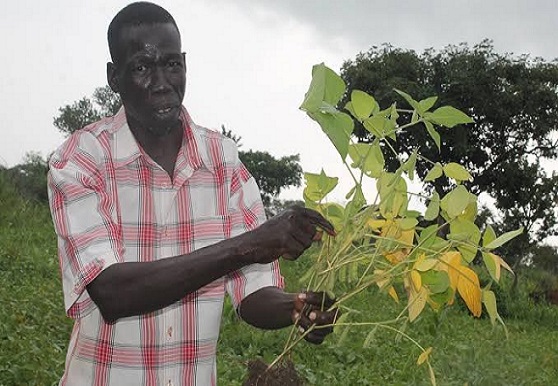
Agriculture remains Uganda’s most impactful sector. It employs over 65% of the population, and 62% of households derive their livelihoods from farming. Yet, 80.2% of these households still practice subsistence farming, limiting growth and economic opportunity
He further pointed out that a market-oriented extension system can help farmers understand prices and demand, select profitable enterprises, improve productivity, reduce post-harvest losses, develop business plans and connect with financial institutions and buyers.
Tumwine said the approach is particularly important for PDM because the programme provides the financing and household structures, while extension services provide the technical knowledge and business support required to make enterprises viable.
Ladder to commercial farming
Government is also creating financing options for farmers at different stages of development.
The Agricultural Credit Facility (ACF), supported with Shs50 billion in the current budget, provides affordable financing for agricultural investments.
Since its establishment, the facility has disbursed more than Shs1 trillion to over 14,000 farmers for activities including grain trading, farm improvements, agro-processing, machinery and post-harvest storage.
This creates a progression from small-scale household financing under PDM and Emyooga to larger commercial loans through facilities such as ACF.
Emyooga, launched in 2019, has similarly targeted organised groups across specialised enterprise categories. More than Shs660 billion has been disbursed as seed capital, while the programme has engaged more than 2.4 million beneficiaries through thousands of SACCOs and associations.
Its emphasis on savings and affordable credit is intended to reduce dependence on informal lenders and build enterprises capable of graduating into larger businesses.
Irrigation and inputs
Commercial agriculture, however, cannot depend entirely on rainfall.
Government has therefore expanded irrigation infrastructure as part of efforts to protect farmers from increasingly unpredictable weather.
Some 145 solar-powered irrigation schemes have been completed, with another 157 under construction. More than 4,300 micro-irrigation systems have also been installed in over 130 districts.
Large irrigation projects in Kween, Butaleja, Lira, Kasese and Oyam are also being finalised.
The government is simultaneously investing in improved agricultural inputs and livestock health. The NARO vaccine facility in Wakiso is producing about 20 million doses of anti-tick vaccines annually, targeting livestock diseases that undermine productivity and household assets.
Mechanisation is another part of the transition, with government promoting equipment such as walk-behind power tillers to reduce dependence on labour-intensive hand-hoeing.
The strategy also seeks to ensure that farmers earn more from what they produce by expanding local processing.
Value addition is critical
Charles Ocici, Enterprise Uganda Director General, said extension services should enable farmers not merely to produce but to produce profitably, access markets, add value and create jobs.
New investments in fortified foods, including baby formula produced from locally grown maize, eggs and milk, are among the initiatives being prioritised.

Value addition on coffee, for instance, can triple farmers’ income
For farmers, value addition offers a route away from selling raw commodities at the farm gate, where prices are often lowest.
“PDM should not end with production,” Ocici said, arguing that beneficiaries should be supported to access reliable and profitable markets.
He said state and non-state partnerships should deliberately provide the markets, finance, processing, technology and investment necessary for sustainable transformation.
Busoga illustrates market challenge
The importance of this approach is particularly visible in regions such as Busoga, where Tumwine identified sugarcane, cassava, rice, maize, coffee, fruits and vegetables, livestock, poultry, fisheries, aquaculture and oilseeds as major opportunities.
Other opportunities include food processing, agro-input businesses, agricultural transport and logistics. The potential, however, depends on whether farmers can connect production to viable markets.
Tumwine argues that local economic development, PDM and extension must therefore operate together. PDM provides households and financing, extension provides technical and business knowledge, while local economic development creates links to investors, processors, markets and employment.
Huge financing gap
Despite the scale of government spending, civil society organisations warn that implementation could determine whether the strategy produces lasting change.
At a post-budget dialogue in Kampala, PELUM Uganda’s Allan Ssebulime said many local governments responsible for delivering agricultural services remain underfunded and poorly equipped.
In Soroti, he said, only 4.1 per cent of the district budget goes to production, while 89 per cent is absorbed by recurrent expenditure. Luwero faces a similar challenge, with more than 70 per cent of funds tied to non-development expenses.
Agricultural extension workers also face operational constraints, including inadequate fuel for motorcycles and insufficient resources to conduct field visits.
Ssebulime also highlighted limited support for aquaculture and the persistent problem of expensive, unreliable animal and fish feed.
“Quality feed is the foundation of productivity. If farmers can’t access or afford it, we can’t talk about transforming agriculture,” he said.
Julius Mukunda, the CSBAG Executive Director has meanwhile warned that high interest rates, which he linked partly to domestic borrowing, can crowd out private investment in agriculture.
Land, markets obstacles
Economists have also cautioned that injecting money into households alone cannot resolve structural constraints.
Prof. David Katamba, a specialist in Corporate Social Responsibility (CSR) and Sustainability Management at Makerere University Business School (MUBS), pointed out that small plots, insecure land arrangements, inadequate storage, poor roads, unreliable electricity and dependence on rain can prevent farmers from successfully commercialising even when financing is available.
“There are issues like late disbursements, misuse of funds and beneficiaries treating revolving capital as grants rather than loans.
The challenge is therefore to ensure that commercialisation does not leave behind food-insecure households, women and young people who lack the land, skills or capital to compete in formal markets,” he said.
He added that instead of producing simply to survive until the next harvest, the policy direction is to create households that operate enterprises, save, borrow responsibly, process their output, negotiate with buyers and reinvest profits.
But the ultimate test will be whether millions of households can move from the hand-to-mouth cycle into sustainable enterprises that generate income, create employment and contribute to Uganda’s wider industrial transformation.







About the Author