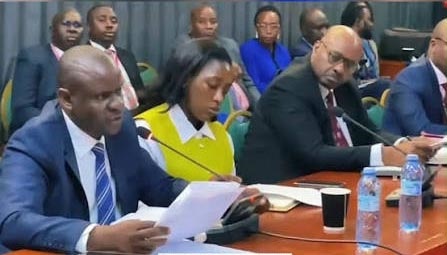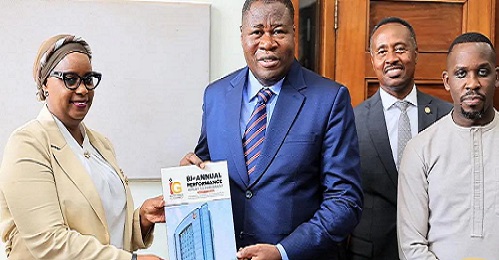

Isaac Musumba, the chairperson of the Local Government Finance Commission (LGFC), said the money belongs to local governments and should be remitted to the respective authorities to supplement their budgets and support service delivery.
Addressing journalists at a press conference at the Uganda Media Centre on Monday, October 12, 2026, Musumba said local governments had collected Shs490.64 billion in locally generated revenue during the financial year that had just ended, but Shs48 billion due to them remained outstanding.
“I call upon the ministries, departments and agencies (MDAs) to give Caesar what is Caesar’s. Pass on the money that you are holding that belongs to the local governments to the respective local governments,” Musumba said.
He revealed that the Permanent Secretary and Secretary to the Treasury (PSST) had already written to the affected government entities directing them to remit the money, but the commission wants stronger enforcement to ensure the outstanding payments are made.
“We hereby request the PSST to do more than just send the money because he has the means to enforce this,” he said.
Shs30.3b in property rates
Adam Babaale, the LGFC secretary, explained that the Shs48 billion comprises approximately Shs30.3 billion in outstanding property rates owed by central government entities operating from premises within local government jurisdictions and about Shs18 billion in revenue associated with communities neighbouring protected areas.
He said government ministries and agencies occupying property within districts, municipalities and other urban authorities are expected to pay property rates to the respective local governments to support service delivery.
“Central government ministries, those offices which are seen in local governments, they are supposed to pay property rates to local governments to support service delivery. The documented money so far now in arrears is Shs30.3 billion,” Babaale said.
The outstanding property rates arise from government facilities and offices located in different parts of the country. These include police facilities and other premises occupied by central government institutions.
Babaale said ministries, including the Ministry of Defence and the Ministry of Internal Affairs, have properties that are assessed for property rates and are expected to make payments to the relevant local authorities.
He explained that the PSST had issued instructions requiring ministries, departments and agencies with rateable properties to plan, budget for and pay the outstanding amounts to the local governments concerned.
“It is a matter of prioritising by the accounting officers of those ministries, departments and agencies to remit that money, to pay that money,” he said.
The commission wants accounting officers to treat the payments as a priority rather than allowing the arrears to accumulate.
UWA withholding Shs18b
The remaining Shs18 billion relates to funds associated with local governments neighbouring protected areas, which are handled through the Uganda Wildlife Authority (UWA).
Babaale said UWA had withheld the money because some local governments had not accounted for funds previously disbursed to them, as required by law.
“UWA has held this money because local governments, according to the law, are supposed to account for the previous money which they got before they get the new one,” he said.
He explained that the commission was taking up the matter urgently and intended to engage UWA to identify the local governments that had failed to account for the earlier disbursements.
“This one for UWA is even more simpler. Let the local government account and the money will be remitted,” Babaale said.
The funds are intended to support communities living around protected areas through improved public services and local development, while also contributing to conservation efforts.
The commission’s intervention will therefore seek to address both sides of the problem: pressing central government entities to pay property rates and helping local governments meet the accountability requirements necessary to unlock the funds held by UWA.
Conference pushed revenue mobilisation agenda
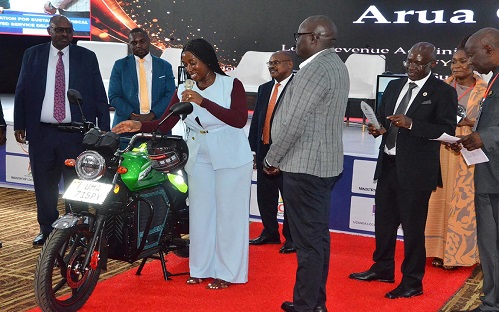
Justine Nameere, the State Minister for Local Government (3rd L) handing over a motor cycle to the best performing district during the Uganda Local Government Own Source Revenue Conference, which was held on Thursday 15th October 2026 at Hotel Africana
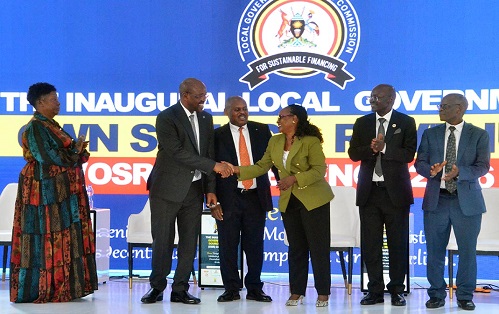
The commission used its “Uganda Local Government Own Source Revenue Conference,” which was held on Thursday 15th October at Hotel Africana, to push for the recovery of the arrears and promote stronger revenue mobilisation across the country.
Held under the theme: “Strengthening Local Revenue Mobilisation for for Sustainable Fiscal Decentralisation and Improved Service Delivery,” the conference brought together over 500 district Chairpersons, Mayors, Chief Administrative Officers, Town Clark’s, Chief Finance Officers in all Local Governments, Ministries, agencies and departments, MPs, development partners, academia and private sector partners.
Musumba said the conference further popularised local revenue matters and reminded local government leaders that collecting revenue is a legal responsibility attached to their offices.
Although local governments receive a substantial portion of their funding from the central government, he said locally generated revenue was necessary to supplement those transfers and finance services that may not be adequately funded from the centre.
“If you don’t collect revenue, how will you remove the garbage in your municipality, or your city, or your town council? How will you support street lighting in your area of operation?” he asked.
Musumba argued that local leaders seeking elective office should be prepared to mobilise revenue to meet the needs of their communities.
“If anybody wants to vie for a leadership office in the local government, they must be prepared to collect revenue. If you can’t, don’t vie for that office,” he said.
The conference brought together local government leaders and other stakeholders who discussed ways of improving collection systems, expand the revenue base and ensure that funds due to local authorities are paid promptly.







About the Author