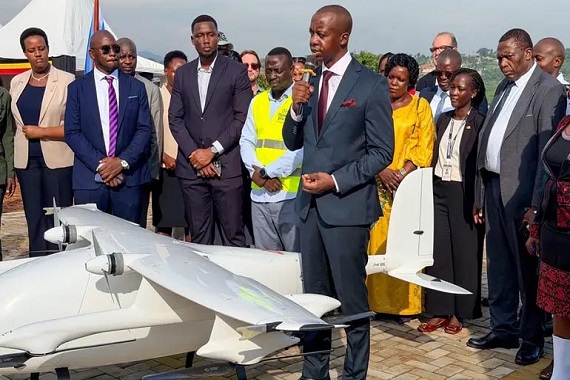
Ministry of health officials unveiling the medical drone service recently
HABARI DAILY I Kampala, Uganda I Medical intervention in Uganda’s hard-to-reach island communities is set to receive a boost following the Ministry of Health’s launch of a medical drone pilot project aimed at speeding up the delivery of essential supplies and the transportation of laboratory samples.
The initiative connects Butabika on the mainland to Koome and Kalangala Town Council, offering an alternative to conventional transport for health facilities serving communities separated by water and often faced with logistical challenges.
Dr Charles Ayume, the Minister of State for Health in charge of Primary Health Care, launched the demonstration flight, which departed from Butabika, travelled to Koome and Kalangala, and returned to its starting point carrying laboratory samples for testing.
The project is intended to establish whether unmanned aerial vehicles can make medical supply deliveries and sample collection faster and more reliable, particularly in areas where road access is limited and water transport can be costly or time-consuming.
Drones to Deliver Medicines, Collect Samples
During the demonstration, the drone transported medical supplies to island health facilities and collected laboratory samples on its return journey to the mainland.
The outward cargo can include essential medicines, HIV testing materials, tuberculosis drugs and kits for expectant mothers. The return flights carry diagnostic samples to laboratories, where they can be analysed to support patient care.
According to the project details, each unmanned aerial vehicle can carry up to 15 kilogrammes of cargo per flight. A single leg of the route takes approximately 40 minutes, providing a potentially faster connection between the mainland and the island facilities.
For health workers, the service could help reduce delays in obtaining medicines and other supplies needed to maintain routine services. It could also shorten the time between collecting a patient’s sample and sending it for testing.
Timely access to diagnostic services is important for identifying illnesses and guiding treatment. Where samples take longer to reach laboratories, patients may have to wait longer for results, while health workers face difficulties making timely clinical decisions.
The ministry hopes the pilot will provide evidence on how aerial transport can address some of these challenges.
Integrating Drones into National Sample Network
Ayume said the flights would help the ministry assess how drone logistics could be incorporated into the existing Integrated National Sample Transport Network.
“Evidence from these flights will inform decisions on how drone transport can be integrated into the existing Integrated National Sample Transport Network, strengthening timely and reliable sample transportation from hard-to-reach communities,” Ayume said.
The network supports the movement of laboratory samples from health facilities to testing laboratories. Introducing drones could provide an additional transport option for facilities where geography, distance or the availability of conventional transport creates delays.
Rather than immediately replacing existing arrangements, the pilot is expected to generate evidence to guide decisions on the practical role drones could play in the national system.
That assessment will be important in determining where the technology can deliver the greatest benefit and how it can work alongside existing transport methods.
Reducing Transport Costs and Delays
The project also seeks to address the cost of moving medical supplies and samples by water. Island facilities often depend on boats to transport health workers, medicines and diagnostic materials, while operating and maintaining boat ambulances can place pressure on limited health budgets.
Drone flights could offer a complementary option for urgent, lightweight deliveries, reducing the need to organise a boat journey for every consignment or sample. Their ability to follow designated aerial routes may also help health facilities plan deliveries more predictably.
However, the pilot will need to establish how the service performs under different operating conditions and whether it can be sustained beyond the demonstration stage. The 15-kilogramme payload limit means drones are best suited to selected medical supplies and laboratory samples rather than bulky equipment or large consignments.
The ministry’s findings will therefore help determine which types of deliveries are appropriate for the technology and where conventional transport will remain necessary.
Improving Access for Island Communities
The initiative targets a practical challenge in delivering healthcare to communities separated from mainland services by water. Health facilities in island areas need dependable access to medicines, testing materials and laboratories, but the logistics of moving items between islands and mainland centres can complicate service delivery.
By connecting Butabika, Koome and Kalangala Town Council, the pilot is testing whether drone transport can make those links more efficient. Faster sample movement could support earlier diagnosis, while more reliable deliveries could help facilities maintain supplies required for routine healthcare.
The ministry intends to use evidence from the flights to determine whether drone logistics can strengthen the Integrated National Sample Transport Network and improve the movement of medical supplies to underserved locations.







About the Author