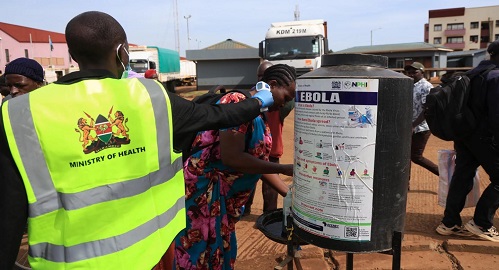
HABARI DAILY I Kampala, Uganda I Kenya has recorded its second death from the Bundibugyo strain of Ebola after a 65-year-old woman, who was a close family member and direct contact of the country’s first confirmed patient, died on Friday evening, October 23, 2026, despite receiving supportive treatment at an infectious disease unit in Nairobi.
The death has raised concern over the spread of the rare but deadly virus in East Africa, although Kenya’s Ministry of Health maintains that all nine confirmed cases belong to a single cluster, with no evidence of wider community transmission.
The woman was Kenya’s third confirmed Ebola case. She had been placed under quarantine following exposure to the initial patient but developed symptoms on October 13, 2026, according to health authorities.
She was subsequently admitted for supportive care at a designated infectious disease facility in Nairobi, where she died after battling the infection.
Her death brings the fatality toll to two among the nine confirmed cases reported in the country, which is managing its first recorded Ebola outbreak.
The Ministry of Health is coordinating with trained response teams and the deceased’s family to conduct a safe and dignified burial, in line with infection prevention protocols intended to minimise further exposure.
Family Cluster Behind the Outbreak
The current outbreak traces back to Kenya’s first confirmed patient, a 40-year-old man who travelled from the Democratic Republic of the Congo (DRC), passing through Uganda before reaching Nairobi.
The man reportedly fell ill in September after travelling through several hospitals in the DRC and subsequently sought treatment in Kenya’s capital. He died on October 5, 2026, becoming the country’s first Ebola fatality.
Health authorities believe the subsequent infections are linked to contacts associated with the initial patient, including family members and healthcare workers who may have been exposed while providing care.
The remaining seven patients are receiving treatment in designated isolation facilities. They include three other relatives of the first victim, three health workers and a hospital cleaner.
The close relationship between the cases has made contact tracing and monitoring central to Kenya’s response, with authorities seeking to identify exposed individuals and prevent infections from spreading beyond the known cluster.
Although the second death demonstrates the seriousness of the outbreak, officials have said there is currently no evidence that the virus has spread into the wider community.
Quarantine and Early Detection
The 65-year-old woman had already been placed under quarantine because of her contact with the first patient before she developed symptoms.
Her case illustrates the importance of monitoring people who have been exposed to Ebola even when they initially appear healthy.
Ebola symptoms can develop after an incubation period, meaning an exposed person may not show signs of infection immediately. This makes quarantine, health surveillance and prompt isolation essential components of outbreak control.
The Bundibugyo strain is a relatively rare form of Ebola virus disease. It can cause fever, weakness, vomiting and diarrhoea, and severe cases may progress to organ failure and bleeding.
The virus spreads through direct contact with the blood and other bodily fluids of infected people, as well as contaminated materials. This makes healthcare workers, caregivers and close family contacts particularly vulnerable when appropriate protective measures are not maintained.
Unlike some other Ebola strains, Bundibugyo does not have an approved vaccine specifically established for its prevention. Consequently, early detection, supportive treatment, contact tracing and strict infection prevention measures remain critical to limiting transmission.
Regional Authorities Intensify Surveillance
Kenya’s outbreak has prompted neighbouring countries to strengthen public health preparedness, particularly because the first patient travelled internationally before his infection was confirmed.
Kenya has introduced enhanced screening for travellers arriving from the DRC and nine other countries considered at higher risk: Uganda, Tanzania, Rwanda, Burundi, Angola, Zambia, Ethiopia, South Sudan and the Central African Republic.
Travellers arriving from the listed countries are required to complete digital surveillance forms before boarding their flights and present QR codes to port health officials upon arrival.
Authorities have also intensified public health screening of aircraft arriving from the affected countries and encouraged the public to report suspected cases and seek medical attention promptly.
The United States has issued a warning advising its citizens against travelling to Kenya, while neighbouring countries, including Uganda, Ethiopia and Somalia, remain alert to the possibility of imported infections.
Uganda has separately barred travellers with a history of travel to the DRC from transiting through the country, following concerns over another traveller who tested positive for Ebola after travelling through Uganda to Nigeria.
Health authorities are investigating possible links between travel routes and reported cases, but the available information does not establish that every case is connected or that infection occurred in Uganda.
Containing Further Infections
Kenya’s Ministry of Health continues to maintain that the nine confirmed cases remain confined to one cluster, with no evidence of wider community spread.
The priority is to provide treatment to those still infected, monitor contacts, enforce quarantine requirements and ensure that safe burial procedures prevent additional exposure.
The death of the 65-year-old woman underscores the potentially fatal consequences of the Bundibugyo strain, even as health authorities work to contain the outbreak.
For Kenya and its neighbours, the challenge is to identify infections early, maintain effective cross-border surveillance and prevent further transmission while investigations establish the full extent and origin of the outbreak.







About the Author