HABARI DAILY I Kampala, Uganda I As the Ebola epidemic escalates regionally, the Ugandan Ministry of Health has barred all travellers with a history of travel to the Democratic Republic of the Congo (DRC) from transiting through Uganda, tightening border controls after a Nigerian woman tested positive for the deadly Bundibugyo strain of Ebola following a journey through the country.
The restrictions, announced on October 23, 2026, are intended to prevent the virus from entering Uganda through travellers who may have been exposed to the outbreak in eastern DRC, even when they show no symptoms while passing through the country.
The decision follows growing regional concern after the woman, identified in reports as the wife of a Swiss diplomat, travelled from eastern DRC through Uganda before arriving in Abuja, Nigeria, where she subsequently tested positive for Ebola.
Ugandan health authorities say the traveller did not exhibit symptoms when she departed the country, but investigations are continuing to establish when she contracted the disease and the circumstances surrounding her infection.
The Ministry of Health, led by Director General of Health Services Professor Charles Olaro, has emphasised that the traveller’s passage through Uganda does not, on its own, establish that she acquired the infection there.
“Travellers with a history of travel to the Democratic Republic of the Congo will not be permitted to transit through Uganda,” the ministry said.
The restrictions apply regardless of travellers’ nationality or intended destination, effectively closing Uganda’s transit routes to people who have recently visited the DRC.
Fear of Undetected Infections
One of the main reasons behind the decision is the possibility that infected travellers could cross borders before developing recognisable symptoms.
The Nigerian case has heightened concern among health officials because the woman reportedly passed through Uganda without showing signs of illness before testing positive after reaching Nigeria.
A similar incident was reported earlier in October, when another traveller who had transited through Uganda from the DRC tested positive for Ebola upon reaching Kenya.
The incidents have raised questions about the challenges of identifying infected people during international travel, particularly when the incubation period allows someone to move between countries before becoming symptomatic.
By imposing a blanket transit restriction on people with a history of travel to the DRC, Uganda is seeking to reduce the possibility of undetected infections crossing its territory and triggering further transmission.
The Bundibugyo strain is a particularly significant concern because there is no approved vaccine specifically established for preventing infection with this strain, making surveillance, early detection and infection prevention important elements of outbreak control.
Border Controls Tightened
The transit ban builds on existing restrictions on passenger movement across the Uganda-DRC border, where standard passenger travel, public buses and commercial flights between the two countries remain suspended under the measures described by authorities.
Crossings are restricted to authorised Ebola response teams, essential security personnel, humanitarian operations and cargo transport.
Individuals permitted to cross under authorised arrangements are subject to strict health surveillance, including a mandatory 21-day quarantine requirement.
Security forces have also intensified patrols along informal border footpaths, which can be used to bypass official screening points.
The ministry has warned that people entering Uganda through unauthorised routes risk prosecution under the Public Health Act.
Communities living near the border have been urged to report suspected illegal crossings so that security personnel and health workers can intervene, screen individuals and initiate follow-up investigations where necessary.
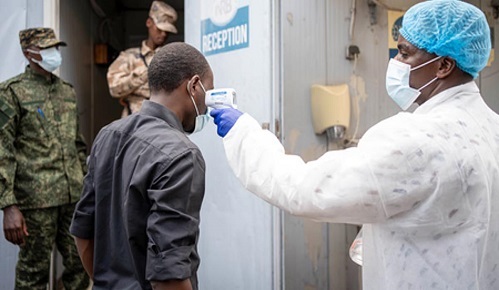
At authorised entry and exit points, including Entebbe International Airport, health authorities have reinforced screening procedures and infection prevention and control measures.
Locator Forms Reintroduced
In another measure aimed at strengthening surveillance, the government has reinstated mandatory digital traveller locator forms for all incoming passengers, regardless of their country of origin.
The forms are intended to help health authorities establish travellers’ movements and contact details quickly if an exposure is suspected or an infection is subsequently confirmed.
This information can support contact tracing by helping officials identify people who may have shared transport, accommodation or other settings with a suspected case.
The ministry is also continuing disease surveillance across the country as part of efforts to detect potential infections early and prevent local transmission.
The restrictions reflect the government’s concern that border screening alone may not be sufficient where travellers are infected but have not yet developed symptoms.
Investigations Continue with Nigeria
Uganda is working with Nigerian health authorities to reconstruct the woman’s travel history and establish when and where she may have been exposed to the virus.
The ministry has requested additional information from Nigeria, including detailed travel records and genomic sequencing results, where available.
Such information could help investigators assess the likely source of infection and determine whether further contact tracing or public health interventions are necessary.
Ugandan authorities have also received technical support from the Africa Centres for Disease Control and Prevention, the United States Centers for Disease Control and Prevention and the World Health Organisation.
Despite the heightened precautions, the Ministry of Health maintains that Uganda has no confirmed active Ebola cases.
Professor Olaro has urged Ugandans and visitors to remain vigilant, maintain good hand hygiene and cooperate with health workers conducting screening at entry points.







About the Author