
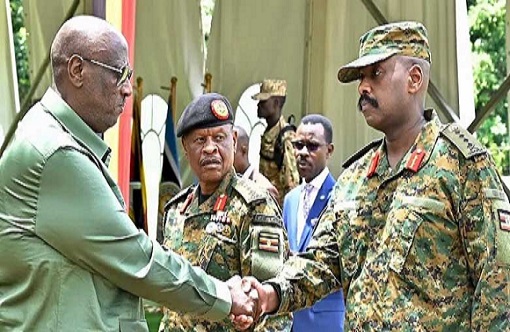
Gen. Salim Saleh (L) and Gen. Muhoozi Kainerugaba (R) extending greetings
HABARI DAILY I Kampala, Uganda I A social media post by Gen. Muhoozi Kainerugaba on August 25, 2026, declaring that Dr Kizza Besigye’s problems were his responsibility to resolve, has emerged as the unexpected trigger for renewed contact between two former bush-war comrades, Gen. Salim Saleh and the detained opposition politician.
The intervention by Muhoozi, the Chief of Defence Forces (CDF) and leader of the Patriotic League of Uganda (PLU), opened a door that had remained shut for decades, giving his uncle, Gen. Saleh, an opportunity to reconnect with a man with whom he had shared the struggles of the 1980s bush war.
What began as a seemingly straightforward social media declaration would eventually set in motion a series of events involving a prison visit, an urgent medical intervention and the revival of personal and political conversations between two men whose relationship had been strained by years of political separation.
Muhoozi’s August 25 post was particularly significant because of the direct language he used in taking responsibility for Besigye’s predicament. For Gen. Saleh, it presented an opportunity to intervene in a situation involving an old friend whose circumstances had become increasingly worrying.
Rather than immediately acting on the statement, however, Saleh first sought clarification from Muhoozi to establish whether the CDF was genuinely serious about taking responsibility for Besigye’s situation.
After confirming that Muhoozi meant what he had posted, Saleh decided to take up the opening and personally reach out to the former Forum for Democratic Change (FDC) president.
His first major step was to visit Besigye at Luzira Prison, where the opposition politician was being detained. The visit marked an important moment in the relationship between the two former comrades, whose paths had diverged over the years following their involvement in the liberation struggle.
However, what Saleh encountered at the prison was more than a political disagreement or a difficult detention situation. Besigye was reportedly in a critical and deteriorating state of health, raising immediate concerns about his wellbeing and the need for urgent medical attention.
Faced with the condition of his former comrade, Saleh moved quickly to organise his transfer from Luzira Prison to the Joint Clinical Research Centre (JCRC), where he could receive specialised medical care.
The intervention enabled Besigye to access intensive medical attention at a time when his health was reportedly failing. It also changed the nature of the engagement between the two men, shifting their interaction from the circumstances surrounding his detention to a more personal encounter centred on his health and wellbeing.
The hospital visit subsequently became an important turning point in reopening communication between Saleh and Besigye.
Their relationship had been shaped by a shared history in the National Resistance Army (NRA) bush war, particularly during the 1980s and 1990s, when they were part of the struggle that brought the National Resistance Movement (NRM) to power.
However, the political developments that followed their victory gradually placed them on different sides of Uganda’s political divide. Besigye eventually emerged as one of President Yoweri Museveni’s strongest political challengers, while Saleh remained an influential figure within the ruling establishment and military circles.
That political separation created a prolonged silence between the former comrades, despite their shared experiences and history.
Muhoozi’s intervention therefore provided an unexpected bridge across a political divide that had endured for years. By declaring that Besigye’s problem was his to solve, the CDF inadvertently created an opening through which Saleh could approach his former colleague without the engagement necessarily beginning as a political negotiation.
The significance of Saleh’s intervention extended beyond arranging medical assistance. It provided an opportunity for two individuals with a common history to reconnect, exchange views and begin reflecting on the events that had shaped their personal and political journeys.
Their renewed engagement also demonstrated how personal relationships forged during Uganda’s liberation struggle continue to intersect with the country’s contemporary political realities.
For Saleh, Muhoozi’s tweet offered an opportunity to reach out to an old friend. For Besigye, the prison visit and subsequent medical intervention provided an opening for renewed communication with a former comrade from whom he had been separated by decades of political disagreements.
Ultimately, what started as a declaration on X on August 25 became the catalyst for a significant personal intervention, bringing Saleh and Besigye back into contact and opening the possibility of conversations that had remained dormant for years.







About the Author