

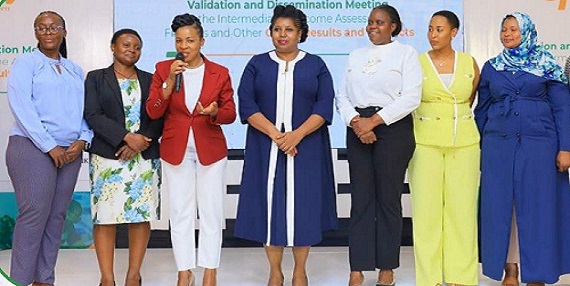
Dr Ruth Aisha Biyinzika Kasolo, the GROW Project Coordinator at PSFU addressing delegates during the release of the Intermediate Outcomes Assessment at Serena Kampala Hotel on October 29th 2026.
HABARI DAILY I Kampala, Uganda I The Growth Opportunities and Productivity for Women Enterprises (GROW) Project, has been able to create millions of jobs by supporting women-owned enterprises to expand their businesses, increase sales and generate employment.
According to an Intermediate Outcomes Assessment that was unveiled today,29th October 2026 at the Serena Kampala Hotel, the programme, which provides affordable credit to women entrepreneurs, has recorded a steady increase in the average number of employees working in beneficiary businesses between 2024 and 2026.
GROW is a government initiative supported by the World Bank and implemented by the Ministry of Gender, Labour and Social Development in partnership with PSFU.
The programme is valued at $217 million, of which $50 million is allocated to the GROW Financing Facility. It became effective on January 20, 2023, and is expected to run until December 31, 2027.
The assessment highlights employment growth among businesses that received loans, alongside a broader target of reaching hundreds of thousands of women entrepreneurs and employees and millions of indirect beneficiaries.
The GROW Project’s Intermediate Outcomes Assessment, presented by the PSFU in partnership with Business Synergies Ltd, found that the average number of employees among beneficiary businesses increased from 1.8 in 2024 to two in 2025 and 2.7 in 2026.
“Among businesses in the control group, which did not receive GROW loans, the average number of employees remained around the same over the same period. The difference points to stronger employment growth among businesses that accessed the facility,” reads part of the report.
The assessment also reported that borrowers’ profits increased by more than 3.2 times compared with those of non-GROW loan borrowers, suggesting that affordable financing has helped participating enterprises strengthen their business performance.
Employment Growth
The rise in average employment from 1.8 workers in 2024 to 2.7 in 2026 represents an increase of approximately 50 per cent in the average number of employees per beneficiary business over the period.
The assessment described the change as a shift from an average of one employee in 2024 to 2.7 in 2026, equivalent to 1.7 additional jobs per business.
The findings suggest that as women entrepreneurs gain access to affordable financing, they are better positioned to expand operations and hire additional workers. “The control group’s average employment figures were one in 2024, 0.8 in 2025 and one in 2026, indicating little overall change,” further reads the report.
Dr Ruth Aisha Biyinzika Kasolo, the GROW Project Coordinator at PSFU, said that the borrowers’ profits increased by more than 3.2 times compared with non-GROW loan borrowers,” she noted, adding that the initiative is bent on improving women entrepreneurs’ providing them with access to financial and business development services.
Esther Ssempiira, a GROW specialist for Monitoring and Evaluation, said the assessment showed that beneficiary businesses were recording improvements in employment and profitability.
She said the report found that the average number of employees among beneficiary businesses increased from 1.8 in 2024 to two in 2025 and 2.7 in 2026.
Ssempiira added that the results suggest affordable financing can help women expand business activity, create jobs and strengthen the income available to support their households.
Aiming to Reach Hundreds
Its development objective is to increase access to entrepreneurial services so women can grow their enterprises in targeted locations, including refugee-hosting districts.
The programme targets more than 60,000 female-owned enterprises. It also aims to benefit 280,000 women entrepreneurs and employees, including 42,000 refugees and 14,000 members of host communities, alongside 1.6 million indirect beneficiaries.
Sarah Kagingo, the Vice Chairperson Board, PSFU, said that the GROW Project was initially bent on addressing collateral barriers. “So for me, seeing these results is very heartwarming. Our trapitite, which include the World Bank, the Government of the Republic of Uganda, and PSFU has bore fruits beyong our imagination,” she said.
Affordable Loans Support Business Expansion
Under the GROW Financing Facility, women entrepreneurs access loans at an interest rate of 10 per cent per year through participating financial institutions. The facility was designed to address the high cost of borrowing that has often prevented women-owned businesses from obtaining credit to expand their operations.
Participating institutions initially included Centenary Bank, DFCU Bank, Equity Bank, Finance Trust Bank, Pearl Bank, formerly PostBank Uganda, and Stanbic Bank. Additional institutions were brought on board to extend access and ease lending requirements.
The assessment found that 95.8 per cent of respondents considered the interest rates favourable compared with prevailing market rates, while 37.4 per cent identified other features of the loan product as attractive to women entrepreneurs.
These findings indicate that affordability is an important part of the programme’s appeal. “Lower borrowing costs can leave business owners with more resources to purchase stock, acquire equipment, improve production and meet operating expenses. Where expansion increases demand for labour, enterprises may take on additional workers.”
The assessment also found that average sales among beneficiary businesses grew by 15.7 per cent between 2024 and 2025, compared with 2.4 per cent among the control group. Average sales for the treatment group rose from about Shs96.7 million in 2024 to Shs111.9 million in 2025.
The combination of stronger sales, higher profits and increased average employment suggests that beneficiary businesses were expanding their economic activity during the assessment period.
Challenges Could Limit Job Creation
Despite the reported progress, the assessment identified barriers that could prevent the programme from reaching more women-owned enterprises and generating further employment.
One challenge is that many smaller businesses require loans below the amounts previously available through the facility.
“Women operating micro-enterprises needing between Shs500,000 and Shs2 million had faced difficulties accessing financing, although the project had adjusted minimum loan limits from November 2025 to Shs2 million for eligible borrowers and Shs1 million for refugees,” further says the report.
It singles out other constraints as collateral requirements, long distances to bank branches and limited information about loan application procedures. Women in rural communities may also prefer SACCOs and microfinance institutions, which were not initially part of the programme’s delivery network.
The assessment recommended expanding access to smaller enterprises, strengthening communication about available loan products and improving coordination between PSFU, the ministry, participating financial institutions and local governments. It also called for greater use of alternative security arrangements, including group guarantees and cash-flow-based lending.
Serena Cavicchi, the World Bank’s Task Team Leader for the GROW Project hailed the outcome of the project, adding that the initiative is scheduled to continue until the end of 2027.
Its employment impact will however depend not only on the performance of businesses already supported, but also on how effectively the programme addresses access barriers and reaches underserved entrepreneurs.







About the Author