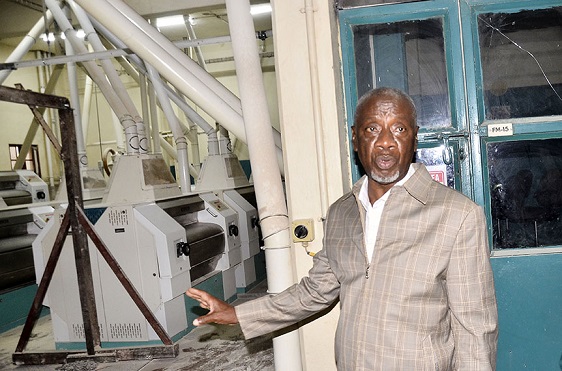
Barbara Mulwana, the manager of Nice House of Plastics (R) runs a second generation business that was founded by his late father, James Mulwana and was awarded by the former UMA Board Chairman, Deo Kayemba for consistency and continuity
HABARI DAILY I Kampala, Uganda I First, second and third generation business owners and managers have been warned on the bumps ahead as they try to maintain their legacy and remain functional, with experts urging families to prioritise succession planning, open communication and shared values if their businesses are to survive beyond their founders.
The warning comes amid growing concerns over family-owned businesses collapsing or getting embroiled in prolonged legal battles following the death of their founders, often leaving behind divided families, fragmented wealth and businesses that eventually disappear.
The challenge of preserving family wealth, maintaining relationships and ensuring a smooth transition of leadership was among the issues discussed at the fourth annual Enjovu Business Conference held at the International School of Uganda, Lubowa, on October 16, 2026.
The conference attracted first, second and third-generation business owners, managers and startup founders from across the country, representing sectors including manufacturing, education, healthcare, construction, retail and other services.
Held under the theme, “Strengthening Relationships, Preserving Values, and Securing Family Business Excellence,” the gathering provided a platform for business families to share experiences, explore opportunities and seek answers on how to protect their enterprises and ensure continuity across generations.
One of the central messages was that building a successful business is not necessarily the greatest achievement of a family enterprise. Rather, the real test is whether the family can preserve the relationships, values and common purpose that sustain the business long after its founder has departed.
Buganda Kingdom’s second deputy Katikkiro, Owek. Robert Waggwa Nsibirwa, challenged family business owners to begin discussing succession and inheritance issues while founders are still alive, rather than leaving their children to resolve disagreements after their deaths.
He argued that families should not measure their success merely by the size of the businesses they establish, but by their ability to nurture generations that can work together and protect what has been built.
“We should not want our wealth to be divided. We want our children to work together and continue with the business. Issues must be discussed; comfortable or uncomfortable. And that is when legacy will be inherited otherwise, wealth will be up in smoke even before the founder decomposes,” Nsibirwa said.
His remarks highlighted a common problem in Uganda, where families sometimes end up in court over ownership, management and distribution of business assets following the death of a founder.
In many instances, disputes that could have been addressed through family discussions and proper succession arrangements end up destroying relationships and paralysing businesses.
The consequence is that enterprises painstakingly built over decades can be lost, sold off or consigned to history because the next generation was never adequately prepared to take over.
Preserving institutional knowledge
The importance of preparing the next generation was illustrated by Manish Varsani, a third-generation member of the family behind Tororo Cement and Varsani Group, whose business history dates back to 1958, when the family started operations in Kenya before expanding into Uganda.
Now at the helm of the family business empire, Varsani observed that the responsibility of a third-generation leader is not necessarily to pursue aggressive expansion, but to maintain and sustain what previous generations have built.
He noted that when a business is managed properly and its foundations remain strong, growth can follow naturally without the family constantly pursuing expansion.
One of the important lessons instilled in him by the older generation was the need to respect elders, a principle that has influenced how he approaches leadership and decision-making within the family enterprise.
At 35, Varsani found himself joining a business in which some employees had served for many years and older members of staff occupied both senior management and lower-level positions.
He recalled proposing the replacement of thousands of menial workers employed in cleaning and estate maintenance with machines, believing automation would improve efficiency.
However, his elders advised against the proposal, arguing that the employees had served the company for many years and had families depending on their jobs.
The experience demonstrated the importance of understanding the history, relationships and social responsibilities that come with inheriting a family business.
For younger generations taking over established enterprises, leadership is therefore not simply about introducing new ideas or changing existing systems. It also requires appreciating the values and experiences that have sustained the business over the years.
Varsani’s experience illustrates why succession should be treated as a gradual process involving the transfer of knowledge, institutional memory and leadership responsibilities rather than an abrupt change following the founder’s departure.
A legacy beyond money and property
Dr Ruth Senyonyi, a counselling psychologist and therapist, emphasised that family relationships and the values passed between generations play an important role in determining whether a family business survives.
She explained that a family legacy consists of values, traditions, life lessons and emotional or spiritual habits passed from one generation to another.
It can also include physical assets and financial inheritance, both of which influence the business legacy that subsequent generations inherit.
This means that succession planning should not be confined to determining who inherits shares, property or other financial assets. Families must also consider the character, relationships and principles they want future generations to uphold.
A family may successfully transfer ownership of a company to its children, but without shared values and the ability to resolve disagreements, the business can still become vulnerable to internal conflicts.
Senyonyi also pointed to the importance of sound business management in building enterprises capable of surviving generational transitions.
She identified consistent and predictable revenue, strong cash flow, disciplined internal operations and a clear understanding of the target market as important ingredients for successful and thriving businesses.
These fundamentals matter because a business that is financially unstable or poorly managed can place additional pressure on family relationships when leadership changes.
A financially healthy enterprise, supported by clear internal operations, gives incoming generations a stronger foundation on which to build.
Succession planning must start early
The discussions at the conference highlighted the dangers of postponing difficult conversations about inheritance, leadership and ownership until the founder is no longer available to guide the process.
When family members have different expectations about who should lead, how wealth should be distributed and what direction the business should take, disagreements can quickly develop into serious disputes.
Such conflicts can undermine the trust between siblings and other relatives, while distracting management from the day-to-day responsibilities of running the business.
For this reason, family business owners were encouraged to create an environment in which uncomfortable matters can be discussed openly, with every generation understanding its responsibilities and the shared objectives of the enterprise.
The experience of the Varsani family also demonstrates the importance of allowing younger members to learn from older generations while gradually taking on leadership responsibilities.
Respecting the experience of predecessors does not necessarily mean rejecting innovation. Rather, it provides younger leaders with an opportunity to understand why certain decisions were made and how changes can be introduced without undermining the values and relationships that hold the business together.







About the Author