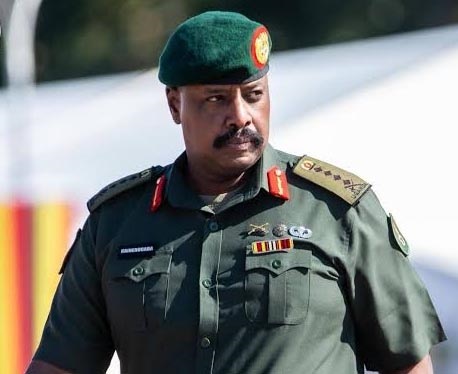
Gen. Muhoozi Kainerugaba
HABARI DAILY I Kampala, Uganda I MP Ofwono Opondo appears determined to take his confrontation with Chief of Defence Forces (CDF) Gen. Muhoozi Kainerugaba to the bitter end, declaring that he would rather die than bow to what he considers military intimidation.
The former government spokesperson has rejected Muhoozi’s demand that he apologises on his knees within seven days, instead telling the army chief that he knows where he wants to be buried should the threats against him turn fatal.
In a defiant post on X on November 6, 2026, Opondo declared that the seventh day of Muhoozi’s ultimatum would find him at Mulanda-Ayago, his ancestral burial ground.
He tagged President Yoweri Museveni, Parliament, Speaker Thomas Tayebwa and Defence Minister Jacob Oboth-Oboth in the post, effectively bringing the country’s highest political and institutional offices into an increasingly uncomfortable confrontation between two prominent figures in the ruling establishment.
The standoff raises questions about why Opondo, a long-serving National Resistance Movement (NRM) loyalist, appears unwilling to retreat despite the extraordinary nature of the threats directed at him.
Opposition to military intimidation
At the centre of Opondo’s defiance is his objection to what he perceives as the growing use of military authority to settle political disagreements and silence critical voices.
Opondo has openly questioned Muhoozi’s political ambitions and involvement in succession politics while serving as an active military officer.
The MP appears particularly uncomfortable with a political environment in which military influence, rather than public consent and constitutional processes, could determine who exercises political power.
During public discussions, including appearances on Capital Gang and NBS Frontline, Opondo challenged Muhoozi to demonstrate his popularity without relying on armed escorts and military protection.
He reportedly dared the army chief to walk through downtown Kampala without guns or military personnel if he genuinely believed that power and public support were interchangeable.
For Opondo, the issue appears to extend beyond a personal disagreement with Muhoozi to the broader question of whether military power should be used to intimidate political opponents.
The Elwelu controversy that escalated tensions
The immediate disagreement that appears to have intensified the confrontation concerns the circumstances surrounding the surrender of retired Gen. Peter Elwelu, the former deputy CDF.
On November 3, 2026, Opondo suggested that Elwelu might have surrendered following a negotiated understanding or truce with security authorities.
Muhoozi, however, insisted that Elwelu surrendered directly on his orders, presenting a different account of the events surrounding the retired general’s apprehension.
The Uganda People’s Defence Forces (UPDF) subsequently disputed a New Vision report suggesting that President Museveni had personally assured Elwelu of his safety.
In a November 5 statement, army spokesperson Col Chris Magezi said Elwelu surrendered after security forces closed in on him and would face proceedings before the General Court Martial.
Although Muhoozi’s subsequent posts threatening Opondo did not explicitly mention Elwelu, the disagreement appears to have contributed to the growing friction.
Human rights and the question of impunity
Opondo’s defiance also comes against the background of his increasingly vocal criticism of alleged human rights violations involving security agencies.
During a parliamentary debate on October 22, 2026, concerning missing persons and alleged human rights abuses, the MP representing older persons in eastern Uganda challenged the government to explain how security personnel were conducting arrests.
He called for investigations into allegations of unlawful detention, abductions and torture, insisting that security agencies should operate within the law.
He has also questioned the treatment of activists, including allegations surrounding the disappearance of Praise Aloikin.
His position suggests that he does not want the military to enjoy unrestricted authority over citizens, regardless of their political affiliations or differences with those in power.
Consequently, an apology to Muhoozi under an ultimatum could be interpreted as surrendering the principle that public officials and citizens should be free to question those exercising state power.
A battle within the ruling establishment?
Beyond the personal confrontation, political observers may interpret the disagreement as reflecting deeper tensions within the NRM establishment over the country’s political future.
Opondo is a veteran of the ruling establishment and has served as government spokesperson, giving him considerable experience navigating the political sensitivities surrounding President Museveni’s administration.
His resistance to Muhoozi’s approach could therefore reflect differences between sections of the established NRM leadership and individuals associated with the army chief’s political ambitions.
However, there is no public evidence that Opondo’s position represents an organised faction within the ruling party.
For now, the confrontation has placed President Museveni in an uncomfortable position, with one of his long-serving political allies openly challenging threats issued by his son, who also commands the country’s military.
Muhoozi had accused Opondo of repeatedly insulting him, warning that he would teach the MP who he was and giving him seven days to apologise on his knees.







About the Author