
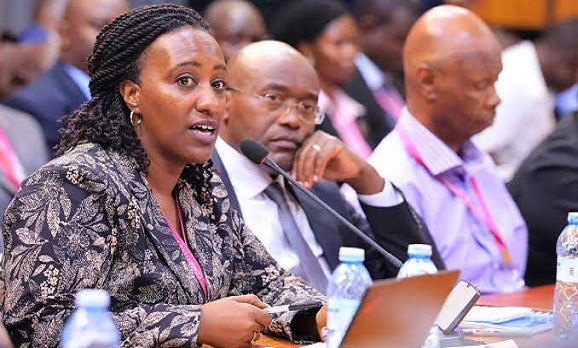
The current UEDCL team facing parliament recently
HABARI DAILY I Kampala, Uganda I Wrongful suspension leading to dismissal, without following established employment procedures, is among the legal risks that prompted Solicitor General Perry Biribonwoha to advise the Ministry of Energy and Mineral Development to engage in constructive negotiations with former Uganda Electricity Distribution Company Limited (UEDCL) Managing Director Paul Mwesigwa rather than maintain his indefinite forced leave.
In a September 11, 2026 legal advisory, Biribonwoha warned that the Ministry’s decision to keep Mwesigwa away from his duties without resolving the circumstances surrounding his suspension could expose the government to costly litigation and claims of unlawful and constructive dismissal.
The Solicitor General cautioned that maintaining the arrangement would likely be overturned by a court because forced leave has no recognised legal basis under the Employment Act (Cap 226) or UEDCL’s Human Resource Manual.
The advice effectively urged the Ministry to find an amicable resolution to the dispute rather than allow an employment matter to escalate into a potentially expensive legal battle.
Forced leave had no legal foundation
At the centre of Biribonwoha’s advice was the legality of the Ministry’s decision to place Mwesigwa on forced leave in April 2026.
The Solicitor General reportedly observed that neither the Employment Act nor UEDCL’s Human Resource Manual provides for forced leave as an employment status. The company’s human resource guidelines instead provide for recognised leave categories, including annual, sick and maternity leave.
He warned that keeping an employee away from work indefinitely, without a clear legal framework or concluding the investigations, could amount to an unlawful employment action.
The circumstances were particularly problematic because Mwesigwa had reportedly been barred from accessing UEDCL premises, company systems and other work resources, while the company appointed an acting managing director to replace him.
According to the legal advisory, these actions could provide grounds for a claim of constructive dismissal, wrongful suspension or unlawful termination.
Constructive dismissal generally arises when an employer’s conduct fundamentally undermines the employment relationship, effectively leaving an employee with little practical choice but to regard the employment contract as terminated.
Biribonwoha therefore advised the Ministry to pursue constructive negotiations to avoid the legal and financial consequences of an unsuccessful court battle.
How the UEDCL management crisis started
Mwesigwa’s troubles began on May 2, 2026, when former Energy Minister Ruth Nankabirwa announced the termination of the contract of UEDCL Board Chairperson Lydia Ochieng-Obbo and placed the managing director on forced leave.
The Ministry said the decisions followed a government review of UEDCL’s management and operations, intended to strengthen accountability, institutional performance and electricity service delivery.
Among the concerns raised was the increase in electricity distribution losses from approximately 15% to 19% following UEDCL’s takeover of the national distribution network from Umeme on April 1, 2025.
Other concerns included frequent power outages, voltage fluctuations, delayed electricity connections, procurement delays and weaknesses in human resource management.
Nankabirwa appointed Joselynne Rwakakooko as acting managing director to ensure continuity of operations while the management review proceeded.
However, the decision to remove Mwesigwa became contentious, particularly after his legal representatives reportedly demanded more than Shs25b in damages in May.
Ministry sought legal guidance
The Ministry’s Permanent Secretary, Irene Bateebe, reportedly sought legal advice on several occasions as the dispute persisted, eventually receiving the September 11 advisory recommending negotiations.
The dispute had also emerged against the background of disagreements over UEDCL’s performance following the end of Umeme’s 20-year electricity distribution concession.
Previous reports indicated that UEDCL had inherited an ageing electricity distribution network requiring substantial investment in transformers, substations and other infrastructure.
In May, investigations by Daily Monitor also highlighted disagreements between UEDCL management, the Energy Ministry and the Electricity Regulatory Authority over procurement, investment priorities and responsibility for the poor state of the network.
The disagreements complicated efforts to establish individual responsibility for the operational challenges facing the electricity distributor.







About the Author