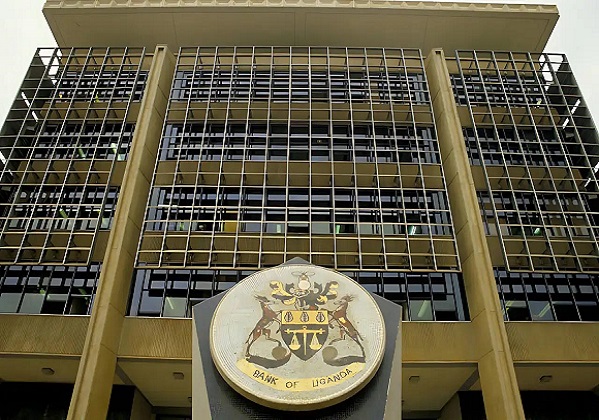
Bank of Uganda headquarters along Kampala Road
HABARI DAILY I Kampala, Uganda I Ugandan traders and manufacturers have raised fears over a possible second interest rate hike by the Bank of Uganda (BoU), appealing to the central bank to maintain its current policy rate when its Monetary Policy Committee (MPC) meets tomorrow, Monday, November 9, 2026.
The business community, particularly manufacturers and traders already struggling with expensive commercial credit, warns that another increase in the Central Bank Rate (CBR) could further suffocate businesses, undermine investment and increase the risk of loan defaults.
The appeal comes less than a month after the central bank delivered a shock 225-basis-point increase in the CBR, raising it from 9.75% to 12% on October 14, 2026.
The aggressive adjustment, the biggest since 2011, was intended to defend the weakening Uganda shilling, contain inflationary pressures and restore stability amid escalating geopolitical tensions in the Middle East and rising international oil prices.
However, businesses say the consequences of that decision are only beginning to filter through the economy, with commercial banks adjusting their lending rates upwards, some exceeding 21%.
Traders struggle with expensive credit
For members of the Kampala City Traders Association (KACITA) and manufacturers under the Uganda Manufacturers Association (UMA), another increase would come at a particularly difficult time.
Business operators say the October adjustment has already increased the cost of servicing loans, particularly facilities whose interest rates are tied to prevailing market conditions.
The higher repayments are eating into working capital, leaving traders with less money to replenish stocks, pay suppliers, meet salaries and finance daily operations.
UMA chairman Aga Sekalala Jr. has warned that manufacturers are increasingly finding it difficult to undertake fresh borrowing and implement business expansion plans because of the rising cost of credit.
For manufacturers, expensive financing threatens investments in machinery, production capacity, technology and new employment opportunities.
Small and medium-sized enterprises (SMEs), which account for a substantial share of business activity and employment in Uganda, are considered particularly vulnerable.
Economists warn that continued increases in borrowing costs could push struggling businesses into loan arrears, potentially forcing commercial banks to tighten lending conditions further.
This could create a vicious cycle in which businesses unable to access affordable financing scale down operations, postpone investments or close altogether.
BoU faces difficult balancing act
Despite the pressure from businesses, the central bank faces a difficult decision as it seeks to contain inflation and stabilise the shilling without undermining economic growth.
Uganda’s annual headline inflation reportedly increased to 5.8% in October, up from 4.6% in September, reflecting rising domestic energy, fuel and utility costs.
Annual core inflation also edged upwards to 4.4%, raising concerns that price pressures could become more entrenched.
The central bank has revised its inflation outlook, projecting that headline inflation could peak between 7% and 7.5%, significantly above its medium-term target of 5%.
The shilling, which had weakened beyond Shs4,500 against the US dollar, has since experienced a volatile recovery, trading within the Shs4,040-Shs4,280 range.
However, the recovery has not completely eliminated concerns about external pressures, particularly the impact of international oil prices and geopolitical instability on Uganda’s import bill.
Economists divided over decision
Financial analysts are divided over whether the MPC will maintain the current 12% rate or introduce another increase.
Economist Dr Fred Muhumuza is among those expecting the central bank to hold the rate steady, arguing that the October adjustment needs time to work through the financial system.
A pause would also allow the central bank to assess the impact of its decision to increase the Cash Reserve Requirement (CRR) to 13.5%, a measure intended to absorb excess liquidity from the banking system.
However, other financial analysts believe another increase remains possible given rising inflation expectations and uncertainty in the international economic environment.
They argue that the central bank may prioritise price stability and currency protection even if this means temporarily imposing additional pressure on businesses.
The MPC’s decision, expected at 1pm, will therefore be closely watched by traders, manufacturers, commercial banks and investors.







About the Author