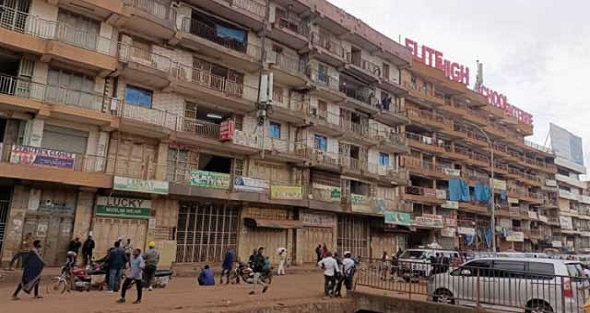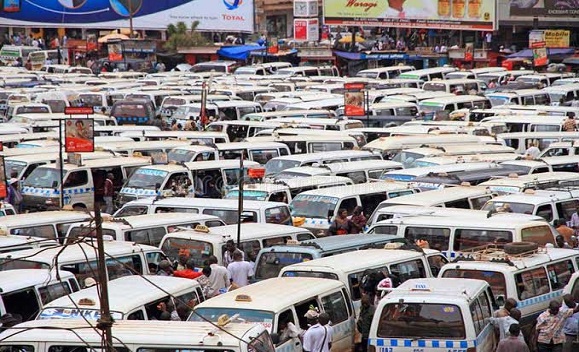

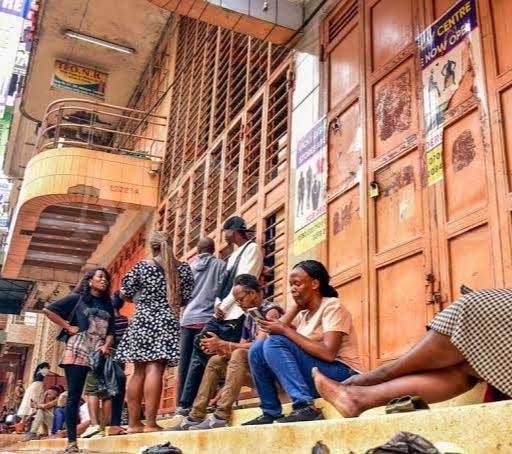
Closed shops in downtown Kampala
HABARI DAILY I Kampala, Uganda I Distrust is behind Kampala traders’ decision to keep their shops closed on November 17, 2026, despite government appeals for dialogue and assurances that President Yoweri Museveni would meet their leaders to address their grievances.
The traders, mobilised by the Kampala City Traders Association (KACITA), maintained their sit-down protest, arguing that previous engagements with government officials had produced little or no tangible improvement in their business conditions.
Their decision to proceed with the strike, despite Prime Minister Robinah Nabbanja’s intervention, reflects growing frustration among business owners who feel that government has repeatedly made promises without addressing the challenges threatening their livelihoods.
Nabbanja had intervened ahead of the planned shutdown, communicating Museveni’s willingness to meet representatives of traders, landlords and the Uganda Revenue Authority (URA) to discuss their concerns.
However, the assurance failed to convince traders to reopen their businesses, with many insisting that another meeting would not solve their problems unless it resulted in concrete decisions and immediate action.
Broken promises and ignored grievances
One of the major reasons behind the traders’ defiance is their dissatisfaction with previous government engagements.
Traders argue that they have held several meetings with government officials and Kampala Capital City Authority (KCCA) representatives, presenting their concerns and proposing solutions, but little has changed.
They complain that their grievances have effectively been “thrown in the dustbin”, making them sceptical about fresh promises of dialogue.
For many business owners, therefore, the proposed meeting with Museveni was not sufficient justification to abandon the strike.
They want assurances backed by specific commitments, implementation timelines and clear solutions to the challenges affecting their businesses.
The traders believe that reopening their shops before securing such commitments would weaken their bargaining position and allow government to postpone action once normal business operations resume.
Taxation and rising operational costs
The financial pressure facing traders has also contributed to their determination to sustain the shutdown.
They cite the 18% Value Added Tax (VAT), the Electronic Fiscal Receipting and Invoicing Solution (EFRIS) and other tax obligations as major burdens on businesses already struggling with declining sales and rising operational expenses.
Although taxation is necessary to finance public services, traders argue that the cumulative burden has reduced their profit margins and made it increasingly difficult for small and medium-sized enterprises to survive.
They are also concerned about high commercial rental charges, particularly properties whose landlords demand payments in US dollars.
The depreciation of business revenues against rising operating costs has left some traders struggling to meet rent, pay employees, service loans and restock their shops.
Commercial property rates have added another layer of pressure, with traders arguing that the cost of occupying business premises is becoming unsustainable.
Auction threats and stranded merchandise
Beyond taxation and rental costs, some traders are facing the threat of losing their properties through bank auctions after failing to meet loan repayment obligations.
The situation has been compounded by delays in clearing imported merchandise at Nairobi and local ports of entry.
Traders say goods have remained stranded for prolonged periods, disrupting supply chains, tying up working capital and, in some cases, resulting in merchandise deteriorating before reaching the market.
For businesses operating on borrowed money, such delays translate into mounting interest payments, lost sales and an inability to meet financial obligations.
Consequently, traders argue that continuing with business as usual while their financial difficulties deepen would only worsen their situation.
Shutdown as a bargaining tool
The decision to close shops was also intended to demonstrate the economic importance of Kampala’s trading community and compel government to respond urgently.
Traders’ leaders argued that a complete shutdown of downtown Kampala was necessary to “push [President] Museveni to the wall” and secure meaningful intervention.
They believe that collective action gives them greater bargaining power than individual complaints or prolonged negotiations.
For the traders, the November 17 shutdown was therefore not simply a protest against taxation, but a demonstration of frustration over what they consider years of ignored concerns.







About the Author