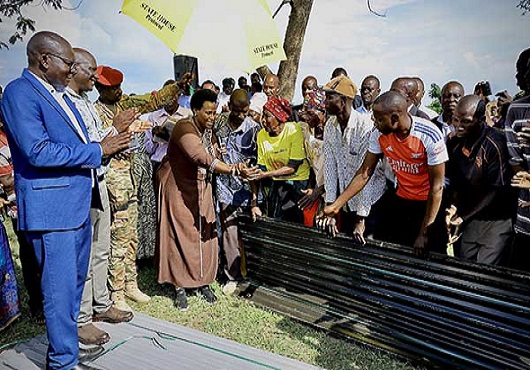
Jane Barekye hands over a donation of iron sheets to community members
HABARI DAILY I Kampala, Uganda I State House has pledged to support the construction of 25 houses for vulnerable families in Kaitambiri Village, Kagoli Parish, Pallisa Sub-county, Pallisa District.
This followed the success of a Presidential initiative that has enabled former wetland rice farmers to venture into commercial fish farming.
The initiative seeks to restore degraded wetlands while providing communities with profitable alternative livelihoods through commercial fish farming.
The pledge was announced on Friday by State House Comptroller, Jane Barekye during a ceremony at Kaitambiri Village, where 1,000 iron sheets were distributed to 25 selected households. The iron sheets were purchased using proceeds from the group’s first fish harvest.
The 79-member Kaitambiri Fish Farmers Group recently generated more than Shs82m from the sale of catfish harvested from just two of the 13 fish ponds established with support from State House.
The project was initiated following President Museveni’s concerns over widespread wetland degradation in the Bukedi sub-region, where communities had increasingly encroached on wetlands to cultivate rice.
Through State House, the President identified Kaitambiri Village as a model community where farmers could be supported to abandon wetland rice cultivation and embrace fish farming as an alternative source of income.
Under the initiative, State House excavated 13 fish ponds on land previously used for rice cultivation. Two of the ponds were initially stocked with 20,000 catfish fingerlings to establish the commercial viability of the project.
The Government also provided fish feeds for seven months, while members of the farmers’ group took responsibility for the day-to-day management of the ponds.
Addressing the farmers during the distribution ceremony, Barekye commended them for embracing President Museveni’s advice to abandon wetland rice cultivation and adopt more sustainable and profitable economic activities.
She said the success of the initial harvest had demonstrated the potential of the President’s intervention in transforming rural livelihoods through practical agricultural enterprises.
Barekye pledged that State House would provide additional fingerlings and feeds to stock all the 13 ponds before the end of the year.
“We are going to provide fingerlings to stock all the 13 ponds, supply feed and ensure security for the fish. If other factors remain constant, we anticipate generating over Shs530m after seven months,” she said.
However, she cautioned the farmers that the next production cycle would be the final phase of direct State House support, urging them to prepare to sustain and expand the enterprise independently.
“You should understand that State House support will end after this round. We expect you to have acquired the knowledge, experience and financial capacity to manage and grow this project on your own,” Barekye said.
Barekye said the 1,000 iron sheets had been earmarked for vulnerable households currently living in grass-thatched houses as part of efforts to improve their living conditions.
She further pledged that the State House would provide labour towards the construction of permanent houses for the 25 selected families.
Under the arrangement, the beneficiaries will be responsible for mobilising funds and purchasing the required construction materials, while State House will provide labour to support the building process.
She said the intervention was intended to ensure that the benefits of government-supported economic activities translate into tangible improvements in the welfare of rural households.
Dr. Morris Ochen, the Commissioner in Charge of Technology Transfer and Presidential Demonstration Farms at State House, said the pilot project had exceeded expectations, demonstrating the profitability of commercial fish farming.
He said the farmers harvested the fish about three weeks ago and sold each kilogramme at Shs7,500, generating more than Shs82m in gross revenue.
“We invested about Shs37.6m in the project and managed to realise over Shs82m from the harvest. This clearly demonstrates that fish farming is a viable and profitable business compared to rice growing in wetlands,” Dr. Ochen said.
He explained that part of the proceeds was used to purchase 1,000 iron sheets for 25 vulnerable households, with each beneficiary receiving 40 sheets.
The group also shared cash proceeds among its 79 members and retained Shs13m as savings for its Savings and Credit Cooperative Organisation (SACCO).







About the Author