

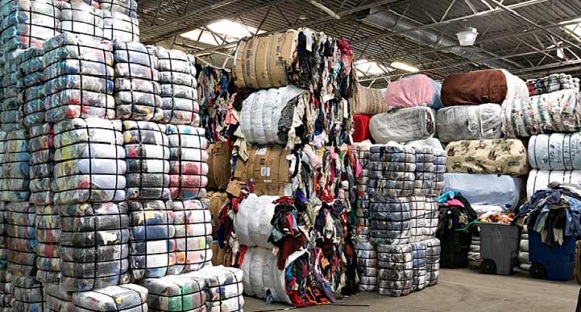
Imported bales of second hand clothes
HABARI DAILY I Kampala, Uganda I As part of the measures to de-escalate the existent conflict between Government and traders which forced them to close their shops last week, the Government has initiated a review of the tax policy on imported garments and textiles following complaints by Kampala traders that high taxes, inconsistent customs assessments and delays in clearing merchandise are undermining their businesses.
The proposed review, which follows President Yoweri Museveni’s intervention, could reshape the taxation framework governing Uganda’s garment and textile imports, a significant component of the country’s merchandise trade that supports thousands of importers, wholesalers, retailers and other businesses.
The move follows a directive by Museveni to Prime Minister Robinah Nabbanja to engage traders and other stakeholders and find lasting solutions to the grievances that triggered the closure of shops, particularly among businesses dealing in imported garments and textiles.
Following an emergency meeting convened by Nabbanja at her office in Kampala on Tuesday, Government established an Inter-Agency Tax Harmonisation Committee to examine the disputed tax policy and recommend measures to resolve the standoff.
The committee will be chaired by Trade Minister Sanjay Tana and comprises State Minister for Finance in charge of Planning Amos Lugoloobi, Deputy Attorney General Jackson Kafuuzi, Uganda Revenue Authority (URA) Commissioner General John Musinguzi, Federation of Uganda Traders Associations chairperson John Kabanda and landlords’ representative Godfrey Kirumira.
Nabbanja said Government was committed to finding a lasting solution that would address traders’ concerns without undermining domestic revenue mobilisation and efforts to protect local industries.
She subsequently directed the Ministries of Finance and Trade to review the tax policy on imported garments and textiles, raising expectations among traders that the controversial taxation formula could be reconsidered.
The committee’s responsibility is to balance the competing interests of importers, Government revenue authorities and domestic manufacturers while developing a framework that supports legitimate businesses without encouraging tax avoidance.
The economics behind Uganda’s garment imports
The importance of the proposed review is underscored by the scale of Uganda’s dependence on imported clothing and textile products.
Trade statistics show that Uganda imported approximately $57.55m worth of knitted and crocheted apparel in 2025, according to UN Comtrade data published through the World Bank’s World Integrated Trade Solution (WITS). China accounted for approximately $51.2m of these imports, demonstrating its dominance as a supplier of new knitted garments to the Ugandan market.
The country also has a substantial second-hand clothing market. Uganda imported approximately $89.7m worth of worn clothing in 2024, equivalent to about 70,700 tonnes, according to trade statistics. The value followed imports of approximately $95.9m in 2023, reflecting the continued importance of second-hand clothing in the country’s retail market.
Research by the Economic Policy Research Centre (EPRC) similarly shows that Uganda’s second-hand clothing imports have expanded considerably over the years, increasing from approximately $28.9m in 2017 to $95.9m in 2023.
The second-hand clothing market is particularly significant because Uganda serves not only as a destination for imported merchandise but also as a redistribution point for neighbouring countries, including the Democratic Republic of Congo, South Sudan and Kenya.
Beyond finished garments, the wider textile and textile-products category accounts for an even larger import bill. Bank of Uganda statistics put private-sector imports of textile and textile products at approximately $300.6m in 2024, rising to a preliminary $366.6m in 2025.
These figures cover a broader category than finished garments, incorporating textile materials and related products, and should therefore not be added directly to apparel and second-hand clothing figures without accounting for possible differences in classification.
The statistics nevertheless demonstrate the economic significance of the sector and why disagreements over its taxation have attracted considerable attention from policymakers and the business community.
For Uganda, the challenge is to maintain access to affordable clothing and textile materials while developing a competitive domestic manufacturing industry capable of meeting local demand and eventually supplying regional markets.
Disputed taxation formula
At the heart of the disagreement is the method used to calculate import duties on garments and textile fabrics, particularly the application of a specific tax based on weight alongside a percentage of the customs value.
Traders protested steep import charges on garments and textiles—including weight-based (per-kilogram) assessments and value-based duties—arguing the rates squeeze profit margins and make formal importation uncompetitive against goods routed through neighboring countries like Kenya and Tanzania.
Businesses also cited prolonged customs clearance delays, disputed valuations, high storage costs, and overlapping Uganda Revenue Authority (URA) enforcement operations, including re-seizing goods after clearance.
Taxation structure
The taxation structure introduced in 2020 subjected imported garments to a duty of 35% or $3.5 per kilogramme, whichever was higher. Imported textile fabrics attracted 35% or $3 per kilogramme, whichever was higher.
However, Government subsequently reduced the specific per-kilogramme component under the financial year 2025/2026 tax measures, effective July 1, 2025.
Under the revised rates, imported garments attract $2.50 per kilogramme or 35% of their customs value, whichever is higher, while imported fabrics attract $2 per kilogramme or 35%, whichever is higher.
Although the reductions were intended to ease the cost of importing fabrics for value addition and support traders, the continued application of the higher-of-two formula remains contentious.
Traders argue that the weight-based component disproportionately affects businesses importing inexpensive but relatively heavy garments and fabrics.
For example, an importer dealing in low-cost jeans, jackets and other heavy clothing may end up paying more under the per-kilogramme assessment than would be expected from the actual value of the merchandise.
They contend that this increases the landed cost of imported products, forcing businesses to raise retail prices or operate with reduced profit margins.
The traders also complain about inconsistencies in the assessment of similar consignments, arguing that merchandise of comparable quantities, sizes and country of origin should attract predictable tax bills.
They maintain that Uganda’s taxation structure places local importers at a competitive disadvantage compared with businesses operating in Kenya and Tanzania, where they claim the applicable tax arrangements are more favourable.
Consequently, they want Government to reconsider the formula and harmonise its taxation framework with regional trading partners.
Protecting local manufacturers Vs supporting importers
The proposed review also raises broader questions about Uganda’s industrialisation strategy, particularly the Government’s commitment to protecting domestic manufacturers through the Buy Uganda, Build Uganda (BUBU) policy.
The policy seeks to encourage the consumption of locally manufactured products, stimulate domestic production, create employment and reduce dependence on imported merchandise.
Government’s decision to maintain significant import duties on garments and textile products is partly intended to prevent cheap imports from undermining local manufacturers who must contend with production costs, financing constraints, electricity expenses and other operational challenges.
However, traders argue that the taxation framework should not make importing so expensive that legitimate businesses are pushed towards alternative markets or informal trading arrangements.
The committee will therefore have to establish whether the existing rates and assessment procedures are achieving their intended industrial policy objectives or inadvertently creating incentives for tax avoidance and cross-border diversion of merchandise.
A possible adjustment would have to consider the interests of domestic textile manufacturers, importers who supply finished clothing to consumers, and businesses that import fabrics for local tailoring and garment production.
The distinction is important because imported fabrics used for value addition can support domestic employment and production rather than simply compete with locally manufactured finished garments.
URA warns against tax evasion
Meanwhile, URA Commissioner General John Musinguzi told the meeting that the authority was concerned about traders importing garments through neighbouring countries, particularly Kenya and Tanzania, to exploit differences in taxation.
Under the East African Community Customs Union framework, goods originating within the EAC are eligible for preferential treatment, including zero import duty when traded among partner states, subject to the applicable rules of origin.
However, Musinguzi said some traders import garments manufactured in China through neighbouring countries, clear the goods under the applicable tax regimes there and subsequently transport them into Uganda, sometimes using passenger buses.
He argued that the practice deprives Uganda of revenue because the merchandise is ultimately destined for the Ugandan market but may avoid taxes that would ordinarily apply if it were imported directly.
Musinguzi maintained that goods originating outside the EAC should not automatically benefit from preferential regional tax treatment simply because they have been cleared through another member state.
His concerns expose the difficulty of harmonising taxation within the region, where differences in national tax policies can influence the routes importers choose when bringing merchandise into their markets.
The traders, however, insist that differences in taxation between Uganda and its neighbours are making it increasingly difficult for them to compete profitably.
They want Government to address the disparities rather than leave Ugandan businesses with higher costs that encourage importers to channel their merchandise through other countries.
EFRIS enforcement adds to traders’ frustrations
Apart from import duties, traders raised concerns about the implementation of the Electronic Fiscal Receipting and Invoicing Solution (EFRIS), particularly the manner in which URA enforcement officers handle merchandise belonging to small-scale businesses.
Kampala City Traders Association chairperson Issa Sekitto told the meeting that traders operating in Nakasero and other commercial areas had complained about their merchandise being impounded during EFRIS enforcement operations.
He argued that URA should establish whether suppliers who sell merchandise to individual retailers are registered on the system before taking enforcement action.
“Before impounding someone’s goods, URA should establish whether the supplier who sold those goods is already registered on EFRIS and whether the trader is also complying with the system. Enforcement should not simply punish small traders without examining the entire supply chain,” Sekitto said.
He called for greater consultation between URA and the business community, arguing that enforcement should not unnecessarily disrupt trading activities or expose small-scale operators to financial losses.
The traders want Government to reconsider aspects of EFRIS implementation and ensure that compliance responsibilities are examined across the supply chain rather than placing the burden entirely on individual shop owners.
Traders await presidential intervention
Federation of Uganda Traders Associations chairperson John Kabanda welcomed the establishment of the Inter-Agency Tax Harmonisation Committee, describing it as a positive step towards resolving the grievances through engagement with the relevant Government institutions.
“Unlike previous engagements, during which the Government simply promised to address our concerns, this time a committee has been established comprising all the stakeholders responsible for the issues affecting us. We are optimistic that most of our concerns will be resolved amicably,” Kabanda said.
He disclosed that the contentious per-kilogramme tax and other matters relating to trade within East Africa had been referred to President Museveni for a final decision.
The traders had hoped to have the issues resolved earlier, but the President’s engagements with visiting Tanzanian President Samia Suluhu delayed the process.
Another meeting was scheduled to continue discussions, as the traders sought practical commitments on taxation, customs clearance and other operational challenges.
Daniel Ngobi, a textile trader operating along Nabugabo Road, said traders wanted tangible solutions to the high cost of importing merchandise, delays in clearing goods and other difficulties affecting their businesses.
Although the sit-down protest had entered its second day, some traders had started reopening their shops, saying they would assess Government’s response and subsequent engagements before deciding whether to continue participating in the shutdown.
A test for Uganda’s tax and industrial policy
The proposed review presents Government with an opportunity to address longstanding tensions between tax administration and the business community while reassessing the effectiveness of its textile import policy.
Its outcome will have implications beyond Kampala’s commercial arcades because the garment and textile trade supports a broad network of wholesalers, retailers, transporters, clearing agents and other businesses.
For consumers, the taxation decisions could also influence the prices of imported clothing, particularly in a market where second-hand garments and inexpensive new apparel provide affordable alternatives for many households.
However, reducing import duties without strengthening local manufacturing could expose domestic producers to greater competition, while maintaining an excessively burdensome framework could encourage informal imports and divert taxable business to neighbouring countries.
The Inter-Agency Tax Harmonisation Committee must therefore find a balance between affordable imports, predictable taxation, effective revenue collection and the development of Uganda’s domestic textile industry.







About the Author