
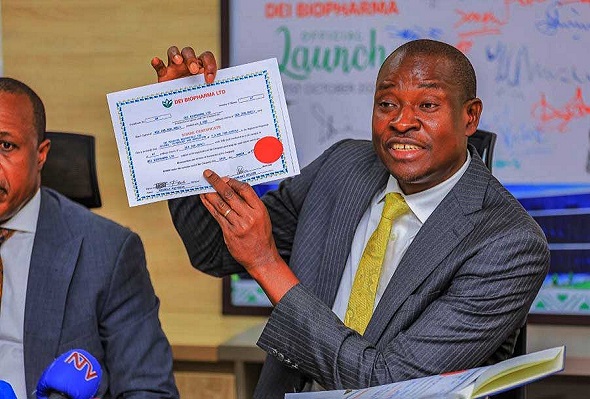
Dr Magoola addressing journalists at Dei BioPharma’s manufacturing facility in Matugga, on November 23, 2026
HABARI DAILY I Kampala, Uganda I Dr Magoola’s fight to block the sale of his property has been taken to the court of public opinion, with the founder and Managing Director of Dei BioPharma accusing unnamed powerful individuals and foreign agents of orchestrating a prolonged campaign to sabotage his pharmaceutical investment while challenging Equity Bank’s planned auction of his assets.
Addressing journalists at Dei BioPharma’s manufacturing facility in Matugga, Wakiso District, on November 23, 2026, Dr Matthias Magoola accused what he described as “mafias” of spreading misinformation about the company, frustrating its efforts to secure international financing and attempting to undermine Uganda’s ambition of manufacturing essential medicines and vaccines locally.
His remarks came amid an escalating financial and legal dispute with Equity Bank, which has advertised several properties belonging to Magoola and his associated companies for sale over disputed loan obligations.
The properties include the pharmaceutical manufacturing complex in Matugga, a wheat milling facility in Luzira and several residential and commercial properties in Kampala and Wakiso.
Through his lawyers, Muwema & Co. Advocates, Magoola has challenged the proposed auction, arguing that the bank is attempting to sell the properties before the courts establish the actual outstanding debt.
Foreign agents sabotage
Magoola alleged that powerful interests had been fighting Dei BioPharma since its inception, using misinformation and foreign connections to damage the company’s reputation and discourage support for its pharmaceutical manufacturing ambitions.
He claimed the campaign had targeted not only the company and its directors but also the Ugandan government and President Yoweri Museveni, who has supported the establishment of the pharmaceutical facility.
According to Magoola, some of the alleged actors were opposed to Uganda acquiring the technology and industrial capacity to manufacture essential medicines and vaccines instead of relying heavily on imports.
He further claimed that foreign agents had lobbied the Bank of Uganda to frustrate a proposed $430 million credit facility from international financiers, denying the company capital required to complete its manufacturing project.
The allegations, which Magoola did not substantiate with publicly disclosed evidence during the briefing, reflect his explanation for the financing difficulties and controversy surrounding the project.
Dei BioPharma’s investment has attracted considerable public attention because of the government’s Shs723.4 billion investment in the company and questions raised by opposition legislators about its valuation, financial position and accountability.
The company has maintained that it had initially secured approximately $430 million in funding commitments, but the money was allegedly withheld following interventions by the groups Magoola described as mafias.
He said the entire Matugga complex requires approximately $1.1 billion to complete, adding that the government intervened with Shs723.4 billion in exchange for a 9.4 per cent shareholding to protect the investment.
Equity Bank’s over Shs148bn debt dispute
The immediate battle, however, concerns Equity Bank’s November 5, 2026 notice, issued through auctioneers Jald (U) Ltd, announcing the intended sale of several properties belonging to Magoola and his associated companies to recover outstanding loans, interest and other charges.
The advertised properties include Dei’s pharmaceutical manufacturing facility in Matugga, a wheat milling plant in Luzira and several commercial and residential properties in Kampala and Wakiso.
Magoola disputes the bank’s calculations, arguing that the proposed auction is premature because the actual outstanding loan balance has not been conclusively established through the court-directed independent audit and reconciliation process.
Through Muwema & Co. Advocates, he issued a Caveat Emptor, meaning buyer beware, warning prospective purchasers against acquiring the advertised properties while the legal dispute remains unresolved.
His lawyers argue that the proposed sale disregards proceedings involving the High Court and Court of Appeal, particularly a September 9, 2026 Court of Appeal decision staying the main proceedings pending determination of an appeal.
The borrowers contend that the court-supervised audit and reconciliation must establish the actual debt before Equity Bank can proceed with recovering the disputed amounts through the sale of their properties.
The dispute originated from bank demands involving approximately Shs82 billion and $43 million, which the companies challenged over loan consolidation, interest calculations and the accounting of their facilities.
Magoola claims that Dei has serviced 21 of the 22 loans acquired across different banks since 2016 and paid Equity Bank more than Shs180 billion since 2024.
He further alleges that an internal audit established that the company had overpaid Equity Bank by Shs137 billion, accusing the lender of irregular loan consolidations and excessive interest charges.
These figures remain contested. Equity Bank has maintained that the auction is lawful and that there is no active court order prohibiting the sale of the mortgaged properties.
Ministerial intervention
Magoola also said efforts to reconcile the accounts had repeatedly failed until the Minister of Science, Technology and Innovation intervened in November 2026 to facilitate a formal reconciliation process.
The intervention was intended to help establish the actual financial position of the borrowers and resolve disagreements over the outstanding obligations.
However, the bank’s position remains that it is entitled to exercise its recovery rights under the lending arrangements, while the borrowers insist that the amount being pursued has not been conclusively established.
The dispute has therefore evolved into a contest involving the interpretation of court proceedings, the independence of the audit process and the bank’s rights over properties pledged as security.
Government accountability questions
The controversy has acquired broader public significance because government injected Shs723.4 billion into Dei BioPharma in exchange for a 9.4 per cent stake, making the pharmaceutical project a matter of public investment and accountability.
Magoola’s November 23 briefing also responded to concerns raised by Leader of the Opposition Joel Ssenyonyi about the government’s investment, the company’s valuation and its financial position.
Magoola and board chairman Dr Patrick Wakida defended the transaction, saying a government valuation placed Dei BioPharma at $2.1 billion before the state acquired its stake.
Parliament has also taken an interest in the matter, with Speaker Jacob Oboth directing the Committee on Science, Technology and Innovation on November 10 to investigate the project and report within two weeks.







About the Author