

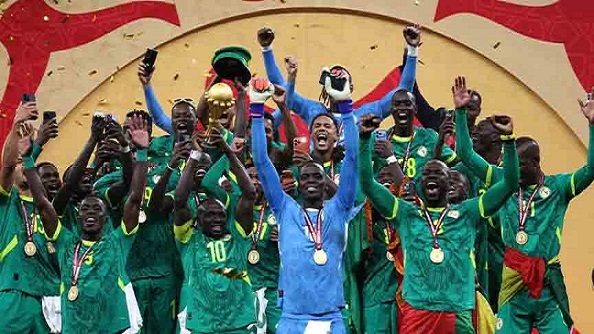
Senegal’s 2025 AFCON victorious team
HABARI DAILY I Kampala, Uganda I Many reasons led to the eventual court ruling, among which is the authority of the match referee to determine whether a football match should continue or be abandoned, a principle that ultimately worked in favour of Senegal in their protracted dispute with Morocco over the 2025 Africa Cup of Nations (AFCON) final.
On Tuesday, November 24, 2026, the Court of Arbitration for Sport (CAS) unanimously upheld Senegal’s appeal, overturning a Confederation of African Football (CAF) Appeal Board decision that had stripped the West African nation of its continental title and awarded it to Morocco.
The ruling restores Senegal’s 1-0 victory over hosts Morocco in the final played in Rabat on January 18, 2026, bringing an end to months of uncertainty over the outcome of one of the most controversial AFCON finals in recent history.

A three-member CAS panel ruled that match referee Jean-Jacques Ngambo Ndala acted within his authority under the Laws of the Game when he decided to resume play after Senegal’s players temporarily walked off the pitch in protest.
The court’s decision effectively overturned CAF’s March 17 ruling, which had declared Morocco 3-0 winners on grounds that Senegal had forfeited the match.
Referee’s authority proved decisive
At the centre of the legal battle was whether Senegal’s decision to temporarily withdraw from the pitch amounted to a forfeiture under CAF regulations, despite the match eventually resuming and producing a sporting result.
CAS determined that the referee had the exclusive authority to decide whether conditions were suitable for the match to continue or whether it should be abandoned.
By blowing his whistle to restart play after Senegal’s players returned to the field, Ndala effectively established that the conditions required for the continuation of the match had been met.
The panel held that this decision fell within the referee’s authority and was protected by the established football principle known as the “field of play” doctrine.
The doctrine generally prevents external bodies, including disciplinary and arbitration authorities, from overturning decisions made by referees on matters falling within their authority during a match, except in exceptional circumstances.
In this case, CAS found no sufficient basis to interfere with the referee’s decision to allow the match to continue.
The court therefore upheld the original result rather than imposing an administrative outcome based on Senegal’s temporary walk-off.
Why CAF’s forfeiture rules did not apply
Another important consideration in the ruling was the interpretation of CAF regulations governing withdrawals and abandoned matches.
Morocco had successfully persuaded CAF’s Appeal Board that Senegal’s players had breached competition regulations by leaving the pitch following the award of a penalty to the hosts.
The Appeal Board relied on provisions, including Articles 82 and 84 of CAF’s regulations, to declare Senegal forfeited the match and award Morocco a 3-0 victory.
However, CAS disagreed with that interpretation.
The arbitration panel determined that the forfeiture provisions were intended to address situations in which a team’s conduct results in a definitive stoppage or abandonment of a match without a sporting result.
Senegal’s conduct, although controversial, did not produce such an outcome because the players eventually returned, the referee restarted the game and the remaining minutes were played.
Consequently, the match was completed on the pitch, making it inappropriate to apply regulations intended for permanently abandoned matches.
The panel consequently set aside CAF’s Appeal Board decision and reinstated the earlier ruling of CAF’s Disciplinary Board, which had initially rejected Morocco’s protest.
How the controversy unfolded
The dispute originated during the final in Rabat on January 18, when Senegalese players walked off the pitch for approximately 14 to 15 minutes in second-half stoppage time.
Their protest followed Ndala’s decision to award Morocco a penalty after a contentious incident in the Senegalese penalty area.
The decision sparked anger among Senegal’s players and technical officials, who temporarily withdrew from the pitch in protest.
After negotiations and the intervention of officials, the Senegalese players returned and the match resumed.
Morocco were subsequently awarded the opportunity to take the penalty, but Brahim Díaz failed to convert the spot-kick, leaving the score level.
The match proceeded into extra time, where Senegal secured victory through Pape Gueye’s decisive goal, sealing a 1-0 triumph.
CAF’s Disciplinary Board initially rejected Morocco’s protest, allowing Senegal’s victory to stand.
However, Morocco appealed, and on March 17, CAF’s Appeal Board overturned the earlier decision, declaring Senegal had forfeited the match and awarding Morocco a 3-0 victory.
The Senegalese Football Federation (FSF) subsequently challenged the decision before CAS on March 25.
A three-member arbitration panel heard the case during a closed-door session in Lausanne, Switzerland, on October 8.
According to reporting by the Monitor, CAF informed CAS on May 13 that it would not submit a substantive response on the merits of the case, leaving the Royal Moroccan Football Federation (FRMF) to defend the Appeal Board’s decision.
Morocco considers further legal action
Despite the ruling restoring Senegal as African champions, Morocco has indicated that it intends to pursue all remaining legal avenues.
However, challenging a CAS award is difficult because appeals can only be lodged before Switzerland’s Federal Supreme Court on limited procedural grounds.
The court does not ordinarily reconsider the sporting merits of a dispute or simply substitute its interpretation of football regulations for that of CAS.
The decision also comes against the backdrop of changes to football regulations intended to discourage teams from abandoning matches in protest against refereeing decisions.
On April 28, 2026, the International Football Association Board (IFAB) approved changes allowing competition organisers to treat walk-offs in protest against refereeing decisions as sending-off offences in future matches.







About the Author