
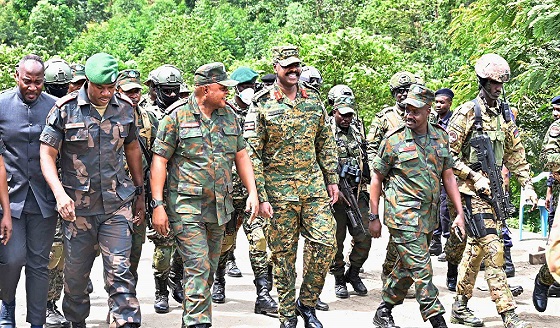
Gen Muhoozi Kainerugaba, the CDF recently met his DRC Counterpart, who hailed Operation Shujaa
HABARI DAILY I Kampala, Uganda I The Uganda People’s Defence Forces (UPDF) is set to withdraw from Lubero town in North Kivu province, eastern Democratic Republic of Congo (DRC), after nearly two years of military deployment, with the army expected to hand over security responsibilities to the Congolese armed forces.
The withdrawal, which is scheduled to begin within the next two weeks, marks a significant development in Uganda’s military involvement in eastern DRC, where its troops have been operating alongside the Armed Forces of the Democratic Republic of Congo (FARDC) in efforts to dismantle armed rebel groups, particularly the Allied Democratic Forces (ADF).
In a statement issued on November 27, 2026, UPDF acting director of defence public information, Col. Chris Magezi, confirmed that Ugandan troops would begin pulling out of Lubero and transfer security responsibilities to the Congolese army.

However, the UPDF did not provide a specific explanation for the decision, disclose the number of soldiers involved in the withdrawal or indicate when the handover would be completed.
The army only clarified that its deployment in the area had primarily been intended to pursue ADF fighters who had fled military pressure in other parts of eastern DRC.
“The UPDF has operated in the area since January 2025 to counter fleeing Allied Democratic Forces (ADF) remnants that sought to escape pressure of joint military operations in North Kivu and Ituri provinces of eastern DRC,” Magezi said.
The decision to withdraw from Lubero comes against the backdrop of changing military priorities in eastern Congo, where Uganda has been involved in a prolonged campaign against armed groups threatening security in the region.
One of the possible explanations for the pullout is an operational recalibration of Uganda’s military deployment, particularly its focus on Ituri Province, where the UPDF has maintained operations against ADF fighters.
Earlier this year, between March and April, the Chief of Defence Forces, Gen. Muhoozi Kainerugaba, had reportedly indicated initial withdrawal orders from Lubero as the Ugandan military reviewed its operational priorities.
The earlier signals pointed towards a possible redeployment of troops to other operational areas, particularly Ituri, where ADF remnants have continued to pose a security threat.
The planned withdrawal also follows reported friction between Ugandan military personnel and some local authorities, as well as changing rebel movements in the wider Lubero territory.
Although the UPDF has not directly linked these developments to its latest announcement, they form part of the broader security and operational environment surrounding the Ugandan military presence in the area.
The security situation in North Kivu has also remained volatile, with fresh fighting reported in different parts of the province.
Clashes involving Congolese government forces and M23 rebels have been reported south of Lubero town, while fighters belonging to the Front for the Refoundation of the Nation (FRN) have also been active near Lake Edward.
The continued fighting highlights the complexity of the security situation in eastern DRC, where several armed groups operate, often pursuing different political, territorial and economic interests.
Uganda’s decision to withdraw from Lubero therefore comes at a time when the wider region continues to experience instability, raising the importance of the FARDC’s capacity to assume responsibility for security in areas previously supported by Ugandan troops.
Operation Shujja remains operational
The planned withdrawal should not, however, be interpreted as an end to Uganda’s military involvement in eastern DRC.
The UPDF maintained that Operation Shujja, the joint military campaign conducted with the Congolese army against the ADF and other armed groups, remains ongoing.
Uganda and DR Congo launched the operation in November 2021, following an escalation of attacks by the ADF, which had established bases in eastern Congo after coming under military pressure in Uganda.
The operation was intended to dismantle the rebel group’s operational networks, destroy its bases and weaken its capacity to launch attacks against civilians in both countries.
The ADF emerged in Uganda during the 1990s before relocating much of its operations to eastern DRC, where it established bases in the vast forests of North Kivu and Ituri.
Over the years, the group has developed links with the Islamic State, with its fighters being associated with deadly attacks against civilian communities, including killings, abductions and the destruction of property.
The November 2021 offensive involved coordinated military operations by Ugandan and Congolese forces, including air and ground assaults targeting ADF positions.
Ugandan troops subsequently expanded their operational presence into several areas of eastern Congo as the rebels moved across the region to escape military pressure.
The deployment in Lubero in January 2025 was part of these efforts, particularly targeting ADF remnants fleeing joint military operations in North Kivu and Ituri.
Nearly two years later, the planned withdrawal signals a change in Uganda’s military presence in Lubero, with the Congolese army expected to assume the security responsibilities previously undertaken by the UPDF.
Nevertheless, the UPDF has not announced any corresponding withdrawal from other areas of eastern DRC where Ugandan soldiers remain deployed.
The extent of the redeployment, the number of troops expected to leave Lubero and whether they will be reassigned to other operational areas remain unclear.







About the Author