
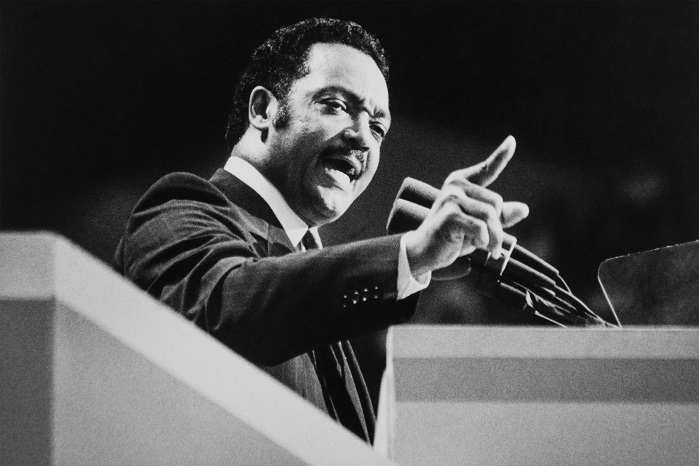
Jesse Louis Jackson
HABARI DAILY I Kampala, Uganda I The late Jesse Louis Jackson (October 8, 1941 – February 17, 2026), a towering figure in the global civil rights movement, is no more.
He fell to Progressive Supranuclear Palsy (PSP), a rare and debilitating neurological disorder that affects the brain and other critical parts of the body, causing incapacitation.
But his was a life well lived. Condolences are pouring in from all around the world. Jackson was an American civil rights activist, politician, and ordained Baptist minister. A protégé of Martin Luther King Jr. during the civil rights movement, he became one of the most prominent civil rights leaders of the late 20th and early 21st centuries.
Jesse Jackson (2nd R), in the evening of his life holding the hand of his wife (2nd L)
From 1991 to 1997, he served as a shadow delegate and shadow senator for the District of Columbia. He was the father of U.S. Representative Jonathan Jackson and former U.S. Representative Jesse Jackson Jr.
Political journey
Jesse Jackson, a key figure during the US civil rights movement of the 1960s, was known for being the first African-American to make the jump from activism to major-party presidential politics.
While other African Americans sought the US presidency, Jackson was the first to find significant success at the ballot box – which would pave the way for those who came after, including Barack Obama and Kamala Harris.
Over the course of his career, Jackson built a movement to bring America’s increasingly diverse population together, with a message that centred on poor and working-class Americans.
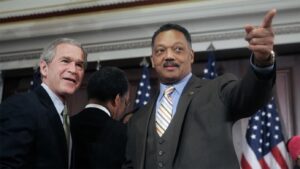
Jesse Jackson hangs out with American President George Bush
A gifted orator, Jackson articulated the frustrations of those who felt like second-class citizens in the world’s most prosperous democracy. His speech to the 1988 Democratic National Convention, which ended with the refrain “keep hope alive”, would be echoed decades later in the “hope and change” slogan of Obama’s successful 2008 presidential campaign.
After his historic run of presidential campaigns, Jackson went on to position himself as an elder statesman within the Democratic Party.
However, Jackson’s later years would be punctuated by scandal, including revelations of marital infidelity and financial impropriety involving his son and political heir, Jesse Jackson Jr, who served as a congressman from Illinois.
In 2017, the elder Jackson was diagnosed with Parkinson’s disease and largely withdrew from public life. That diagnosis was subsequently changed to one of progressive supranuclear palsy, a degenerative brain disease with similar symptoms.
Life of activism
Born in Greenville, South Carolina, Jackson began his activism in the 1960s and founded the organizations that later merged to form the Rainbow/PUSH Coalition.
Expanding his work into international affairs in the 1980s, he became a vocal critic of the Reagan administration and launched a presidential campaign in 1984.
Initially viewed as a fringe candidate, he finished third for the Democratic nomination behind former Vice President Walter Mondale and Senator Gary Hart. He continued his activism and mounted a second presidential bid in 1988, finishing as the runner‑up to Massachusetts Governor Michael Dukakis.
Jackson did not seek the presidency again, but in 1990 he was elected as the District of Columbia’s shadow senator, serving one term during the Bush and Clinton administrations.
Although initially critical of President Bill Clinton, he later became a supporter. Jackson hosted Both Sides with Jesse Jackson on CNN from 1992 to 2000.
A critic of police brutality, the Republican Party, and conservative policies, he was widely regarded as one of the most influential African‑American activists of his era.
Early life and education
Jackson was born in Greenville, South Carolina, 84 years ago to Helen Burns (1923–2015), an 18-year-old high school student, and her 33-year-old married neighbor, Noah Louis Robinson (1908–1997).
His ancestry includes Cherokee, enslaved African-Americans, Irish plantation owners, and a Confederate sheriff. Robinson, a former professional boxer, worked for a textile brokerage and was a well‑known figure in the Black community.
A year after Jesse’s birth, his mother married Charles Henry Jackson, a post-office maintenance worker who later adopted him. Jesse took his stepfather’s surname, though he also maintained a close relationship with Robinson as he grew up. He said that he considered both men his fathers.
He attended the racially segregated Sterling High School in Greenville, where he was elected student class president, finished tenth in his class, and earned letters in baseball, football, and basketball.
Upon graduating from high school in 1959, Jackson rejected a contract from a minor-league professional baseball team so that he could attend the University of Illinois on a football scholarship.
After his second semester at the predominantly white college, he transferred to North Carolina A&T, a historically black university in Greensboro, North Carolina.
Accounts of the reasons for the transfer differed, though Jackson said he changed schools because racial prejudice prevented him from playing quarterback and limited his participation on a competitive public‑speaking team.
Work with Martin Luther King Jr
Impressed by Jackson’s drive and organizational abilities, King soon began giving Jackson a role in the Southern Christian Leadership Conference (SCLC), though he was concerned about Jackson’s apparent ambition and attention-seeking. When Jackson returned from Selma, he was charged with establishing a frontline office for the SCLC in Chicago.
In 1966 King and Bevel selected Jackson to head the Chicago branch of the SCLC’s economic arm, Operation Breadbasket, and he was promoted to national director in 1967.
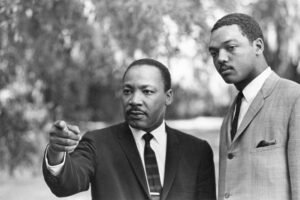
Jesse Jackson (L) with Martin Luther King Jr, shortly before the later was gunned down by an assassin
Jackson became involved in SCLC leadership disputes following King’s assassination on April 4, 1968. When King was shot, Jackson was in the parking lot one floor below.
Jackson told reporters he was the last person to speak to King, and that King died in his arms – an account that several King aides disputed. In the wake of King’s death, Jackson worked on SCLC’s Poor People’s Crusade in Washington, D.C., and was credited with managing its 15-acre tent city.
International activism
Jackson’s influence extended to international matters in the 1980s and 1990s. In 1983, he traveled to Syria to secure the release of a captured American pilot, Navy Lt. Robert Goodman, who was being held by the Syrian government.
Goodman had been shot down over Lebanon while on a mission to bomb Syrian positions in that country. After Jackson made a dramatic personal appeal to Syrian President Hafez al-Assad, Goodman was released.
The Reagan administration was initially skeptical about Jackson’s trip, but after Jackson secured Goodman’s release, Reagan welcomed Jackson and Goodman to the White House on January 4, 1984.
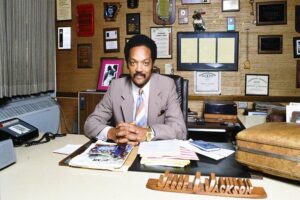
Rev Jesse Jackson in his study, deliberating on International politics
This helped to boost Jackson’s popularity as an American patriot and served as a springboard for his 1984 presidential run. In June 1984 Jackson negotiated the release of 22 Americans being held in Cuba after an invitation by Cuban president Fidel Castro.
On the eve of the 1991 Persian Gulf War, Jackson made a trip to Iraq to plead with Saddam Hussein for the release of foreign nationals held there as a “human shield”, securing the release of several British and 20 American individuals.
In 1997, Jackson traveled to Kenya to meet with Kenyan President Daniel arap Moi as United States President Bill Clinton’s special envoy for democracy to promote free and fair elections.
In April 1999, during the Kosovo War and NATO’s bombing of Yugoslavia, he traveled to Belgrade to negotiate the release of three U.S. POWs captured on the Macedonian border while patrolling with a UN peacekeeping unit.
Along with Serbian American congressman Rod Blagojevich, he met with then-Yugoslav president Slobodan Milošević, who later agreed to release the three men. Jackson’s negotiation was not sanctioned by the Clinton administration.
His international efforts continued into the 2000s. On February 15, 2003, Jackson spoke in front of over an estimated one million people in Hyde Park, London at the culmination of the anti-war demonstration against the imminent invasion of Iraq by the U.S. and the United Kingdom.
In November 2004 Jackson visited senior politicians and community activists in Northern Ireland in an effort to encourage better cross-community relations and rebuild the peace process and restore the governmental institutions of the Belfast Agreement.
In August 2005 Jackson traveled to Venezuela to meet Venezuelan President Hugo Chávez, following controversial remarks by televangelist Pat Robertson that implied that Chávez should be assassinated.
Jackson condemned Robertson’s remarks as immoral. After meeting with Chávez and addressing the Venezuelan Parliament, Jackson said there was no evidence that Venezuela posed a threat to the U.S. He also met representatives from the Venezuelan African and indigenous communities.
Fare thee well, Jesse Jackson.







About the Author