
dfcu Bank And Meta Plant And Equipment Launch Partnership To Scale Vehicle And Asset Financing For Farmers And Agribusinesses
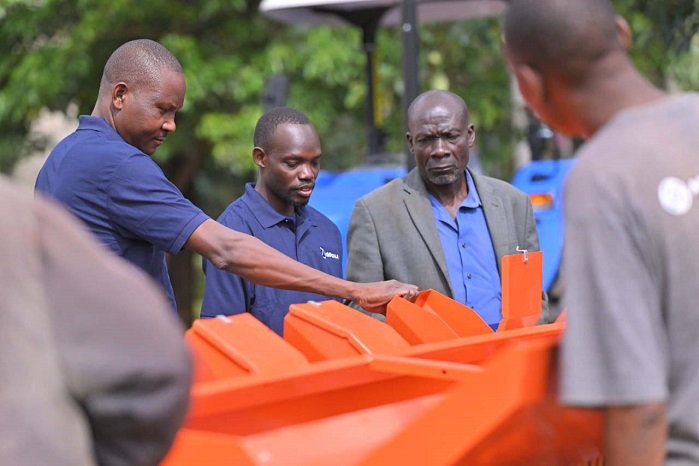
dfcu Bank and Meta Plant and Equipment Uganda Limited officials unveiling the partnership in Kampala recently
HABARI DAILY I Kampala, Uganda I Uganda’s push toward modernising agriculture has gained fresh momentum following a strategic partnership between dfcu Bank and Meta Plant & Equipment Uganda Limited.
The collaboration, announced on Thursday, March 19, 2026, is expected to expand access to vehicle and asset financing while accelerating agricultural mechanisation across the country.
The partnership brings together dfcu’s strong financing capabilities and Meta’s expertise as a supplier of agricultural and construction machinery. Meta, part of the wider Meta Group operating across East and Southern Africa, is the authorised dealer for globally recognised brands such as New Holland, Dezzi and Fieldking.
The company is known for providing high-performance equipment backed by reliable aftersales service, technical support and spare parts availability.
The initiative was officially launched at Kakira Sugar Factory, a key agro-industrial hub that underscores the importance of agriculture to Uganda’s economy. Operated by the Madhvani Group, Kakira Sugar Limited is the country’s largest sugar producer, with a crushing capacity of about 7,500 tonnes of cane per day.
The factory supports thousands of outgrowers and sustains livelihoods across the Busoga sub-region, making it an ideal location to anchor such a transformative partnership.
By launching the initiative at Kakira, the partners positioned themselves directly within an active agricultural value chain. The Busoga sub-region alone has over 13,000 sugarcane outgrowers supplying various factories, presenting a high-impact opportunity to scale mechanisation, boost productivity and strengthen supply chains.
Through this collaboration, farmers and agribusiness operators will be able to access both equipment and financing at the point of need. dfcu’s Vehicle and Asset Finance solution offers up to 90 percent financing for assets such as tractors, harvesters, irrigation systems, commercial vehicles and industrial machinery.
The financing model is designed with flexible repayment structures aligned to seasonal incomes, making it accessible to both smallholder farmers and large enterprises.
Annette Kiconco, Chief Retail Banking Officer at dfcu Bank, emphasised the significance of the partnership, noting that agriculture employs over 70 percent of Uganda’s population and contributes about a quarter of the country’s GDP. However, she pointed out that mechanisation levels remain low, limiting productivity and growth.
Her remarks were echoed by Gloria Ssuuna Namutebi, Senior Manager for Vehicle and Asset Finance at dfcu, who highlighted that reducing the upfront cost burden—requiring customers to contribute only 10 percent—will enable more farmers and SMEs to invest in modern equipment without straining their cash flow.
On the supply side, Meta reaffirmed its commitment to delivering reliable machinery tailored to Uganda’s agricultural needs. The company noted that access to quality equipment, combined with strong aftersales support, will ensure long-term value and consistent performance for farmers.
Farmers have welcomed the initiative, with Busoga Outgrowers Association Chairperson Mombwe David Christopher describing it as timely. He noted that improved access to tractors and modern equipment will enhance planting efficiency, increase yields and stabilise supply to sugar factories.
Uganda’s mechanisation levels remain below recommended standards, with fewer than 1.5 tractors per 1,000 hectares of arable land. This has led to continued reliance on manual labour and post-harvest losses of up to 30 percent in some value chains.
By integrating financing with access to high-quality machinery, dfcu Bank and Meta are addressing a critical gap in Uganda’s agricultural sector. The partnership is expected to drive efficiency, improve yields and support the country’s transition toward commercialised and sustainable agriculture, while strengthening its participation in regional markets.
About the Author