
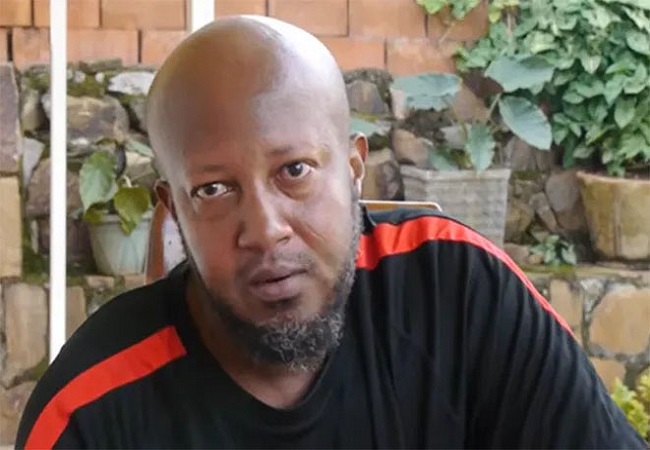
Aimable Karasira
HABARI DAILY I Kampala, Uganda I The death of Rwandan singer and government critic Aimable Karasira shortly before his release from prison has sparked fresh suspicion among activists and opposition voices, with some alleging possible involvement by the Rwandan government in circumstances surrounding his death.
Karasira, 48, died in Kigali on Wednesday while being released from prison, according to the Rwanda Correctional Service.
In a statement, prison authorities said the singer died at Nyarugenge Hospital after allegedly overdosing on prescription medication.
RCS spokesperson Hillary Sengabo later told local broadcaster TV One that Karasira had been battling diabetes, high blood pressure and mental health complications.
False dose of medication
According to Sengabo, Karasira was being escorted out of prison between 2pm and 3pm when he allegedly took another dose of medication.
“He took another dose of his medication,” Sengabo reportedly said, adding that prison officers attempted to intervene but “it was too late.”
Authorities said a post-mortem examination would be conducted to establish the exact cause of death.
However, critics of the Rwandan government have questioned the official explanation, arguing that the timing of Karasira’s death — just as he was about to regain freedom — raises serious concerns.
Denise Zaneza, a prominent Rwandan human rights activist living in Belgium, called for an independent international investigation into the incident.
“After years of persecution and imprisonment, the authorities announce your death just as you were supposed to regain your freedom,” Zaneza wrote on X.
History of repression
She said the circumstances surrounding Karasira’s death fit into what she described as “Rwanda’s long history of repression, lack of transparency, suspicious deaths in detention, and the mistreatment of critics and dissidents.”
Karasira had become one of Rwanda’s most outspoken government critics through his YouTube channel, “Ukuri Mbona” — translated as “The Truth As I See It” — where he openly criticized the ruling Rwandan Patriotic Front and President Paul Kagame.
He was arrested in 2021 and later sentenced in 2025 to five years in prison for inciting division.
Although prosecutors had also charged him with genocide denial, justifying genocide and inciting public disorder, Rwanda’s High Court acquitted him on those counts last year.
Karasira’s supporters argue that his prosecution was politically motivated and linked to his outspoken criticism of the government.
The singer, who was also a former lecturer in computer science at the University of Rwanda, had repeatedly challenged the official narrative surrounding the 1994 genocide.
Like many Rwandans, Karasira lost family members during the genocide in which an estimated 800,000 people, mainly ethnic Tutsis and moderate Hutus, were killed in 100 days.
RPF rebels suspects
However, Karasira controversially accused fighters from the RPF rebel movement of killing members of his family during the conflict, alleging they suspected them of collaborating with government forces.
His comments touched one of Rwanda’s most politically sensitive subjects and drew strong criticism from government supporters.
In her tribute, Zaneza said Karasira showed courage by speaking openly about his family’s suffering.
“You spoke openly about the killing of members of your family by RPF soldiers in 1994; a story that many in Rwanda feel is not allowed to be told because it challenges the official narrative promoted by Paul Kagame’s government,” she wrote.
“For speaking out, you were imprisoned. For sharing your truth, you were silenced,” she added.
The controversy surrounding Karasira’s death has revived memories of another high-profile case involving gospel singer Kizito Mihigo, who died in police custody in 2020 under circumstances authorities described as suicide.
Human rights bodies up in arms
Like Karasira, Mihigo was also a genocide survivor and had publicly criticized the government.
Human rights organizations have long accused the Rwandan government of suppressing dissent, allegations Kigali consistently denies.
In 2021, Human Rights Watch urged Rwandan authorities to investigate what it called “suspicious deaths and disappearances of critics, opposition members, civil society actors, and journalists.”
The Rwandan government has repeatedly defended its record, insisting that national unity and reconciliation policies are necessary to prevent a return to ethnic divisions that fueled the genocide.
Authorities discourage public discussions centered on ethnic identity, preferring citizens to identify simply as Rwandans.
Nevertheless, opposition figures and activists argue that critics of the state continue to face intimidation, arrest and unexplained deaths.
Karasira’s death is now likely to intensify scrutiny of Rwanda’s human rights record, especially among international observers already concerned about shrinking political space in the country.
As calls grow for an independent investigation, questions continue to linger over how one of Rwanda’s most controversial government critics died only moments before walking free.