

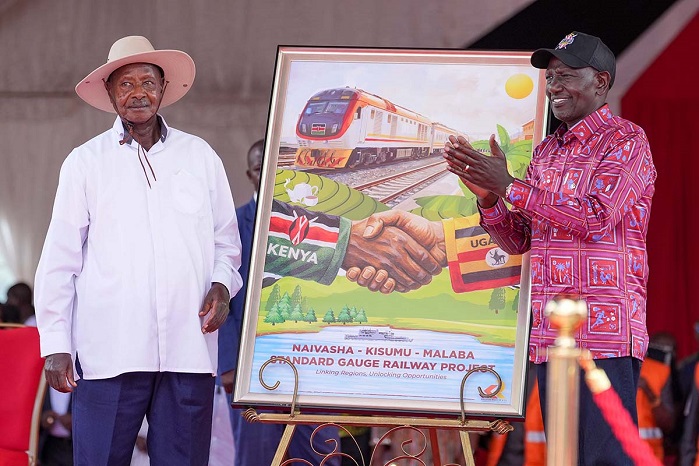
He congratulated President Ruto and the people of Kenya upon what he described as a major milestone in regional infrastructure development. He underscored that the railway is part of a broader strategy to rationalise transport systems across the region, especially in Uganda, where over-reliance on road transport has long driven up costs and inefficiencies.
“The railway is part of the rationalisation of our transport system,” Museveni said, noting that Uganda’s current model—where passengers, light cargo, heavy cargo, and petroleum products all depend on roads—is both unsustainable and costly.
He outlined a long-term vision in which heavy cargo is shifted to rail, petroleum products to pipelines and water transport, and roads reserved primarily for passengers and light goods.
The Eldoret–Malaba SGR line is central to this vision. As the final Kenyan stretch before the Ugandan border, it will serve as a gateway for goods entering Uganda and the wider Great Lakes region. By linking directly to future railway expansions into Kampala, the line is expected to drastically cut transport time and cost, boosting Uganda’s competitiveness in both regional and international markets.
President Museveni also highlighted broader structural challenges affecting Africa’s economic growth, including high transport costs, expensive electricity, and costly financing. He warned that unless these “cost pushers” are addressed, African goods will struggle to compete globally. The SGR, particularly the Eldoret–Malaba segment, directly tackles one of these challenges by offering a faster, more efficient logistics corridor.
President Ruto, on his part, praised Museveni’s long-standing commitment to regional integration and emphasized the wider economic impact of the railway. “The SGR extension will unlock economic potential not only for Kenya but for the entire East African region, including Rwanda, Burundi, South Sudan, and the Democratic Republic of Congo,” he said.
Ruto revealed that cargo volumes through the Port of Mombasa reached 7.37 million tonnes in just six months of 2025, with nearly 70 percent destined for Uganda. However, inefficiencies along the Northern Corridor mean cargo can take up to 80 hours to reach Malaba and over 100 hours to arrive in Kampala. Such delays, he noted, undermine business competitiveness.
“A slow transport corridor inevitably loses business,” Ruto said, stressing the urgency of modernising logistics infrastructure.
Transit times reduce
The Eldoret–Malaba SGR line is expected to dramatically reduce these transit times, lower freight costs, and improve reliability. This will not only enhance trade efficiency but also stimulate key sectors such as agriculture and fisheries, particularly around the Lake Victoria basin.
Moreover, the railway forms part of a larger integrated network connecting Mombasa, Nairobi, Naivasha, Kisumu, Malaba, and eventually Kampala. This interconnected system is poised to become a backbone of regional commerce, facilitating seamless movement of goods from the Indian Ocean coast deep into the African hinterland.
Leaders from both countries expressed optimism that the project will accelerate regional integration, strengthen economic cooperation, and significantly boost bilateral trade volumes. The launch ceremony was also attended by Rebecca Alitwala Kadaga and Katumba Wamala, among other officials.
As construction begins, the Eldoret–Malaba SGR line stands out as a game-changer—one that could redefine trade dynamics, lower the cost of doing business, and bring East Africa closer to its long-envisioned economic integration.
Major trade partner
Uganda’s has in recent years become a major trade partner to Kenya, replacing many Western powers who previously occupied that position. Uganda’s top exports to Kenya in 2024 included tea ($38 million), milk ($37.7 million), and unglazed ceramics ($32.4 million).
On the other hand, Kenya’s primary exports to Uganda in 2024 were cement ($105 million), coated flat-rolled iron ($64 million), and refined petroleum ($60.9 million).
A January 2026 report (covering the 12 months ending November 2025) indicates Uganda’s exports to Kenya were $592.9 million, making Kenya the second-largest export market for Uganda after the DRC.