
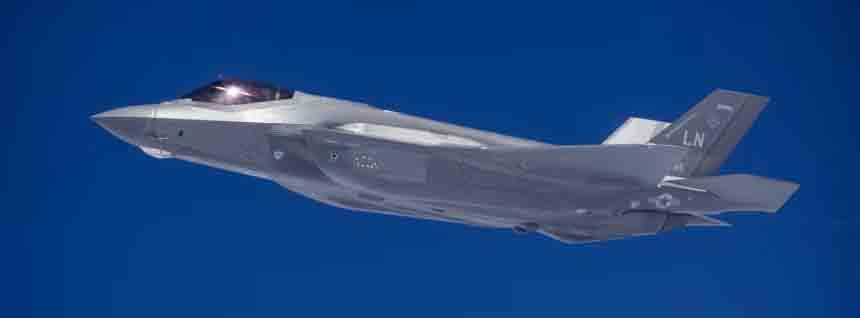
A US F-35 stealth-focused airplane in operation
HABARI DAILY I Kampala, Uganda I The United States military’s loss of four aircraft in the ongoing war with Iran—and a fifth forced into an emergency landing—has raised critical questions about operational risks, coordination failures, and the evolving nature of modern warfare.
The latest incident involved a F-35 Lightning II, one of the world’s most advanced and expensive fighter aircraft, valued at over $100 million. According to United States Central Command spokesperson Capt.
Tim Hawkins, the jet was struck by suspected Iranian fire while flying a combat mission over Iran. The aircraft managed to land safely at a US base in the Middle East, and the pilot remains in stable condition. Investigations into the incident are ongoing.
Military analysts point to several factors behind the aircraft losses so far. Chief among them is the increasing sophistication of Iranian air defense systems. Although US officials, including Defense Secretary Pete Hegseth, insist that Iran’s defenses have been “flattened,” the apparent ability to strike or at least challenge a stealth platform suggests residual capability and adaptability on the battlefield.
Three F-15 Eagle jets shot down
Another major factor is friendly fire and coordination breakdowns among allied forces. Three F-15 Eagle jets were mistakenly shot down by Kuwaiti air defenses in a significant identification failure. While all six crew members ejected safely, the incident highlights the dangers of operating in a congested and fast-moving combat environment involving multiple international actors.
Mechanical failure and operational strain also appear to be contributing factors. A KC-135 Stratotanker crashed in western Iraq under unclear circumstances, killing all six crew members on board. The US military has ruled out both hostile and friendly fire, pointing instead to possible technical or environmental causes.
The intensity and pace of the conflict, now entering itsforth week, may also be stretching US resources and personnel. Extended sorties, high operational tempo, and long-distance deployments increase the likelihood of accidents and system fatigue.
Meanwhile, reinforcements continue to arrive, including the 31st Marine Expeditionary Unit and the USS Tripoli, signaling a potential escalation.
Despite official claims of decisive progress, the aircraft losses underscore the complex and unpredictable nature of the war, where technological superiority does not always guarantee immunity from risk.
USAF active inventory as of 2025
The United States Air Force (USAF) continues to operate one of the world’s most advanced and diverse aerial fleets, with its active inventory in late 2024/2025 reflecting a careful balance between legacy strength and next-generation modernization.
At the core of its air power are thousands of fighter jets, led by the rapidly expanding F-35A Lightning II fleet, now numbering over 440 aircraft across active duty and Air National Guard units. The fifth-generation stealth jet is increasingly becoming the backbone of US air superiority strategy.
Alongside it, the reliable F-16 Fighting Falcon remains widely deployed with more than 650 units, while the combat-proven F-15 Eagle and its variants—including the newer F-15EX Eagle II—continue to play a critical role.
Stealth-focused F-22 Raptor is game changer
The stealth-focused F-22 Raptor, with around 185 units, remains a cornerstone of high-end air dominance, while the rugged A-10 Thunderbolt II continues to provide close air support.
In the strategic bombing category, the USAF fields a powerful trio: the long-serving B-52 Stratofortress, the supersonic B-1B Lancer, and the stealthy B-2 Spirit. The next-generation B-21 Raider is now entering production, signaling the future of long-range strike capability.
Support aircraft remain equally vital. The KC-135 Stratotanker and KC-46 Pegasus sustain global operations, while heavy lifters like the C-17 Globemaster III and the enduring C-130 Hercules ensure rapid deployment and logistics.
The USAF also fields advanced unmanned and reconnaissance systems, including the MQ-9 Reaper and the high-altitude U-2 Dragon Lady.
Key trends show a clear shift toward modernization, with older aircraft gradually being retired in favor of stealth platforms like the F-35 and advanced systems such as the F-15EX, capable of carrying up to 12 AMRAAM missiles. Despite this evolution, legacy aircraft like the F-15—boasting an unmatched combat record of 104 victories and zero losses—remain integral to the force.
As global threats evolve, the USAF’s mix of innovation and experience ensures it remains a dominant force in modern air warfare.







About the Author