
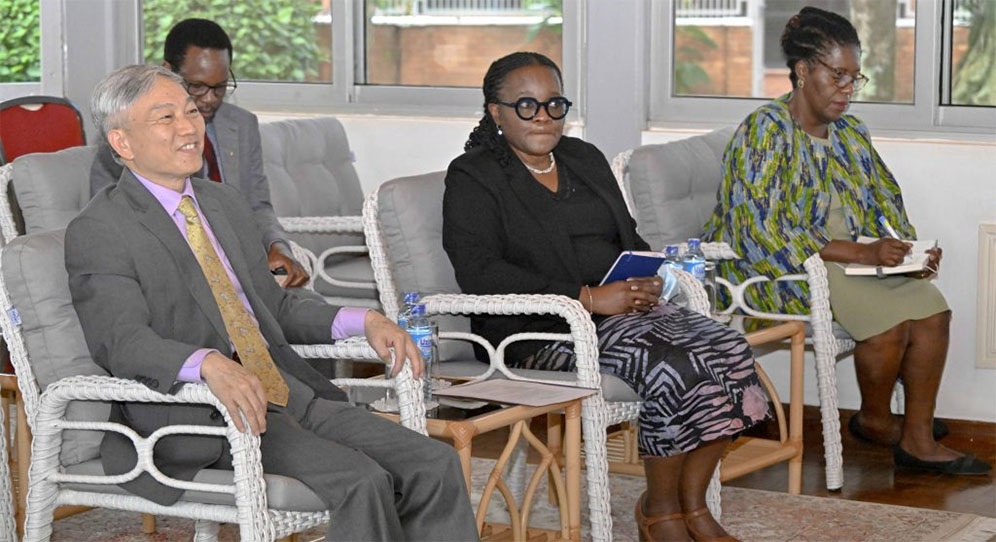
Qimiao Fan (L), with his delegation which included Francisca Ayodeji Akala and Tonderai Fadzai Mukonoweshuro at State House Nakasero
HABARI DAILY I Kampala, Uganda I The World Bank is to resume full fledged funding to Uganda by investing in railway production, commercial agriculture and agro processing, in a move expected to accelerate the country’s economic transformation and lower the cost of doing business.
This renewed commitment was revealed during a high-level meeting between Yoweri Museveni and a delegation from the World Bank led by Qimiao Fan, the Division Director for Kenya, Rwanda, Somalia, and Uganda, who was accompanied by the World Bank Country Manager for Uganda, Francisca Ayodeji Akala and Tonderai Fadzai Mukonoweshuro, the Senior Operations Officer World Bank in Zimbabwe.
Held at State Lodge Nakasero, the meeting was also attended by key government officials including Matia Kasaija, the Finance minister and Attorney General, Kiryowa Kiwanuka, among others.
Qimiao Fan reaffirmed the global lender’s readiness to support Uganda’s priority sectors, particularly infrastructure, energy and agriculture. “I’m happy to say that I have the documents and the World Bank seriously pledges to support you financially,” he said, signalling a strong vote of confidence in Uganda’s economic direction.
He commended Uganda for maintaining macroeconomic stability and pursuing growth-oriented policies, noting that such efforts have created a conducive environment for renewed investment. The World Bank, he added, will prioritise strategic projects such as the Standard Gauge Railway (SGR), which is seen as a cornerstone for regional trade and industrialisation.
President Museveni welcomed the development, emphasising the central role of the railway in reducing transportation costs and improving efficiency in the movement of goods. “These are the funds I want. I want funds for capacity building and to give the basics for production at lower costs,” he said.
The President explained that the SGR would be dedicated primarily to heavy cargo, complementing other modes of transport. “That’s why we are saying the railway should be for heavy cargo, the pipeline for petroleum products. The railway and water transport for cargo whereas roads will remain for passengers and light cargo,” he added.
Beyond transport infrastructure, the World Bank also pledged to support Uganda’s energy sector, recognising affordable electricity as a key enabler of industrial growth. Investments in energy are expected to boost manufacturing, agro-processing and other value-adding industries that depend on reliable power supply.
Agriculture, which remains the backbone of Uganda’s economy, is another major beneficiary of the renewed partnership. Qimiao highlighted plans to support agribusiness through targeted training programmes aimed at enhancing skills and promoting value addition. This approach is expected to shift farmers from subsistence production to more commercial, market-oriented practices.
President Museveni expressed satisfaction with this focus, noting that Uganda’s agricultural sector has long suffered from limited value addition. “I’m also happy with the proposal to support agricultural industrialisation and agro-processing,” he said.
He pointed out that traditional education systems have largely emphasised raw material production without equipping graduates with skills in processing and value addition. “The system here even in university was to train people even those doing Bachelor of Science in Agriculture and their job was to produce the raw materials but no value addition was taught,” he observed.
The renewed World Bank funding is therefore expected to address these gaps by promoting agro-industrialisation, creating jobs and expanding Uganda’s export base. By linking production with processing and markets, the initiative aims to increase incomes for farmers while strengthening the country’s trade competitiveness.
President Museveni also underscored the importance of affordable financing and efficient transport systems in driving economic growth, reiterating that Uganda’s development strategy hinges on lowering production costs across key sectors.
He commended the World Bank for its continued partnership and its commitment to fostering inclusive development. The latest pledge signals a deepening of cooperation between Uganda and the global lender, with a clear focus on infrastructure, energy and agriculture as pillars of long-term prosperity.