

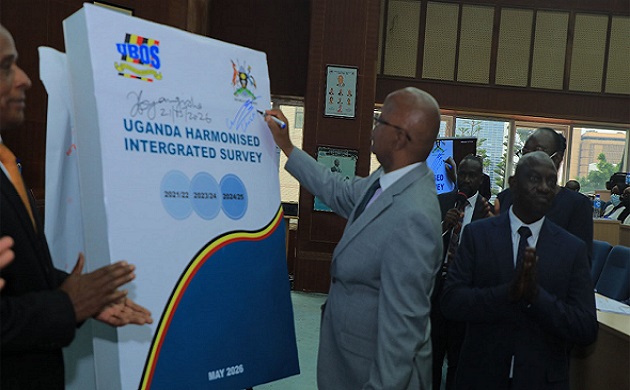
Dr Chris Mukiza, the UBOS Executive Director signs on the report as other officials look on as the report was unveiled today, May 21st 2026 in Kampala
HABARI DAILY I Kampala, Uganda I Despite the Uganda Government’s many initiatives aimed at job creation, the number of unemployed citizens continue to rise year after year, raising fresh concerns about the country’s ability to absorb the growing youthful population into productive employment.
The Uganda Government has invested over Shs 9 trillion on wealth and job creation initiatives over the last decade, with Shs 3.3 trillion spent on the Parish Development Model (PDM) alone by the end of the 2024/25 financial year.
The latest findings released by the Uganda Bureau of Statistics show that unemployment in Uganda increased from 10.2 percent in 2021/22 to 11 percent in 2024/25, despite improvements in education, literacy, financial inclusion and expansion of household enterprises.
The statistics are contained in the Uganda Harmonised Integrated Survey (UHIS) 2021/22, 2023/24 and 2024/25, unveiled in Kampala by Dr Chris Mukiza, the UBOS Executive Director, at their headquarters in Kampala today.
“The unemployment rate slightly increased by less than one percent, from 10.2 percent in 2021/2022 to 11 percent in 2024/2025,” Dr Mukiza said while presenting the labour force findings.
The report paints a mixed picture of Uganda’s labour market. While some sectors registered growth in employment opportunities, thousands of Ugandans, especially young people entering the labour market every year, are still struggling to secure stable jobs.
Dr Mukiza explained that the Uganda Harmonised Integrated Survey was designed to monitor changes in socio-economic indicators and provide evidence for planning and policy making.
Social planning tool
“The survey provides data and statistics on socio-economic and agriculture indicators required for planning, policy making and informing national, regional and international development frameworks,” he said.
According to the findings, the proportion of Ugandans aged 15 years and above engaged in non-farm wage employment increased from 14.9 percent in 2021/22 to 19.7 percent in 2024/25. Non-farm self-employment also increased from 22.6 percent to 24.3 percent over the same period.
However, the gains were not enough to offset the growing pressure from new entrants into the labour market.
The report further shows that the proportion of people classified as “not employed” increased from 7 percent in 2021/22 to 8.1 percent in 2024/25.
Dr Mukiza noted that Uganda’s labour market is undergoing a gradual structural transformation, with more citizens shifting away from subsistence agriculture into the services sector and urban-based economic activities.
Employment in Agriculture falls
“Nationally, employment of persons in the Agriculture, Forestry and Fishing sector has declined by 8.3 percentage between 2021/22 and 2024/25,” he said.
According to UBOS, employment in agriculture fell from 61.6 percent in 2021/22 to 53.3 percent in 2024/25, while employment in the services sector rose from 29.5 percent to 36.5 percent.
The findings also show that service and sales jobs increased significantly from 26 percent in 2021/22 to 31.5 percent in 2024/25, reflecting growing urbanisation and expansion of informal businesses.
Even with these changes, youth unemployment remains a major concern as thousands of graduates and school leavers continue to compete for limited formal jobs.
Dr Mukiza said the survey was intended to help government and development partners understand such changing labour dynamics and formulate better interventions.
“To produce inter-survey changes in demographic and socioeconomic indicators notably household headship, education, labour, financial services, poverty among others,” he said while explaining the objectives of the survey.
5.5% transitioned into unemployment
The report indicates that 21.8 percent of Ugandans transitioned into employment by 2024/25, while 5.5 percent transitioned into unemployment during the same period. Another 21.3 percent moved out of the labour force altogether.
Among males, 6.5 percent transitioned into unemployment compared to 4.7 percent for females.
Dr Mukiza said the survey generated longitudinal data that would help government monitor welfare changes and evaluate programmes aimed at improving livelihoods.
“To provide information on welfare dynamics at household level and to generate longitudinal data to support policy analysis, monitoring and evaluation of projects, investments and programmes,” he explained.
The survey also highlighted the paradox facing Uganda’s economy. While education indicators have improved significantly, employment opportunities are not growing at the same pace.
According to UBOS, school attendance among children aged 6-12 years increased from 85.5 percent in 2021/22 to 94.6 percent in 2024/25. Literacy rates among persons aged 10 years and above also rose sharply from 73.6 percent to 85.3 percent.
At the same time, access to mobile money services increased from 34.4 percent to 47.7 percent nationally, while households operating enterprises rose from 36.9 percent to 38.8 percent.
Dr Mukiza said the survey integrated the Uganda National Panel Survey and the Annual Agricultural Survey in order to improve efficiency and reduce duplication in data collection.
“Integration entails shared samples, shared questionnaires and similar field work protocols thereby improving technical efficiency, avoiding duplication, aligning methodologies, improving coverage, achieving estimate precision and timely outputs,” he said.
The survey covered 5,640 households drawn from 470 enumeration areas across Uganda using a two-stage stratified sampling method.
Youth bulge
Despite the government’s continued investment in programmes such as the Parish Development Model, Emyooga and youth livelihood initiatives, the latest UBOS findings suggest that unemployment remains one of Uganda’s biggest socio-economic challenges, particularly among the youth population that continues to grow rapidly every year.
According to the UBOS 2025 Labour Market Survey, Uganda’s official unemployment rate stands at 12.2%. This translates to roughly 700,000 to 800,000 actively unemployed working-age individuals. However, job distress and underutilization—which include those underemployed in subsistence agriculture or informal trade—affect about 7.7 million Ugandans (41.6% of the workforce).