

Dr. Richard Wemesa Builds Multi-Dimensional Agribusiness Enterprise With dfcu Bank Support
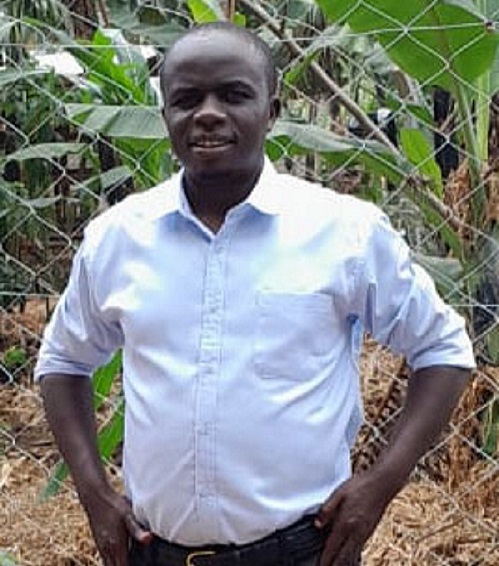
Dr. Richard Wemesa
HABARI DAILY I Kampala, Uganda I Uganda’s agriculture sector is undergoing a gradual but significant transformation, with financial institutions such as dfcu Bank increasingly playing a pivotal role in supporting farmers to transition from subsistence to commercial production.
At the centre of this shift are farmers like Richard Wemesa, whose journey reflects the evolving face of agriculture in Uganda—one driven by structure, financing, and market-oriented thinking.
Dr. Wemesa’s story begins in Sironko District, where he grew up in a family that depended heavily on farming. Despite his parents being teachers, agriculture—particularly coffee—was central to the household’s livelihood.
“I grew up in Sironko District in a household where farming was part of my daily life. My parents were teachers, but like many families, they relied on agriculture, especially coffee, to meet basic needs, including school fees,” he said.
He added that farming at the time was not structured or mechanised. “It was labour-intensive and routine. He recalls waking up as early as 3:00AM, walking for up to two hours through the hills, and starting work in the fields by 5:00AM. ‘Coffee paid our school fees,” he says.”
That early exposure to agriculture would later shape his long-term ambitions, even as his education took him on a different path. Dr. Wemesa earned a government scholarship to Makerere University, eventually completing a PhD in Economics and Planning. He went on to build a career in Uganda’s financial sector, spending more than a decade in banking.
Former dfcu Bank worker
While working at dfcu Bank headquarters in Nakasero as a Sales, Credit Analysis and Evaluation Manager, he gained deep insight into how businesses are structured, financed, and sustained.
After ten years in banking, he made a deliberate return to agriculture—not as a fallback, but as a strategic investment.
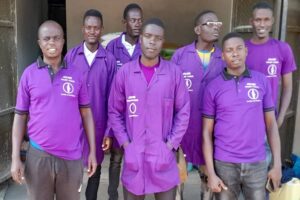
Some of Dr. Wemesa’s workers at the farm
Agriculture employs more than 70 percent of Uganda’s population, yet much of it remains subsistence-based, characterised by low input, low output, and vulnerability to weather and price shocks. Limited access to financing and underdeveloped value chains have historically constrained growth.
However, change is taking root. Increasingly, farmers are embracing commercial agriculture, investing in scale, systems, and market linkages.
With financial backing from dfcu Bank, including an overdraft facility of Shs 90 million, Dr. Wemesa began building a structured agribusiness designed for sustainability and growth.
“Without dfcu, this wouldn’t have been possible,” he says.
Integrated operation
Today, his farm has evolved into a fully integrated operation. He cultivates over 50 acres of maize and runs milling operations producing more than 20 tonnes per day. In addition, he manages poultry, piggery, dairy, and fish farming enterprises, all interconnected to maximise efficiency and minimise waste.
The integration allows outputs from one unit to support another, creating multiple revenue streams and strengthening resilience against market fluctuations.
Equally important has been securing reliable markets. Dr. Wemesa currently supplies food to St Julian High School in Gayaza, ensuring consistent demand and predictable income.
His success has not gone unnoticed. In 2025, he was recognised among the winners of the Best Farmers Awards, an initiative organised by Vision Group in partnership with dfcu Bank, the Embassy of the Kingdom of the Netherlands, KLM Royal Dutch Airlines, and Koudijs Animal Nutrition.
Since its inception in 2014, the awards have recognised over 130 farmers, promoting best practices in productivity, sustainability, and agribusiness management. Winners also gain exposure to international farming standards through study visits to the Netherlands.
The winning ticket
Dr. Wemesa’s selection followed a rigorous evaluation process, with judges highlighting not just the scale of his operations but also his strong record-keeping, adoption of modern farming techniques, and commitment to sustainability.
His farm now employs more than 60 people, providing stable livelihoods in a rural setting where formal employment opportunities are scarce. It has also become a learning hub for other farmers seeking to transition into commercial agriculture.
His journey reflects a broader trend in Uganda’s agriculture sector, where access to finance, improved systems, and stronger market linkages are beginning to converge.
Through targeted financing, sector-specific solutions, and partnerships such as the Best Farmers Awards, dfcu Bank is positioning itself as a key enabler in this transformation—supporting farmers who are not only feeding the nation but also building sustainable, scalable businesses that contribute to economic growth.
About the Author