
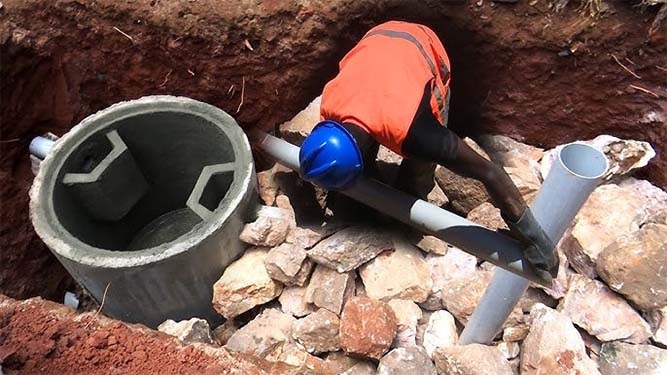
A builder installing a bio-digester toilet
HABARI DAILY I Kampala, Uganda I Researchers have warned that defects in bio digester toilets could result in system failures, including the inability to handle organic waste loads, raising fresh concerns about the safety and effectiveness of the increasingly popular sanitation technology in Uganda.
A study conducted by the department of civil and environmental engineering at Makerere University has revealed that poorly installed biodigester systems and improper handling of untreated waste could lead to groundwater contamination, foul smells and environmental pollution.
The findings were presented on Wednesday during a stakeholder engagement meeting at Hotel Africana by Dr Swaib Semiyaga, a registered civil engineer and lecturer in the department of civil and environmental engineering.
The research was commissioned by the National Building Review Board (NBRB) following growing public complaints about the performance and safety of biodigester toilets that have rapidly spread across urban areas as an alternative sanitation solution.
“This technology uses a culvert similar to those used in road construction. Many Ugandans are now building toilets using this system,” Semiyaga said.
He explained that the system involves placing a pre-cast concrete culvert inside a pit and surrounding it with stones to create a soak pit through which wastewater disperses into the soil.
“When the toilet is flushed, wastewater goes into the culvert. The water then flows into the stones around it,” he noted.
No scientific evidence
However, the researchers warned that many of the claims made by promoters and installers of biodigester systems are not backed by scientific evidence.
“We have been having challenges in this country where people promoting this technology use very smooth marketing messages. They claim it never fills up, does not smell and produces clean water, but most of what they are saying has no proof,” Semiyaga said.
According to the study, one of the major defects identified in biodigester systems is their limited capacity to manage large amounts of waste over time. Researchers found that contrary to popular belief, biodigesters eventually fill up and require regular emptying.
“What we found is that it is not true that this technology does not fill up. There is already evidence from apartments and other places where users are emptying them frequently. It is a small culvert, and the stones around it cannot absorb water forever, so it easily gets full,” Semiyaga said.
The study further established that structural weaknesses in poorly designed systems can lead to leakage of untreated wastewater into surrounding soil and groundwater sources.
Laboratory tests carried out by the research team showed treatment efficiency of less than 20 percent in removing contaminants from wastewater.
Can contaminate groundwater
“This means what goes in is almost what comes out. If used in areas with groundwater, it can easily contaminate it,” Semiyaga warned.
Researchers also tested various additives, including enzymes, bacteria and chemicals marketed as improving decomposition of waste inside biodigesters. However, the findings showed little evidence that the products significantly improved performance.
“Promoters claim these bacteria and enzymes eat up faecal matter. We tested different additives on the market and did not find significant changes, showing that the enzymes can effectively break down the material,” Semiyaga said.
Some users interviewed during field visits also reported persistent foul smells and overflowing systems, especially in densely populated buildings and institutions.
Semiyaga cautioned that the effectiveness of biodigesters largely depends on the quality of the soak pit and surrounding soil conditions.
“If the soak pit cannot absorb water, the technology may not be effective. What ends up in the environment is untreated wastewater,” he explained.
The researchers recommended that biodigesters should mainly be used in dry areas with suitable soil and should not be installed in institutions with heavy user loads such as schools, hospitals and apartment blocks.
Numerous complaints
NBRB communications manager and spokesperson Herbert Zziwa said the board commissioned the study after receiving numerous complaints from the public.
“This study is a result of concerns we got from the public about the compliance and safety of biodigesters. As the board regulating building, we commissioned Makerere to extensively investigate the technology,” Zziwa said.
He added that the findings and stakeholder feedback would guide future policy decisions on regulation and construction standards.
Semiyaga also warned that the rising popularity of biodigesters has attracted unqualified installers, resulting in substandard construction and poor-quality concrete structures.
He stressed that properly designed septic tanks remain the most reliable waste management option, calling for stricter regulation and technical oversight in the sanitation sector.