
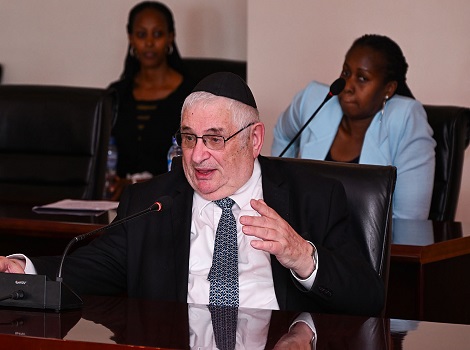
Gilbert Weill, one of the former Entebbe hostages of the 1976 Israel rescue mission during his meeting with President Museveni at State House Entebbe on Tuesday, 23 June 2026
HABARI DAILY I Kampala, Uganda I After touring the old airport terminal at Entebbe International Airport, where Weill and other hostages had been held during the hijacking, he was overcome with emotion. Weill expressed gratitude to President Museveni for the special invitation, describing the return to Uganda after nearly five decades as emotional and deeply significant.
“It is very exciting to come back after such a long time,” he said.
The delegation comprised Israeli and Belgian former hostages, reflecting renewed people-to-people ties and growing friendship between Uganda, Israel and Belgium.
For Gilbert Weill, a survivor of the dramatic 1976 Entebbe Airport hijacking, returning to Uganda nearly 50 years after one of the most traumatic experiences of his life was both a journey through history and a moment of healing.
Now 78 years old, Weill was hosted by President Yoweri Museveni at State House, Entebbe, during a special visit that brought together former hostages, family members and friends to commemorate an event that remains one of the most remarkable episodes in international aviation history.
The visit included a tour of the old airport terminal at Entebbe International Airport, where hijacked passengers were held captive during the week-long ordeal that gripped the world in June and July 1976. Standing once again in the same building where uncertainty and fear had once dominated his thoughts, Weill reflected on the passage of time and the profound changes that have taken place since then.
His return was not only a personal milestone but also a gesture of reconciliation and friendship between nations connected by the events of nearly half a century ago.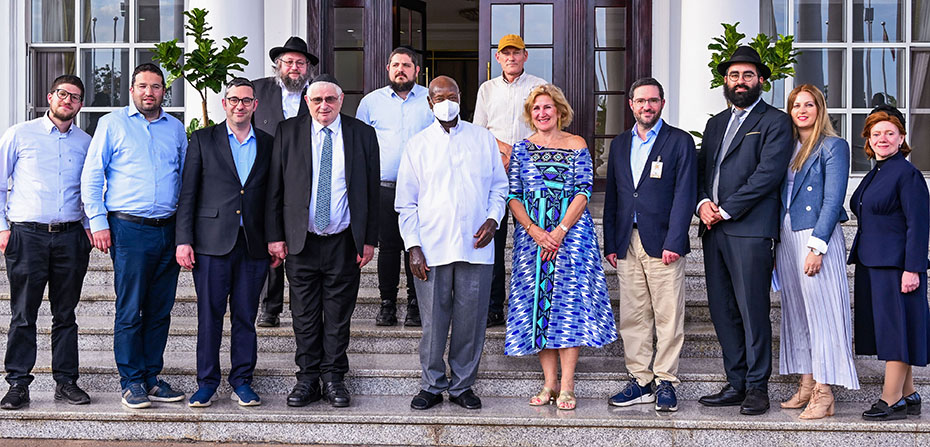
President Museveni poses for a photo with former Entebbe hostage Gilbert Weill (on his R), his family members and other members from Israel after a meeting at Entebbe on Tuesday
During his meeting with the President, Weill expressed appreciation to the Ugandan government for facilitating the visit and preserving the memory of an event that shaped the lives of many survivors. He thanked the President for the special invitation and the warm reception extended to him, his family and fellow visitors.
President Museveni used the occasion to share Uganda’s journey since the turbulent years of the 1970s. He recounted the country’s liberation struggle and efforts to rebuild institutions after decades marked by political instability and conflict.
Reflecting on the 1976 hijacking, Museveni observed that while the incident was tragic, the rescue operation that followed had significant political consequences. According to the President, the operation weakened the aura of invincibility surrounding former dictator Idi Amin and exposed vulnerabilities within his regime.
The President noted that the aftermath of the incident contributed to the gradual erosion of fear among Ugandans and became one of several events that challenged Amin’s grip on power.
Museveni also highlighted the progress Uganda has made since those difficult years. He spoke about the country’s efforts to overcome divisions rooted in tribalism and religious politics, emphasizing the importance of national unity, stability and development.
The President further outlined Uganda’s economic potential, pointing to opportunities in agriculture, mineral resources, freshwater wealth and a youthful population. He encouraged stronger economic cooperation between Uganda, Israel and European countries, particularly in areas such as value addition, manufacturing and export-oriented investment.
“There is a lot of potential here,” Museveni said, adding that Uganda offers investment opportunities that can serve both African and international markets.
For Weill and the other former hostages, the visit was about more than revisiting a historical site. It represented an opportunity to reconnect with a country that has transformed significantly since the events of 1976.
The meeting, which was also attended by Uganda’s Ambassador to Belgium, Mirjam Blaak Sow, underscored the importance of preserving historical memory while building new bridges of friendship.
As Weill departed from the old terminal that once symbolized fear and uncertainty, he carried with him a different memory—one of gratitude, reconciliation and renewed hope for stronger ties between Uganda and the families forever linked to the Entebbe story.







About the Author