
Ramathan Ggoobi
HABARI DAILY I Kampala, Uganda I The Uganda Government has released Shs23.03 trillion to finance public expenditure for the first quarter of the 2026/27 financial year, marking the official commencement of implementation of the country’s Shs84.39 trillion national budget with a strong focus on sustaining macroeconomic stability, accelerating economic growth and improving service delivery.
The first-quarter release represents approximately 27 percent of the approved national budget and provides expenditure limits for Ministries, Departments and Agencies (MDAs), Local Governments and other public institutions for the period between July and September 2026.
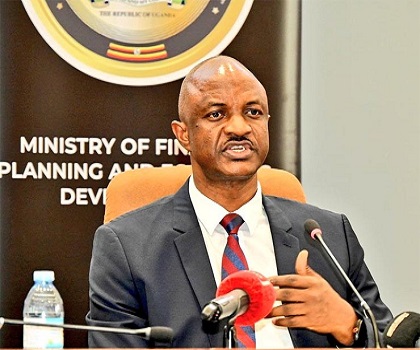
Speaking during a press briefing in Kampala on Friday, the Permanent Secretary and Secretary to the Treasury (PSST), Ramathan Ggoobi, said the quarterly releases have been carefully structured to finance Uganda’s development priorities while safeguarding fiscal discipline and ensuring debt sustainability.
Macroeconomic stability
“Uganda enters the new financial year from a position of strong macroeconomic stability, characterised by accelerated economic growth, low inflation, a stable Uganda Shilling, increased exports and improving investor confidence,” Ggoobi said.
He added that the government was determined to preserve these gains while implementing its ambitious development agenda.
“The Quarter One expenditure releases have been carefully aligned to sustain this momentum while preserving fiscal and debt sustainability,” he said.
The Shs23.03 trillion release is intended to finance a broad range of government priorities, including infrastructure development, security, human capital development and the day-to-day operations of public institutions. Among the largest allocations is Shs1.53 trillion earmarked for the Ministry of Works and Transport to support ongoing road and transport infrastructure projects considered vital for economic growth.
Government officials say priority has been given to completing ongoing infrastructure projects instead of spreading scarce resources across numerous new initiatives, a strategy aimed at delivering visible results while avoiding cost overruns and project delays.
The quarterly releases also include funding for counterpart financing of projects supported by development partners, enabling Uganda to unlock additional external financing for strategic investments.
2027 Africa Cup of Nations (AFCON) prioritised
Another notable component of the first-quarter funding is support for preparatory activities ahead of the 2027 Africa Cup of Nations (AFCON), which Uganda will jointly host with Kenya and Tanzania. Resources have been allocated for sports infrastructure, logistics and other strategic investments necessary to ensure successful hosting of Africa’s premier football tournament.
The government said the first-quarter expenditure plan is aligned with its broader Tenfold Growth Strategy, an ambitious programme designed to transform Uganda into a 500-billion-dollar economy through targeted investments in productive sectors.
According to Ggoobi, fiscal policy for the 2026/27 financial year is anchored on financing Uganda’s key growth drivers while ensuring prudent management of public resources.
Priority sectors under the strategy include agro-industrialisation, tourism development, mineral beneficiation, science, technology and innovation, Information and Communication Technology (ICT), and the creative economy.
These sectors are expected to increase production, generate employment opportunities, expand exports and raise household incomes over the medium and long term.
“Every shilling released must contribute to economic growth, job creation and improved delivery of public services to citizens,” Ggoobi said.
Measurable economic returns
He noted that government would continue directing limited public resources towards programmes capable of delivering measurable economic returns instead of financing non-essential expenditure.
The Treasury chief explained that expenditure ceilings for the first quarter were determined after taking into account expected domestic revenues, projected cash inflows, available financing and the approved fiscal framework.
“The expenditure limits have been programmed in line with expected cash flows, availability of financing and the approved fiscal framework to ensure sustainable implementation of government programmes,” Ggoobi said.
He said the approach is intended to ensure that government spending remains within available resources while maintaining implementation of priority programmes across sectors.
The Treasury also reaffirmed its commitment to enforcing expenditure controls by limiting non-essential spending while protecting strategic investments that directly contribute to economic transformation.
Officials believe this approach will strengthen fiscal discipline, reduce wastage and ensure taxpayers receive value for money.
Beyond releasing the funds, Ggoobi issued a strong directive to Accounting Officers across Ministries, Departments, Agencies and Local Governments to immediately begin implementing approved programmes and avoid unnecessary delays that have previously slowed service delivery.
Strict financial discipline required
He urged public institutions to align expenditure with expected cash inflows, observe strict financial discipline and ensure timely procurement processes to maximise the impact of government spending.
According to Ggoobi, citizens are less interested in the amount of money released than in the tangible improvements the funds produce in their daily lives.
He challenged Accounting Officers to ensure that public resources translate into better roads, improved healthcare services, quality education, enhanced security, higher agricultural productivity and more employment opportunities.
The Treasury warned against budget indiscipline, stressing that proper planning, timely procurement and sound financial management would determine whether the ambitious national development targets are achieved.
Ggoobi also reiterated government’s commitment to transparency in public financial management, saying increased publication of budget documents and expenditure releases enables citizens to understand national priorities and hold public institutions accountable.
“Access to budget information enables citizens to understand national priorities and demand accountability in service delivery,” he said.
The Treasury has in recent years expanded publication of budget releases, expenditure reports and performance assessments as part of broader reforms aimed at strengthening accountability and improving public confidence in government financial management.
Uganda’s economy resilient
The first-quarter releases come at a time when government says Uganda’s economy continues to demonstrate resilience despite persistent global economic uncertainties.
According to the Treasury, the country has maintained favourable macroeconomic indicators, including declining inflation, a relatively stable exchange rate, improving export earnings and growing investor confidence.
Officials argue that maintaining fiscal discipline while investing strategically in productive sectors will help sustain robust economic growth over the coming years and accelerate Uganda’s journey towards middle-income status.
Government also believes that disciplined public expenditure, complemented by increased private sector investment, remains central to achieving the country’s long-term development aspirations.
The release of the first-quarter expenditure limits officially launches implementation of the 2026/27 national budget, with Ministries, Departments, Agencies and Local Governments expected to immediately commence execution of approved programmes in line with the National Development Plan and the Tenfold Growth Strategy.







About the Author