
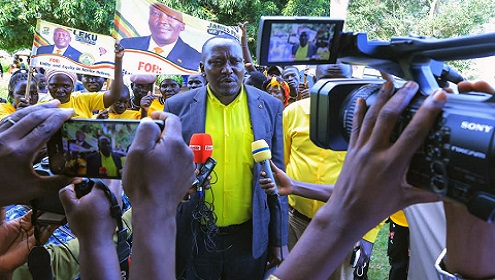
James Leku Pilli addressing the press
HABARI DAILY I Kampala, Uganda I James Leku Pilli’s overwhelming victory in the Adjumani West County parliamentary by-election was built on a combination of internal NRM reconciliation, the withdrawal of potential rivals, high-profile presidential backing and a campaign that closely connected itself to local development priorities.
Pilli, the National Resistance Movement (NRM) candidate, secured 12,423 votes, representing about 83 per cent of the 14,982 valid votes cast, to defeat independent candidate Gasper Draga, who obtained 2,559 votes, or about 17 per cent.
The Electoral Commission declared Pilli the winner at 8:31 p.m. on September 17 at Adjumani District Council Hall after the constituency’s results had been tallied.
His victory was particularly striking because it followed a closely contested NRM primary in which he had faced six other aspirants.
Turning rivals into allies
A major factor behind Pilli’s performance was his approach to the divisions that emerged during the NRM primary.
On September 3, Pilli won the party ticket with 9,336 votes, narrowly defeating Ben Anyama, who obtained 9,152 votes. The 184-vote margin demonstrated how evenly support had initially been distributed among the leading contenders.
Instead of allowing the primary contest to spill into the parliamentary election, Pilli embarked on efforts to reconcile with his former competitors.
He presented them as “brothers” rather than political enemies, a strategy that helped reduce the possibility of NRM supporters splitting their votes among several candidates.
This was important in a constituency where internal disagreements within the ruling party had the potential to weaken its candidate.
The unity strategy received a major boost when Anyama and Patrick Tandrupasi withdrew from the parliamentary race before polling day. Their departure, together with the withdrawal of other potential rivals, left Pilli facing only Draga on the ballot.
The withdrawals effectively removed several candidates who could have drawn support from sections of the NRM or the wider electorate, allowing the party’s political machinery to rally behind a single candidate.
Museveni’s intervention
Pilli’s campaign also benefited from direct mobilisation by President Yoweri Museveni.
On the final day of the official campaign, Museveni travelled to Adjumani to campaign for the NRM candidate, giving Pilli’s bid a significant national-level endorsement.
The President’s appearance provided an opportunity for the NRM to mobilise its grassroots structures behind Pilli after the divisive party primary.
It also reinforced the message that the parliamentary race was an opportunity for voters to maintain continuity with the ruling party’s development agenda.
Carrying Moses Ali’s legacy
Pilli also carefully positioned himself as a successor to the development agenda associated with the late Gen. Moses Ali, whose death on July 18 created the vacancy.
Ali was a veteran military officer and senior NRM politician who represented Adjumani West for decades and served in several senior government positions, including First Deputy Prime Minister.
Rather than presenting his candidacy as a departure from Ali’s political legacy, Pilli promised to pursue some of the projects and priorities left unfinished under his predecessor.
Among the issues highlighted during the campaign were the tarmacking of the Obongi-Adjumani road, upgrading health facilities and elevating Adjumani town to municipality status.
By linking his campaign to projects familiar to residents, Pilli was able to present himself as a candidate offering continuity while also seeking to address outstanding development needs.
Local issues appeal
Another important feature of the NRM campaign was its emphasis on issues specific to Adjumani.
NRM Electoral Commission chairman Tanga Odoi said the party deliberately concentrated on localised campaign content and community-specific concerns.
The strategy was intended to make the election less about broad national political arguments and more about issues directly affecting residents.
According to Odoi, this approach increased community ownership of Pilli’s candidacy.
The election itself ended with a decisive numerical advantage for Pilli. Out of 15,216 ballot papers counted, the Electoral Commission recorded 234 rejected ballots and 19 spoilt ballots, leaving 14,982 valid votes.
The constituency had 51,437 registered voters and 114 polling stations.