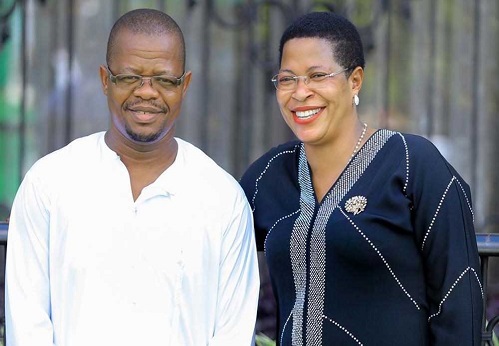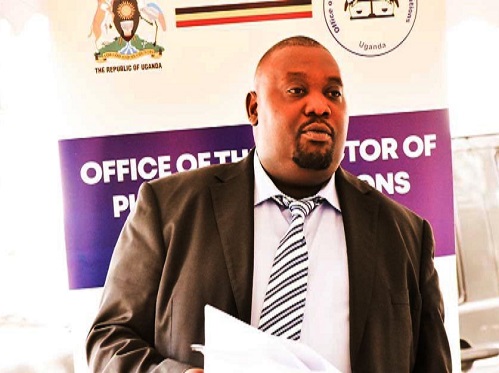

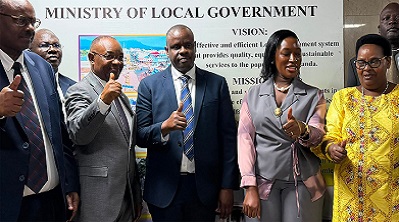
Balaam Barugahara (4th L) has denied that there is no lift between him and his junior collegue Justine Nameere (2nd R)
HABARI DAILY I Kampala, Uganda I Once great allies in the fight against graft, the two ministers are no longer moving together, raising questions about the state of their relationship and whether their once-visible partnership has fallen apart.
Local Government Minister Balaam Barugahara, however, insists there is no feud between him and his junior minister, Justine Nameere. Asked why the two no longer appear together as they once did, Barugahara offered a simple explanation: their responsibilities have changed.
When Habari Daily put a question to him why he no longer moves with his junior minister, Justine Nameere, his answer was bold and straight forward:
“We are not supposed to move together. She is an MP who has a constituency and she has to balance her work with her role as an MP. Anyway, we have no issues because our roles are well stipulated in the Constitution,” Barugahara responded.
His answer appears designed to dismiss suggestions of a fallout, but the question itself points to a noticeable change in the relationship between the two ministers. Once seen on the same side of the government’s campaign against corruption, Barugahara has increasingly taken centre stage in a series of rallies and inspections across local governments, while Nameere has maintained her own political and constituency responsibilities.
Barugahara presents the separation not as a disagreement, but as a practical consequence of their different duties.
Yet his remarks come against the backdrop of an increasingly aggressive campaign against corruption, a crusade in which he has positioned himself as one of the government’s most outspoken voices.
‘There is a lot of rot’
Barugahara says his travels across districts have exposed serious weaknesses in local government systems, from ghost workers and inflated enrolment figures to shoddy public works.
During his inspection of institutions in the Bugisu sub-region, he said he visited a school where the headteacher reported an enrolment of 1,480 pupils. When a physical headcount was conducted, however, only about 700 pupils were allegedly found.
For Barugahara, the discrepancy represents more than an administrative error. It is evidence of the financial losses the Government suffers when public officials manipulate records.
He also cited Bungokho Health Centre, where he said seven ghost workers were discovered, each allegedly earning more than Sh1 million.
“There is a lot of rot in the local governments, but we are going to restore sanity,” he said.
He listed corruption, ghost workers and poor-quality work among the problems his ministry intends to tackle, promising to visit every district and pursue those responsible for what he described as fraudulent schemes.
His rhetoric has been uncompromising. He even suggested that Uganda needs a corruption detention facility in Karamoja where corrupt officials could be kept.
But Barugahara says he is not acting alone. He says lawyers and criminal investigations officers accompany him and assist in determining who should be arrested and who should not.
The minister also insists his campaign is more practical than conventional audits because it involves physically visiting institutions and checking what is actually happening on the ground.
A minister under pressure
The aggressive campaign has attracted both praise and criticism. While some Ugandans have applauded the minister’s approach, others have questioned whether his dramatic inspections and arrests amount to political theatre.
Barugahara rejects that accusation.
“Haven’t you seen those arrested and prosecuted?” he asked, arguing that the arrests demonstrate that the campaign is producing tangible results.
He also dismisses concerns that his actions could put him at risk from corrupt officials.
“I am a self-made person and a child of God. If anybody intends to bewitch me, they are daydreaming,” he said, framing the fight against corruption as a generational battle.
He says he belongs to the Patriotic League of Uganda (PLU), headed by Gen. Muhoozi Kainerugaba, and describes the movement’s objective as creating a progressive and corruption-free country where citizens are treated equally.
“I shall not rest until we have a corruption-free country,” he says.
That political identity has also become part of the debate around his work. Critics have accused him of politicking, but Barugahara says he is not a politician, describing himself instead as a patriot.
The Nameere question
It is within this environment that questions about his relationship with Nameere have gained prominence.
Nameere, a junior minister in the same ministry, has been part of the wider government machinery, but Barugahara now says there is no expectation that the pair should move around together.
His explanation that Nameere must balance ministerial responsibilities with her parliamentary constituency duties is straightforward. He insists their roles are clearly defined by the Constitution and that there are “no issues” between them.
Still, the absence of the once-visible partnership leaves room for speculation, particularly because the two operate within the same political and ministerial space.
Barugahara does not accuse Nameere of wrongdoing, nor does he suggest that their relationship has deteriorated. Instead, he draws a line between personal relations and official responsibilities.
For him, the bigger issue is the campaign against corruption.
‘Every minister must join the battle’
Barugahara argues that the responsibility for fighting corruption cannot be left to the Inspectorate of Government or the State House Anti-Corruption Unit alone.
“These entities are understaffed,” he says, arguing that every minister should contribute to the fight.
He believes the President was right to appoint ministers who are not involved in elective politics to help in the campaign.
His own lack of an elected political position, he says, gives him freedom to pursue the campaign without worrying about electoral consequences.
He is equally uncompromising when it comes to attempts to bribe him. Barugahara says he has recording devices and has even deactivated his mobile money numbers to prevent anyone from depositing money into his accounts in an attempt to compromise him.
“I don’t accept bribes,” he says, adding that his salary is sufficient for his needs.
Defending his approach
Barugahara’s campaign has also extended beyond institutions directly associated with his ministry. He has visited schools, health facilities and other government establishments, prompting questions about whether he is encroaching on the responsibilities of other ministries.
His response is that local government is a universal responsibility.
“Almost all workers in the district are under my ministry,” he says, arguing that his office therefore has a legitimate interest in what happens across districts.
He also dismisses criticism of the address system he owns and uses in his anti-corruption campaign. Although the system belongs to him, he says the Government does not pay him for its use and that he considers it a personal contribution to the fight against corruption.
Alcohol, LC1s and discipline
His reform agenda extends to local administration and social behaviour.
Barugahara has pushed a 3:00pm drinking directive, arguing that allowing people to drink throughout the day can contribute to crime and reduce productivity. His argument is that people who spend their earnings drinking from morning to evening may eventually resort to theft to find money for the following day.
He says local governments have powers to enact by-laws regulating the vice, particularly because previous attempts by Parliament to pass comprehensive alcohol legislation have failed.
He has also warned newly elected LC1 chairpersons against corruption, specifically cautioning them against demanding a 10 per cent cut from property sales. Such demands, he says, should be reported directly to him.
From youth affairs to Cabinet
Barugahara’s rise within government has been rapid. He previously served as State Minister for Youth and Children Affairs before being elevated to a full Cabinet position.
Yet he has never contested for an elective political position in Masindi, his home area.
He says this was partly because of President Yoweri Museveni’s advice. Barugahara recalls being asked whether he had first become an MP for Masindi before being appointed minister. When he answered no, the President questioned why he wanted to involve himself in elective politics.
Barugahara says he listened.
“I am naturally an obedient person,” he explains, comparing the President’s guidance to that of a father whose instructions should be respected.
“I want to inform all the readers that I am not a politician,” he says.
That assertion is central to how Barugahara wants his public campaign to be understood. Whether inspecting schools, confronting alleged ghost workers, advocating restrictions on drinking or defending himself against accusations of politicking, he portrays himself as a government loyalist engaged in a generational mission.
And when it comes to Nameere, he maintains the same message: there is no quarrel to resolve.
They simply have different roles.
Whether that explanation will end speculation about the apparent distance between the two ministers remains to be seen. For now, Barugahara appears more interested in the battle he says lies ahead — taking his anti-corruption campaign to every district, confronting what he calls the “rot” in local governments and, ultimately, restoring what he describes as sanity to public service.







About the Author