

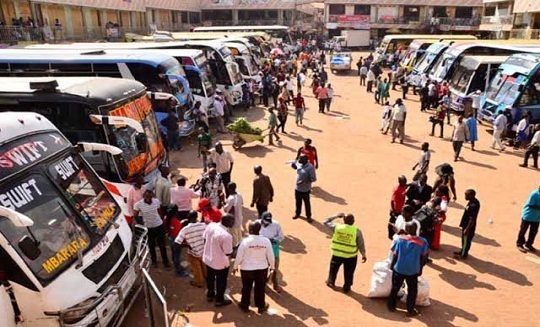
Namayiba bus park in downtown Kampala
HABARI DAILY I Kampala, Uganda I Ugandans traveling by bus will have to dig deeper into their pockets following a fresh increase in public transport fares across major upcountry routes, a development that threatens to further strain household budgets, increase the cost of doing business and complicate travel plans ahead of the December festive season.
The latest adjustments, announced by the United Bus Owners Association (UBOA), took effect on November 14, 2026, affecting 31 routes connecting Kampala to destinations across western Uganda, including the Rwenzori and Bunyoro regions.
The increase comes barely two weeks after bus operators serving northern Uganda raised their fares, citing escalating fuel prices, vehicle maintenance expenses and other operational costs.
Under the revised fare structure, passengers travelling from Kampala to Mbarara will now pay Shs40,000, while those heading to Kabale will part with Shs50,000. The Kampala-Kisoro journey has been priced at Shs60,000.
Travellers heading to Fort Portal, Ishaka and Ntungamo will pay Shs45,000, while those travelling to Kasese, Rukungiri, Bundibugyo and other destinations will pay between Shs55,000 and Shs60,000.
The Kampala-Hoima and Kampala-Masindi routes have been set at Shs30,000, while passengers travelling to Kihihi and Kanungu will pay Shs65,000, the highest fare among the listed destinations.
Although the association’s notice, dated November 13, does not indicate the previous charges or specify the exact increments, the adjustments represent another financial burden for passengers who depend on public transport for business, employment, education and family obligations.
Household Budgets Under Pressure
The immediate consequence of the fare increases is likely to be a reduction in the disposable income of households, particularly low-income earners who frequently travel between Kampala and upcountry districts.
For many Ugandans, travelling to their villages is not a luxury but a necessity, involving family responsibilities, agricultural activities, funerals, weddings, medical appointments and other social obligations.
With fares rising across several destinations, families that previously budgeted a specific amount for transport will now have to find additional money or reconsider their travel arrangements.
The impact could be particularly severe for households with several members travelling together.
For instance, a family of four travelling from Kampala to Kisoro will now require Shs240,000 for a one-way journey alone, excluding local transport, meals and other travel-related expenses.
A return journey would require Shs480,000, an amount that could consume a significant portion of the monthly earnings of an average household.
Similarly, a family travelling to Kanungu would need Shs260,000 for a one-way journey for four passengers, translating into Shs520,000 for a return trip.
Such expenses could force some families to reduce the number of people travelling, postpone visits or remain in urban areas during the festive season.
The consequences may also extend to students, workers and small-scale traders who regularly move between Kampala and rural communities.
Businesses and Traders Face Higher Costs
Beyond individual passengers, the rising transport charges could have implications for businesses that depend on the movement of people and goods between Kampala and upcountry markets.
Small-scale traders who travel to Kampala to purchase merchandise and transport it to regional towns could face increased operating expenses.
Although passenger fares are not necessarily equivalent to cargo transportation charges, higher fuel and vehicle operating costs could also place pressure on parcel delivery and goods transportation services.
Traders dealing in agricultural produce, retail merchandise and other commodities may eventually transfer part of the additional costs to consumers.
This could contribute to higher prices of goods in upcountry markets, particularly where businesses depend on frequent transportation from Kampala.
The increases could also affect businesses that rely on workers travelling between districts, as employees may demand higher transport allowances or face reduced take-home earnings after meeting commuting expenses.
For families in rural areas, the cost of travelling to Kampala for specialised medical services, education and administrative requirements could become increasingly prohibitive.
Fuel Prices Behind the Adjustments
Bus operators attribute the fare increases to the sharp rise in fuel prices and other operational expenses.
Diesel prices at some fuel stations in Kampala have approached Shs7,500 per litre, while petrol prices have crossed Shs7,000.
The high pump prices have been driven by international oil market movements, a weakening shilling and increased costs associated with importing and distributing petroleum products.
Global crude oil prices have approached the $100-per-barrel mark, putting pressure on fuel-importing economies such as Uganda.
The depreciation of the shilling against the US dollar has further complicated the situation because petroleum products are purchased on international markets using foreign currency.
Even when international crude oil prices ease or the shilling gains value, local pump prices may not immediately reflect the improvements.
This is partly because fuel companies may still be selling stocks purchased at higher prices, while transportation, storage, exchange-rate and distribution costs continue to influence the final price.
For bus operators, fuel represents one of the biggest recurring expenses involved in running long-distance transport services.
A bus travelling hundreds of kilometres between Kampala and western Uganda consumes substantial quantities of diesel, making changes in pump prices particularly significant.
Operators also face increasing expenditure on spare parts, tyres, lubricants, insurance and routine vehicle servicing.
These expenses have become increasingly difficult to absorb without adjusting fares, particularly for companies operating older vehicles or serving routes with relatively low passenger volumes.
Northern Uganda Already Affected
The latest increases in western Uganda follow similar adjustments implemented by operators serving northern Uganda at the beginning of November.
The changes, which took effect between November 1 and 2, saw ordinary bus fares from Lira to Kampala rise from Shs30,000 to Shs40,000.
Some services on the Lira-Kampala and Gulu-Kampala routes have been charging between Shs40,000 and Shs50,000.
The developments indicate that the pressure on public transport costs is not confined to a particular region but is spreading across Uganda’s major upcountry transport corridors.
For passengers, the successive adjustments mean that travelling between Kampala and regional towns is becoming increasingly expensive at a time when many households are already struggling with the rising cost of living.
Festive Season Travel
The timing of the fare increases is particularly concerning because they come as Ugandans begin preparing for the December holiday season.
December traditionally attracts increased movement as urban residents travel to their ancestral homes, attend family gatherings, participate in cultural events and celebrate Christmas and New Year with relatives.
The anticipated increase in passenger demand could place additional pressure on transport operators, with industry managers warning that further fare adjustments remain possible if operating expenses continue rising.
If additional increases are implemented, some travellers could be forced to make their bookings earlier, reduce the frequency of their journeys or explore alternative means of transport.
For families already struggling to meet school fees, rent, food and other household obligations, the additional transport expenses could complicate end-of-year financial planning.
The situation also raises questions about the affordability of public transport, particularly for low-income Ugandans who have limited alternatives to long-distance buses.
While operators argue that fare adjustments are necessary to maintain their businesses and continue providing services, passengers are increasingly exposed to the consequences of rising operational costs.







About the Author