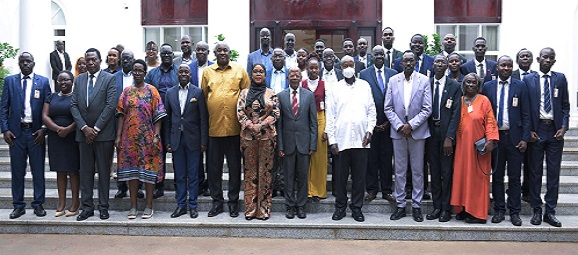

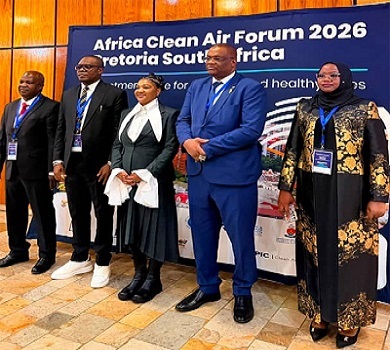
KCCA’s ED Sharifah Buzeki (Right), attending the South African summit
HABARI DAILY I Kampala, Uganda I Kampala has emerged as a city rewriting its environmental story, evolving from a city with only a handful of air quality monitoring devices into one of Africa’s leading examples of technology-driven environmental management backed by strong community participation.
The Ugandan capital’s remarkable transformation was showcased at the Africa Clean Air Forum 2026 in Pretoria, South Africa, where Kampala Capital City Authority (KCCA) Executive Director Sharifah Buzeki shared the city’s progress during a presentation titled “The Kampala Experience.”
Her presentation painted a vivid portrait of how Kampala has embraced innovation, policy reforms and citizen engagement to tackle one of urbanisation’s greatest challenges—air pollution.
Addressing delegates from across the continent, Buzeki traced Kampala’s journey from its modest beginnings in 2018, when the city installed its first air quality monitors, to today’s expansive network of 134 monitoring stations.
“From our first air quality monitors installed in 2018, Kampala has grown into a city with 134 monitoring stations, including hyperlocal sensors that provide real-time public data,” she said. “This has made Kampala one of Africa’s most transparent cities in air quality reporting because the information is available to everyone and supports evidence-based decision-making.”
Pollution level targets
Despite recording average pollution levels of 39 micrograms per cubic metre (µg/m³), Kampala has set itself an ambitious target of cutting pollution levels by half before the end of the decade.
According to Buzeki, the city is relying on a strong legal and policy framework to achieve this goal.
“Our ambition is to reduce average pollution levels by 50 percent by 2030. This ambition is backed by the National Environment and Public Health laws, the Kampala Clean Air Action Plan 2025–2030 and the soon-to-be enacted Kampala Air Quality Management Bill,” she said.
While technology has played a critical role in monitoring pollution, Buzeki stressed that Kampala’s greatest success has been in turning clean air into a people’s movement.
“What makes Kampala’s story compelling is not just technology, but people,” she told delegates. “Clean air has become a civic movement where residents organise weekend clean-up exercises, journalists have been trained as clean air champions and Village Health Teams integrate air quality monitoring into their everyday work.”
She explained that the community-led approach has fundamentally changed public attitudes towards environmental conservation.
“This grassroots energy has ensured that clean air is not viewed as a government directive. Instead, it has become a shared responsibility woven into everyday life.”
Redesigning the transport system
Beyond monitoring pollution, Kampala has embarked on redesigning its transport systems to reduce emissions.
The city has invested in cycling lanes, pedestrian walkways and the introduction of electric buses, while government tax incentives on electric vehicles and motorcycles are encouraging cleaner modes of transport.
At the same time, a modern traffic control centre is being established to coordinate all signalised junctions across Kampala, helping reduce traffic congestion and vehicle emissions.
“These initiatives are not only about reducing pollution, but about building a culture of green mobility and healthier living,” Buzeki said.
She noted that improving mobility is central to achieving cleaner air because transport remains one of the largest contributors to urban emissions.
International recognition
Kampala’s progress has already attracted international recognition. The city received the National Environment Sustainability Award in June 2026 and was nominated for the prestigious Guangzhou International Award for Urban Innovation, making the shortlist of 15 cities selected from more than 265 applicants worldwide.
In another milestone, Kampala became the first African city to join the International Network of Tree Cities, with an urban tree density of 5,705 trees per square kilometre.
Buzeki said these recognitions demonstrate that African cities can deliver world-class environmental solutions through innovation and collaboration.
As she concluded her presentation, the KCCA Executive Director reminded delegates that air pollution remains a regional and global challenge that cannot be addressed by cities acting independently.
“Pollution knows no borders,” she emphasised. “African cities must embrace community involvement, real-time data and integrated approaches if we are to deliver cleaner air for future generations.”
Her message resonated strongly with the theme of this year’s Africa Clean Air Forum, which places investment and collaboration at the centre of improving air quality across the continent.
Call on Africa
The forum opened with a passionate call to action from South Africa’s Deputy Minister of Forestry, Fisheries and the Environment, Bernice Swarts, who reminded participants that clean air should never be viewed as a luxury.
She urged governments, researchers, development partners and city authorities to work together in building healthier and more sustainable cities, noting that protecting air quality is essential for public health, economic productivity and climate resilience.
Running until July 16 at the University of Pretoria and the CSIR Convention Centre, the Africa Clean Air Forum 2026 has brought together policymakers, scientists and urban leaders determined to turn clean air from an aspiration into reality.
Kampala’s experience has emerged as one of the forum’s standout success stories, demonstrating how strong political commitment, smart technology and active citizen participation can transform a rapidly growing African city into a model of environmental stewardship.







About the Author