

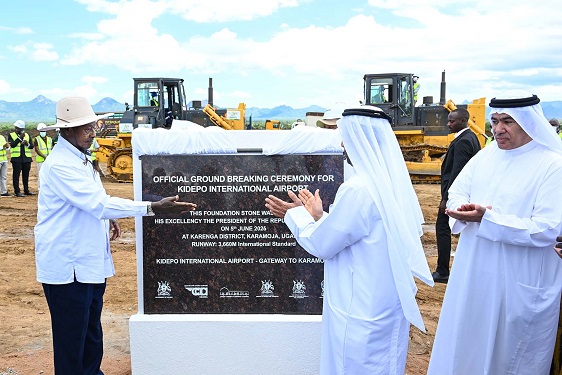
President Museveni and the Chairman of Sharjah Chamber of Commerce and Industry Abdallah Sultan unveiling the mark stone to flag off the construction of Kidepo International Airport in Karenga district on Friday, 5th June 2026
HABARI DAILY I Kampala, Uganda I Tourism and trade are expected to become the dominant drivers of economic transformation in Karamoja following President Yoweri Museveni’s launch of the construction of Kidepo International Airport in Karenga District, a landmark infrastructure project aimed at unlocking the region’s vast economic potential.
The airport, the first international aviation facility in Karamoja, is being funded by the Sharjah Chamber of Commerce and Industry of the United Arab Emirates at a cost exceeding USD 72 million (approximately Shs270 billion). The project will feature a 3.6-kilometre runway, a 7,408-square-metre passenger terminal and a massive 74,200-square-metre cargo terminal, positioning the region as a strategic gateway for both international visitors and commercial trade.
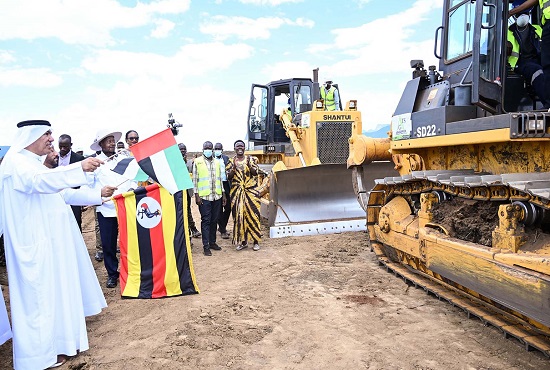
President Museveni and a delegation from Sharjah Chamber of Commerce and Industry led by Abdallah Sultan (2nd L) flagging off the construction of Kidepo International Airport in Karenga district
Speaking during the groundbreaking ceremony, President Museveni described the airport as a direct outcome of the enormous tourism value of Kidepo Valley National Park, one of Uganda’s most celebrated wildlife conservation areas.
The President said the investment demonstrates how natural resources, when properly protected and managed, can generate wealth and attract major infrastructure developments.
“Now, Kidepo, which you wanted to destroy with goats, sheep and donkeys, is now bringing you this investment here, an airport like Entebbe Airport,” Museveni told residents.
His remarks underscored the government’s belief that tourism will become one of the leading sectors driving prosperity in Karamoja. For decades, the region’s economic activities have largely revolved around livestock keeping and subsistence livelihoods. However, the construction of an international airport is expected to accelerate a shift towards a service-based economy anchored on tourism, hospitality and transport.
Kidepo Valley National Park has steadily gained international recognition as one of Africa’s premier wildlife destinations, attracting visitors seeking unique safari experiences. Yet accessibility challenges have limited the number of tourists reaching the park. The new airport is expected to significantly reduce travel time for international visitors and investors, making Karamoja more attractive as a tourism destination.
Museveni emphasized that tourism represents one of the world’s most lucrative industries, noting that the global tourism sector contributes approximately $ 11.6 trillion annually to the world economy. He urged the people of Karamoja to embrace opportunities arising from tourism and related services instead of relying solely on traditional economic activities.
The President also assured communities living near Kidepo Valley National Park that they would directly benefit from the airport through employment opportunities, business growth and improved infrastructure. He commended residents of Karenga District for voluntarily providing land for the project, describing their cooperation as an investment in the future prosperity of the region.
Beyond tourism, the airport is expected to revolutionize trade in Karamoja. The inclusion of a large cargo terminal signals government ambitions to transform the sub-region into an important commercial hub capable of connecting local producers to national and international markets.
Improved air transport infrastructure is expected to facilitate the movement of goods, attract investors and support emerging industries across the region. With direct air cargo services, products from Karamoja will have quicker access to domestic and international markets, creating new opportunities for exporters and entrepreneurs.
President Museveni used the occasion to encourage both local and international investors to take advantage of Uganda’s growing economy and expanding markets. He assured investors that Uganda offers a favorable business environment and a ready market for products and services.
The Chairman of the Sharjah Chamber of Commerce and Industry, Abdallah Mohamad Sultan Alowais, said the airport project is already creating employment opportunities, with 1,620 Ugandans currently working on its construction. He revealed that the development will be implemented in three phases and praised the people of Karenga for supporting the initiative.
The employment opportunities generated during construction are expected to be followed by even greater job creation once the airport becomes operational. Tourism facilities, hotels, transport services, logistics companies and trade-related businesses are anticipated to emerge around the airport, creating thousands of direct and indirect jobs.
Leaders from Karamoja highlighted the region’s growing attractiveness to investors, attributing the trend to improved security following the successful disarmament of cattle rustlers. They noted that peace and stability have created conditions necessary for large-scale investments to flourish.
Karamoja Affairs Minister-designate Dr. John Baptist Lokii pointed to several ongoing investments, including cement factories, marble processing plants, mining operations and the new airport, as evidence of the region’s economic transformation.
The airport project is therefore seen as more than an aviation development. It represents a catalyst for broader economic growth, capable of connecting Karamoja to global tourism circuits and international trade networks.
Uganda Civil Aviation Authority Deputy Director General Olive Birungi Lumonya said regulatory assessments have already been conducted to ensure the project meets aviation standards.
Expectations are currently high that Kidepo International Airport will open a new chapter for Karamoja. With tourism and trade positioned at the center of the region’s development agenda, leaders believe the project could transform one of Uganda’s historically marginalized regions into a thriving economic destination for investors, businesses and visitors from around the world.







About the Author