
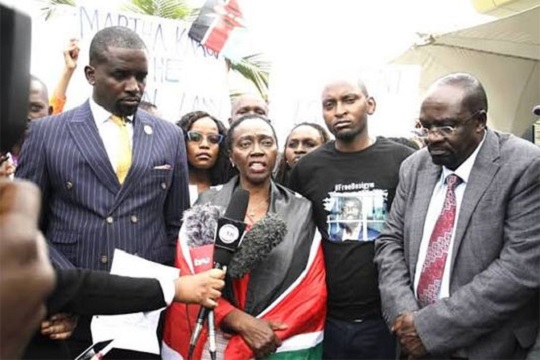
Martha Karua addressing a press conference in Nairobi
HABARI DAILY I Kampala, Uganda I Kenyan lawyer and politician Martha Karua has announced plans to sue the Ugandan government following her deportation from Uganda, citing what she describes as a series of unlawful actions by immigration authorities at Entebbe International Airport.
Karua said the case could be filed either in Ugandan courts or before the African Court, arguing that her treatment violated her legal rights, professional privileges and regional freedom-of-movement guarantees.
Karua, who serves as lead defense counsel for Ugandan opposition politician Dr. Kizza Besigye, travelled to Kampala on June 22 to join the legal team representing Besigye, Obeid Lutale and former Kampala Lord Mayor Erias Lukwago. However, upon arrival at Entebbe International Airport, she was denied entry and later deported back to Nairobi.
According to Karua, the primary basis of her planned lawsuit is what she considers the unlawful denial of entry into Uganda. She maintains that she had obtained the necessary authorization to practice before Ugandan courts and was entitled to enter the country under East African Community (EAC) freedom-of-movement provisions.
Karua said she had already been cleared through immigration and was waiting in the baggage collection area when an officer informed her that an alert had been placed against her name.
The officer reportedly escorted her through several immigration offices before she was informed that her entry had been prohibited. Karua said no convincing explanation was provided for the decision. She was later asked to complete forms and submit to questioning, which she declined, arguing that officials had failed to explain why she was being detained.
Another key ground for the lawsuit concerns what Karua describes as harassment of legal counsel involved in Besigye’s defense. She argues that her deportation followed the arrest and alleged torture of her co-counsel, Erias Lukwago, and forms part of a broader pattern of intimidation directed at members of the defense team. According to Karua, such actions undermine the integrity of the judicial process and raise serious concerns about whether Besigye can receive a fair trial.
Karua has also accused Ugandan authorities of unlawfully confiscating and accessing her mobile phones during her detention at the airport. She said immigration officials seized both of her phones without legal justification and held them for approximately three and a half hours. The phones were reportedly taken after she attempted to use them while being detained.
She recounted that one officer abruptly grabbed her first phone, while another individual seized the second phone moments later. Karua questioned why officials would take possession of her personal property when she was merely being deported and not accused of any crime.
The Kenyan lawyer believes the devices may have been accessed without her consent during the period they were in government custody. She claimed the phones were potentially “contaminated” and expressed concern that officials may have extracted data or installed harmful software. As a result, she refused to reclaim the devices when they were returned shortly before her departure.
Karua further revealed that authorities attempted to move her to what they described as a holding room, which she interpreted as a detention cell. She instead sought refuge in the Kenya Airways lounge, where she remained under the watch of Ugandan security personnel until boarding her return flight.
The Uganda Law Society has also questioned the decision to deny Karua entry, noting that she travelled alongside other Kenyan lawyers who were allowed into the country. By press time, Ugandan immigration authorities had not publicly explained the reasons for her deportation.
Karua says the planned lawsuit will seek accountability for what she views as violations of her rights and professional duties, while also highlighting broader concerns about the treatment of legal practitioners involved in politically sensitive cases.







About the Author