
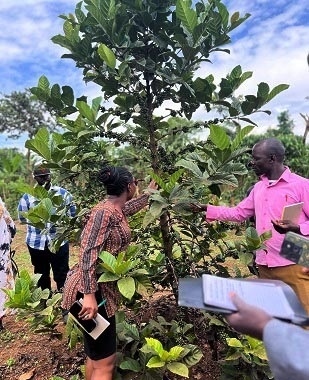
Dr. Catherine Kiwuka and farmers assessing Excelsa coffee trials at Kawanda
The coffee sub sector is set to receive a huge boost after local scientists developed new drought-resistant coffee varieties expected to strengthen production, protect farmers against climate change and improve the country’s coffee earnings.
According to the Ministry of Agriculture, Animal Industry and Fisheries (MAAIF) and the Uganda Coffee Development Authority coffee production has surged past 9 million bags due to newly maturing coffee trees from expanded planting programs.
The new varieties, developed by scientists at the National Coffee Research Institute (NaCORI) under the National Agricultural Research Organisation (NARO), represent a significant step towards addressing the growing threat of prolonged dry spells and rising temperatures to Uganda’s coffee industry.
Coffee is one of Uganda’s leading agricultural export commodities, supporting millions of livelihoods through farming, processing, transportation and trade. However, unpredictable rainfall, extended droughts and increasing temperatures threaten productivity, particularly among smallholder farmers who depend on rain-fed agriculture.
The introduction of drought-tolerant varieties could help farmers maintain production under increasingly difficult climatic conditions, reduce crop losses and improve household incomes.
The scientists developed the experimental varieties through selective cross-breeding, exploration of wild coffee genetic resources and extensive field testing. One approach involved crossing indigenous Kisansa coffee, a type of Liberica, with commercial Robusta coffee to develop experimental lines with improved tolerance to heat and water stress.
Researchers have also explored grafting traditional and commercial Robusta and Arabica varieties onto hardy root systems to improve their ability to withstand unfavourable growing conditions.
Another important component of the research has been the search for naturally resilient coffee plants in Uganda’s forests. Scientists, working with international partners, including researchers from France’s Institut de Recherche pour le Développement (IRD), have explored forests such as Budongo and Semuliki for wild Robusta coffee plants that survive high temperatures and prolonged dry spells.
These wild plants provide valuable genetic material that can be used to develop coffee varieties better adapted to changing environmental conditions. By identifying and incorporating drought-tolerance traits into breeding programmes, researchers hope to produce varieties that combine resilience with desirable commercial characteristics.
The experimental lines are being evaluated against established commercial varieties, including KR8, KR9 and KR10, in drought-prone districts such as Nakaseke, Ssembabule and Ntungamo. These trials are important in determining whether the new varieties can deliver reliable performance under actual farming conditions.
Researchers are also multiplying promising plants through clonal propagation and assessing them in screen houses and field trials across different locations. The process is intended to ensure that selected varieties retain important qualities, including good cup quality, large beans, high productivity and resistance to diseases such as coffee wilt disease.
The potential benefits for farmers could be substantial. Drought-resistant varieties may reduce the risk of losing entire harvests during prolonged dry periods, improve the stability of coffee yields and make coffee farming more attractive in areas increasingly affected by climate variability.
For Uganda, improved resilience could help safeguard export earnings, strengthen the coffee value chain and support the country’s ambitions to expand coffee production and increase value addition.







About the Author