

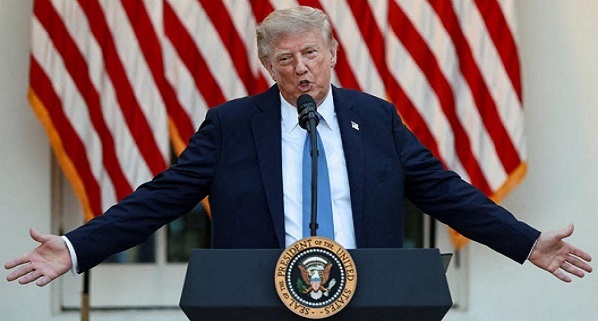
President Donald Trump
HABARI DAILY I Kampala, Uganda I The Americans have mated their dissatisfaction upon President Donald Trump, delivering a devastating political blow to his Republican Party after Democrats captured control of both the House of Representatives and the Senate in the November 3, 2026 midterm elections.
The stunning Democratic victory, which had appeared almost impossible only a year ago, represents a major reversal of political fortunes for Trump, whose declining popularity, controversial foreign policy decisions, rising cost of living and handling of the economy became a liability for Republican candidates across the country.
The outcome leaves Trump facing an increasingly hostile Congress during the final two years of his presidency, with Democrats now positioned to frustrate his legislative agenda, investigate his administration, scrutinise government spending and challenge his efforts to reshape the federal judiciary.
The results also represent a significant rejection of the Republican majorities that had enabled Trump to push through much of his political programme since returning to the White House.
A stunning Democratic comeback
Democrats broke through several Republican strongholds, winning competitive Senate races in states that Trump comfortably carried during the 2024 presidential election.
Among the biggest victories was Texas, where state Representative James Talarico defeated Republican Attorney General Ken Paxton. Paxton had controversially secured Trump’s endorsement over incumbent Senator John Cornyn during the Republican primary.
In South Carolina, paediatrician Annie Andrews defeated Republican Darline Graham, who had only been appointed to the Senate in July following the sudden death of her brother, longtime Senator Lindsey Graham.
Former North Carolina governor Roy Cooper also defeated former Republican National Committee chairman Michael Whatley, giving Democrats another important Senate seat.
Other notable victories included Adam Hamilton’s defeat of Republican Senator Roger Marshall in Kansas and former Senator Sherrod Brown’s return to the Senate after defeating Jon Husted in Ohio.
Democrats also made significant gains in the House of Representatives, picking up seats in Pennsylvania, New Jersey and North Carolina, among other states.
The victories dismantled Republican control of both congressional chambers, fundamentally changing the balance of power in Washington.
Schumer returns to power
One of the immediate consequences of the Democratic victory will be the return of Senator Chuck Schumer of New York as Senate majority leader in January 2027.
Schumer is expected to secure the position when Senate Democrats hold their leadership elections in early December, although some incoming senators have expressed reservations about supporting him.
His return will place him at the centre of negotiations with Trump over federal spending, government priorities, judicial appointments and other contentious policy questions.
Democratic control of the Senate gives the party the authority to determine the chamber’s legislative schedule and exercise greater oversight over the executive branch.
It also gives Democrats the power to summon administration officials to testify before congressional committees, demand explanations for government decisions and investigate allegations of misconduct.
Trump’s executive officials, who previously operated with considerable protection from a Republican-controlled Congress, could consequently find themselves spending more time answering questions from Democratic lawmakers.
The administration’s handling of immigration, the economy, the Iran conflict, trade policy and federal law enforcement is likely to attract particular scrutiny.
Trump’s judicial ambitions face fresh obstacles
Perhaps one of the most consequential changes will concern Trump’s ability to reshape America’s federal judiciary.
Control of the Senate is particularly important because presidential appointments to federal courts, including the Supreme Court, require Senate confirmation.
With Democrats controlling the chamber, Trump’s judicial nominees could face prolonged scrutiny, difficult confirmation hearings and outright rejection.
The same applies to other senior executive branch appointments requiring Senate approval.
Democrats have already warned that Trump’s judicial and executive nominees will face a difficult confirmation process.
This could significantly slow the president’s efforts to install judges and senior officials who support his political and ideological priorities.
However, Democrats will have to balance their desire to challenge Trump’s appointments against the need to ensure that government institutions continue functioning.
Iran war and economic frustrations cost Republicans
The Republican defeat was largely driven by voter dissatisfaction with the direction of the country, particularly the economy and Trump’s handling of the prolonged military conflict with Iran.
High petrol and diesel prices, which voters increasingly associated with the war, became a major campaign issue.
The conflict also heightened concerns about America’s international commitments, military expenditure and the financial burden placed on ordinary households.
Trump’s trade war, including confrontations with Canada, one of America’s oldest allies and an important trading partner, further complicated the Republican campaign.
Tariffs contributed to higher prices for consumers and businesses, giving Democrats an opportunity to portray the administration as responsible for worsening economic conditions.
The president also suffered political damage following the killings of two American citizens in Minneapolis by federal agents deployed to the city as part of the administration’s immigration enforcement operations.
These incidents intensified criticism of Trump’s immigration policies and the conduct of federal law enforcement agencies.
A Fox News poll conducted among registered voters in mid-October found Trump’s job approval rating had fallen to just 36 per cent, while 64 per cent disapproved of his performance.
Only 22 per cent of independent voters approved of his leadership, a particularly worrying development for Republicans seeking support beyond their traditional political base.
Approval among Republicans had also declined to 76 per cent.
Exit polling further indicated that approximately three-quarters of voters were angry or dissatisfied with the country’s direction, while 70 per cent wanted Congress to impose stronger checks on presidential power.
Money could not save Republicans
The Republican Party entered the elections with a substantial financial advantage, spending enormous sums to protect its Senate majority.
Senate Republicans and their aligned political action committees reportedly spent nearly three-quarters of a billion dollars defending their candidates.
In Texas, outside groups spent more than $153 million attacking Talarico. In Ohio, Republican-aligned groups spent over $115 million against Brown.
Similar spending campaigns were mounted against Democratic candidates in Michigan and Maine.
However, Democrats compensated for some of this financial disadvantage through impressive fundraising by individual candidates.
During the third fundraising quarter of 2026, Democratic candidates in more than a dozen Senate races raised over $250 million, compared with approximately $56 million collected by their Republican counterparts.
Talarico alone raised more than $60 million, while Paxton collected approximately $10 million during the same period.
The Democrats’ campaign message, centred on affordability, economic frustrations and what they described as a culture of corruption within Trump’s administration, ultimately proved more effective than Republican efforts to defend the president’s legislative record.
What happens during Trump’s final two years?
The immediate challenge for Trump will be navigating a Congress that is no longer politically aligned with his administration.
Although Democrats now control both chambers, they cannot automatically implement their preferred policies. Any legislation they pass must still receive presidential approval.
Trump retains his veto powers, meaning Democrats will need to negotiate with the White House to secure major legislative victories unless they can assemble the constitutionally required supermajorities to override a veto.
This creates the possibility of prolonged political confrontations over government funding, taxation, immigration, healthcare, trade and national security.
Federal spending negotiations could become particularly difficult, with Democrats likely to demand concessions in exchange for supporting government financing arrangements.
The change in congressional leadership also creates uncertainty over Trump’s One Big Beautiful Bill Act, which made permanent tax cuts introduced during his first administration, extended corporate tax benefits and introduced provisions such as no tax on tips and no tax on overtime.
Democrats could seek to reverse, modify or subject aspects of the legislation to further scrutiny.
Another immediate question concerns the remaining legislative business before the current Congress concludes.
Outgoing Senate Majority Leader John Thune must decide whether to prioritise confirming as many Trump nominees as possible during the lame-duck session or pursue a budget reconciliation package to finance the Defence Department.
A presidency under pressure
Despite the electoral setback, Trump has indicated that he will accept the results and work with Democrats.
However, the new congressional balance of power could make his final two years in office considerably more difficult.
Democrats will face pressure from their supporters to translate their electoral victories into tangible policy changes, while Republicans will have to decide how best to defend the president without alienating voters ahead of the next national elections.
For Trump, the defeat is more than the loss of congressional seats. It is a public referendum on his leadership, economic management and governing style.
With Democrats controlling the House and Senate, the president faces the prospect of investigations, legislative obstruction, difficult spending negotiations and increased scrutiny of his administration.
The November 3 elections have therefore transformed Washington’s political landscape, turning what had been a Republican-controlled Congress into a powerful Democratic counterweight.







About the Author