
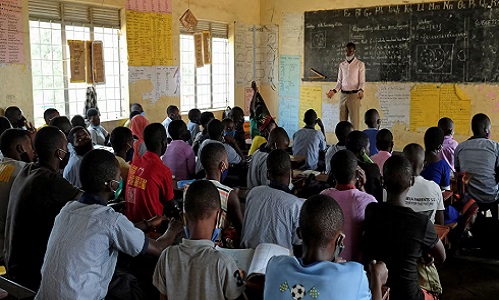
HABARI DAILY I Kampala, Uganda I PTA-funded teachers have withdrawn from classrooms in government-aided schools across Uganda, creating a staffing crisis as a government crackdown on unauthorised school charges leaves schools without the money previously used to pay locally hired educators.
The stalemate has emerged after government intensified enforcement of the Universal Primary Education (UPE) and Universal Secondary Education (USE) policies, directing schools to stop imposing compulsory Parent-Teacher Association (PTA) charges on parents.
While the policy is intended to protect families from additional education costs, schools that have historically relied on PTA collections to meet operational shortfalls say they are now struggling to sustain teachers hired outside the official government payroll.
Schools lose source of funding
For years, government-aided schools have collected varying amounts from parents to supplement government funding and meet costs that are not adequately covered by their official allocations.
In some schools, parents have been asked to contribute between Shs20,000 and Shs50,000 per term, with part of the money used to employ additional teachers where government staffing levels were insufficient.
The enforcement of the no-fee policy has effectively cut off this source of funding.
As government officials and district authorities warn schools against imposing compulsory charges, parents have also become increasingly reluctant to pay PTA contributions, fearing that such payments violate government directives.
The result is that schools can no longer reliably raise the money required to pay teachers who were employed through local arrangements.
Without salaries, many of the teachers have stopped reporting for duty, leaving school administrators caught between government regulations and the need to keep classrooms functioning.
Some teachers ordered out
The funding crisis has been compounded by direct interventions from local authorities. In Kiryandongo District, for example, authorities have reportedly directed teachers who are not on the official government payroll to leave government-aided schools.
Such directives have heightened uncertainty among locally recruited teachers, many of whom had been working alongside government-paid teachers to address staffing shortages.
The situation highlights a difficult contradiction within the public education system: schools are being required to operate without charging parents, while at the same time facing staffing gaps that government recruitment has not fully addressed.
Education experts warn that removing PTA-funded teachers without immediately replacing them could increase the workload of teachers who remain on the government payroll.
Classrooms face staffing gaps
Government-aided schools already face significant shortages of teachers in several parts of the country.
PTA-funded teachers have consequently played an important, although informal, role in filling gaps in the official establishment.
Their withdrawal could mean larger classes, fewer lessons and increased pressure on government-employed teachers.
In some schools, the impact could be more severe, particularly where locally hired teachers account for a significant proportion of the teaching workforce.
Parents and school administrators therefore face a dilemma. While the enforcement of free education protects families from compulsory charges, the removal of an important source of supplementary financing has exposed weaknesses in the funding available to schools.
The current stalemate raises questions about how government can maintain the no-fee policy while ensuring that schools have adequate resources to employ enough teachers.
No national figure for PTA teachers
The scale of the problem is difficult to establish because there is no official national figure for PTA-funded teachers.
Unlike teachers employed through the government payroll, PTA-funded educators are recruited independently by individual school management committees, boards and parent associations.
Their numbers therefore vary from one school to another and can change as schools gain or lose the ability to raise supplementary funds.
The Ministry of Education and Sports’ Education Management Information System (EMIS) captures government payroll and broader staffing information, including approximately 177,936 public-school teachers, but it does not maintain a centralised tally of teachers whose salaries are financed directly through PTA arrangements.
The current crackdown is also causing the number of PTA-funded teachers to fluctuate rapidly as schools reduce or terminate such positions.
Government’s funding dilemma
The withdrawal of PTA-funded teachers has consequently exposed a wider financing challenge within Uganda’s public education system.
The government’s insistence that UPE and USE schools should not impose compulsory charges has placed schools under greater pressure to operate within official government financing.
At the same time, schools still have to provide instruction to growing numbers of pupils and students despite staffing shortages.
Unless alternative funding and recruitment mechanisms are provided, education stakeholders warn that the enforcement of the no-fee policy could unintentionally worsen teacher shortages and disrupt learning.







About the Author