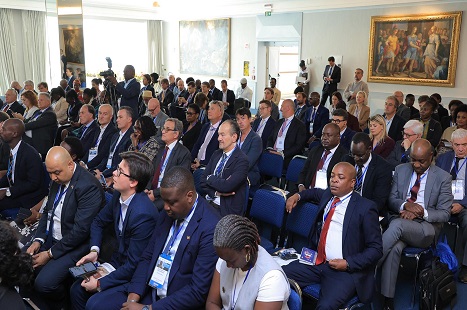

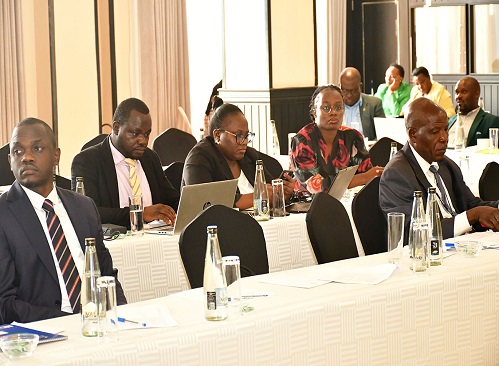
Derek Namisi, the Principal Economist at the Ministry of Education and Sports (L) listens in during the ongoing Financial Year 2027/28 national grant negotiations between central and local governments.at Mestill Hotel Nsambya (Photo by Judith Nantundi)
HABARI DAILY I Kampala, Uganda I The drastic fall in the Chimpazee population from over 600 to a mere 300 in three years prompted President Yoweri Museveni to direct that Bugoma Central Forest Reserve be handed over to the Uganda Wildlife Authority (UWA) for stronger protection, New Vision has learnt.
The move is part of a wider government effort to protect critical ecosystems that are facing increasing pressure from illegal logging, wildfires, charcoal burning, agricultural encroachment and unplanned settlements.
George Owoyesigire, the Commissioner for Wildlife Conservation at the Ministry of Tourism, Wildlife and Antiquities, said the ministry has been pushing for selected central forest reserves to receive stronger legal protection.
“We, the Ministry of Tourism, have been proposing to Cabinet to consider strengthening the protection of selected central forest reserves,” Owoyesigire said, during the annual negotiations between Government and Local Governments on Programme Conditional Grants for Financial Year 2027/2028.
To be held between 17th to 25th August at Mestil Hotel, in Nsambya, the negotiations will see different MDA and Local Governments table their financial needs during the prescribed period.
According to Owoyesigire, Cabinet has so far agreed to consider upgrading two forest reserves, while the President has separately directed that another forest be turned into a national park.
“Echuya Central Forest Reserve is approved by Cabinet to be upgraded to a national park,” he said, adding that Goma Central Forest Reserve is to also be upgraded into a national park, while Bukarewa Central Forest Reserve is to be considered for upgrade into a wildlife reserve.”
The proposals, however, are not yet final. Owesigire explained that the Wildlife Act requires Parliament to give the final approval for the creation or upgrading of protected areas.
The ministry is also studying the possibility of upgrading several other forests, although Owesigire stressed that the government was considering only selected reserves rather than all the country’s central forest reserves.
Among those being examined are Odukoti, Ogodongo, Mabira and Kagombe forests in Kagadi.
“We are looking at a couple of forests to see if they can be considered for upgrade,” Owesigire said, adding that consultations were still ongoing and he could not give a definite date for when Parliament would make the final decisions.
The urgency of the proposed upgrades is underlined by the dramatic decline in Uganda’s forest cover.
Fall In Forest Cover
Owesigire said that around 1900, more than half of Uganda’s land surface was covered by forests. By 1990, forest cover had declined significantly, and by 2015 only about eight to nine per cent of the country’s land surface remained forested.
Recent assessments by the Ministry of Water and Environment, the National Environment Management Authority and the forestry sector indicate that total forest cover has since risen to about 13 per cent. However, he said much of the increase is attributed to plantation forests, meaning Uganda’s natural forest cover remains at only about 10 per cent.
He attributed the destruction of forests to a combination of population growth, agricultural expansion, unplanned settlements and development activities.
“In 1900, we were about two million people. By the 1950s, we were about six million people, and today we are about 48 million people,” he said.
“We can continue to increase, but we must also save the remaining forests.”
Boosting Tourism
The proposed national parks are also being viewed as an opportunity to expand Uganda’s tourism industry and create employment for communities living around the protected areas.
Owesigire said forests could generate revenue through ecotourism while providing employment and alternative sources of income for local communities.
He singled out Bugoma as particularly important because of its location along Uganda’s western tourism circuit.
Tourists travelling towards destinations such as Semuliki, Kibale, Queen Elizabeth and Rwenzori could be encouraged to stop at Bugoma to experience its forests and chimpanzees, creating an additional tourism attraction.
Bugoma’s chimpanzee population has become a major conservation concern. Owesigire said a census conducted around 2000 found about 600 chimpanzees in the forest. However, a 2023 study by the ministry and the Wildlife Conservation Society found that the population had fallen to fewer than 350.
“Chimpanzees are endangered, and they are very important. They are like human beings,” he said, noting that chimpanzees share about 98.7 per cent of their genetic makeup with humans.
Owesigire said the animals were important not only ecologically but also economically because international tourists pay to see them.
Following the presidential directive, UWA has deployed personnel in Bugoma, working alongside the police, UPDF and other security agencies.
The government is also increasing resources for conservation. Owoyesigire said more than Shs250 billion has been budgeted this year to manage and protect national parks and wildlife reserves.
1,300 Additional Rangers
He added that 1,300 additional rangers had been recruited to reinforce the existing force, bringing the number of rangers protecting Uganda’s conservation areas to close to 3,000.
Protecting forests is not simply about conservation but also about Uganda’s economic and environmental future.
Owoyesigire said forests absorb carbon dioxide, help combat climate change and provide communities with firewood, medicinal plants and materials for construction.
“Man cannot survive without these forests,” he said, arguing that government must therefore pursue alternatives to activities that destroy forests while strengthening protection.
Dr. Jane Kyarisiima Mwesiga serves as the Deputy Head of Public Service urged Local Governments to be accountable in their spendind, adding that beginning this year, Government will conduct Citizen Satisfaction Survey to enable locals pin their leaders on poor service delivery.







About the Author