

What Does Leasing A Boeing 737-800 Aircraft Mean To The Struggling Uganda Airlines?
HABARI DAILY I Kampala, Uganda I Uganda Airlines is betting its future on fleet expansion and operational restructuring as the national carrier moves to overcome persistent financial losses, flight disruptions and growing passenger demand across Africa.
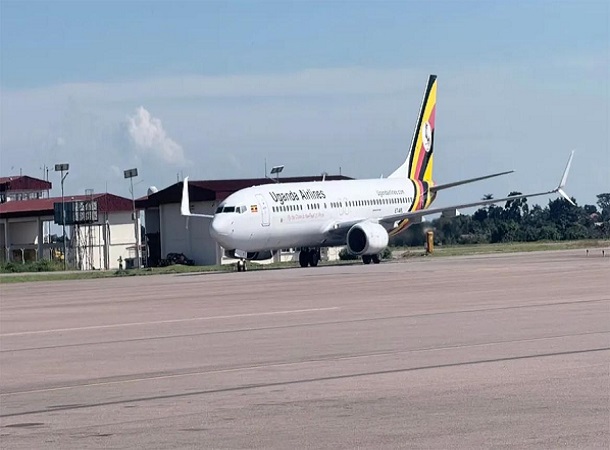
The airline this week added the first of two leased Boeing 737-800 aircraft to its fleet in a move that industry observers say could signal the beginning of a more ambitious recovery and expansion strategy for the state-owned carrier.
The aircraft, registered ET-APL, arrived at Entebbe International Airport painted in Uganda Airlines colours, marking a significant milestone in the airline’s narrow-body operations and an attempt to address mounting pressure on its regional network.
For years, Uganda Airlines has struggled with a fleet imbalance that has constrained its ability to compete effectively on regional routes. The airline’s Bombardier CRJ-900 aircraft, each carrying about 76 passengers, have often proved too small for busy regional destinations such as Nairobi, Lagos and Johannesburg.
At the same time, the carrier’s Airbus A330-800neo aircraft, configured mainly for long-haul operations with more than 250 seats, are considered too large and less economical for shorter regional routes.
Operational flexibility
The newly introduced Boeing 737-800 offers what aviation analysts describe as a critical “middle ground.” With a seating capacity of about 160 passengers, the aircraft is expected to provide Uganda Airlines with greater operational flexibility while easing pressure on the overstretched regional fleet.
“This addition strengthens our operations and enhances flexibility,” Uganda Airlines said in an official statement, adding that the Boeing 737-800 will allow the national career to stabilise its schedule and provide the capacity required on high-demand routes.
The acquisition comes at a crucial time for the airline, which has recently faced growing criticism from passengers over delayed flights, last-minute cancellations and limited seat availability on some of its busiest routes.
Airline officials say the aircraft will immediately be deployed on regional services linking Entebbe to Nairobi, Lagos and Johannesburg, where both passenger traffic and cargo demand have continued to rise steadily.
The airline secured the aircraft through a wet-lease agreement with Ethiopian Airlines under an ACMI arrangement, meaning the Ethiopian carrier provides the aircraft, crew, maintenance and insurance.
The arrangement allows Uganda Airlines to immediately deploy the aircraft without waiting to recruit and train additional crew or establish new maintenance systems.
Girma’s main bet
Industry experts believe the strategy reflects the influence of veteran aviation executive Ato Girma Wake, who was appointed acting chief executive officer of Uganda Airlines in February 2026.
Wake is widely respected across the aviation industry for helping transform Ethiopian Airlines into one of Africa’s most successful and profitable carriers. Analysts say his appointment could shape a new direction for Uganda Airlines as it seeks to stabilise operations while pursuing long-term growth.
Regional aviation analyst Wolfgang H. Thome said the decision to paint the aircraft in Uganda Airlines colours suggests the arrangement is more strategic than previous short-term leasing solutions.
“Unlike previous short-term leasing arrangements, the aircraft appearing in Uganda Airlines livery points to a more structured operational approach,” Thome noted.
The arrival of the Boeing 737-800 also signals a broader shift in Uganda Airlines’ ambitions as the carrier seeks to strengthen its position across East, West and Central Africa.
The airline has increasingly faced competition from larger regional operators, including Ethiopian Airlines, Kenya Airways and RwandaAir, all of which possess larger fleets and stronger route networks.
Profitability possible?
Analysts argue that for Uganda Airlines to survive and eventually turn profitable, it must expand strategically while improving operational efficiency and reliability.
The second Boeing 737-800 expected in the coming weeks is anticipated to further reduce pressure on the airline’s existing fleet and improve schedule consistency through the end of 2026.
However, aviation insiders caution that the wet-lease arrangement is only a temporary fix and does not fully solve the airline’s long-term structural challenges.
Wet-leasing often comes with higher operational costs because the airline pays not only for the aircraft but also for crew and technical support services. Experts say Uganda Airlines will eventually need to either purchase or dry-lease its own narrow-body aircraft to lower operating expenses and gain greater operational independence.
The airline’s long-term sustainability will also depend on its ability to improve passenger numbers, increase cargo revenues and maintain reliable schedules that can rebuild customer confidence.
Despite the financial losses that have characterised much of its operations since relaunching in 2019, government officials continue to view Uganda Airlines as a strategic national asset capable of boosting tourism, trade and regional connectivity.
The expansion strategy also aligns with Uganda’s broader economic ambitions of positioning Entebbe as a regional aviation hub linking East Africa to West Africa, Southern Africa, the Middle East and Asia.
If successfully implemented, analysts say the ongoing fleet expansion could mark the beginning of a gradual turnaround for Uganda Airlines — transforming it from a struggling state carrier into a more competitive regional airline capable of supporting Uganda’s trade, tourism and economic growth objectives.
About the Author