
HABARI DAILY I Kampala, Uganda I Nothing under the face of the earth should interfere with Sabbath, which the Seventh-day Adventists consider a sacred covenant between God and humanity, and that conviction has now placed the church on a collision course with the Ugandan government’s newly launched National Cleaning Days programme.
The Seventh-day Adventist (SDA) Church in Uganda has strongly objected to the government’s decision to hold mandatory monthly community cleaning exercises on the last Saturday of every month, arguing that the directive directly conflicts with the church’s observance of the Sabbath.
The nationwide sanitation campaign, announced by the Office of the Prime Minister, is expected to begin on July 25, 2026, with all Ugandans encouraged to participate in community clean-up activities from 8:00 a.m. to 11:00 a.m. Police have indicated that movement of people and vehicles will be restricted during the exercise, except for emergency services and other exempted categories, to ensure compliance.
Saturday not an ordinary day
For the Seventh-day Adventist Church, however, the timing presents a serious challenge because Saturday is not an ordinary day but the biblical Sabbath, observed from Friday sunset until Saturday sunset.
In a July 24, 2026 letter addressed to members of the Adventist community, Uganda Union Mission President Pr Kajoba Samuel reaffirmed the church’s support for environmental conservation while insisting that worship obligations cannot be compromised.
“According to Scripture, the Sabbath is God’s holy day, observed from sunset on Friday to sunset on Saturday,” Kajoba wrote.
“During these sacred hours, God calls His people to cease from their ordinary work and dedicate their time wholly to worship, fellowship, acts of mercy and communion with Him.”
His message has resonated with thousands of Adventists across Uganda who fear they could be forced to choose between obeying government directives and remaining faithful to one of the central pillars of their faith.
The Seventh-day Adventist Church teaches that the Sabbath is the fourth commandment and should be devoted entirely to worship, spiritual reflection and ministry. Consequently, church leaders argue that compulsory participation in public cleaning exercises during those sacred hours would interfere with their constitutional right to freedom of religion.
Conciliatory approach
Rather than rejecting the government’s sanitation campaign altogether, the church has adopted a conciliatory approach by engaging state authorities in search of a compromise.
Kajoba revealed that church leaders are already holding discussions with government officials to find a solution that accommodates both public health objectives and religious freedoms.
Among the proposals submitted is allowing Adventist believers to participate in the cleaning exercise either on Friday before sunset or on Sunday after the Sabbath has ended.
The church believes such flexibility would enable its members to contribute fully to environmental cleanliness without violating their religious convictions.
As negotiations continue, Kajoba appealed to church members not to confront authorities but instead remain patient and prayerful.
“I kindly appeal to every member to remain calm, prayerful and steadfast in faith,” he said.
The dispute comes as the government intensifies efforts to improve sanitation across Uganda through the newly established National Cleaning Days Programme.
Inspired by Museveni
Launching the initiative on behalf of the Office of the Prime Minister, Prime Minister Robinah Nabbanja said the campaign was inspired by President Yoweri Kaguta Museveni, who has long advocated for a nationwide culture of cleanliness as a way of reducing preventable diseases.
According to Nabbanja, poor sanitation continues to impose a heavy burden on Uganda’s healthcare system despite many sanitation-related illnesses being entirely preventable.
“I want to start by reminding Ugandans that 75 percent of our disease burden is preventable. This burden includes diseases such as malaria, diarrhoea, typhoid and others, which are directly linked to poor sanitation and environmental management,” she said.
She cited alarming statistics showing that Kampala alone generates between 2,000 and 2,500 tonnes of solid waste every day, yet only 50 to 60 percent is collected and properly disposed of. The remaining garbage blocks drainage channels, contaminates water sources and creates breeding grounds for disease-causing organisms.
Nabbanja also highlighted the devastating human cost of poor sanitation, revealing that approximately 33 Ugandan children die every day from diseases associated with unsafe water, inadequate hygiene and poor sanitation.
She explained that the National Cleaning Days Programme is anchored in constitutional provisions requiring citizens to protect the environment and public health, alongside the Public Health Act and National Cleaning Day Policy Guidelines.
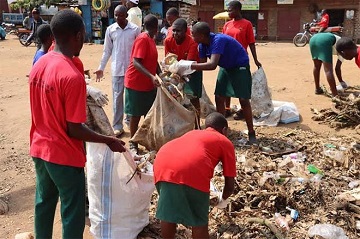
Under the programme, the last Saturday of every month has been designated as National Cleaning Day, with organised activities expected to take place across villages, towns and cities. Government ministries and agencies have each been assigned specific responsibilities.
The Ministry of Local Government will coordinate district implementation, while the Ministry of Health will provide technical guidance on sanitation. The Ministry of Water and Environment will oversee environmental protection, with the National Environment Management Authority (NEMA) enforcing environmental regulations.
Security guaranteed by Uganda Police
Uganda Police will provide security and enforce public order during the exercise, while the Ministry of Works and Transport will support waste collection logistics. Resident District Commissioners have also been tasked with coordinating activities in their respective districts.
The Prime Minister urged local councils, religious institutions, schools, businesses, markets and households to actively participate by cleaning compounds, desilting drainage channels, collecting garbage, maintaining public toilets, clearing bushes, planting trees and educating communities on proper sanitation practices.
She emphasised that cleanliness should become a permanent way of life rather than a once-a-month obligation.
“I call upon all Ugandans to embrace this programme with patriotism and commitment. Together, let us build a cleaner, healthier, more productive and prosperous Uganda,” Nabbanja said.
While both the government and the Seventh-day Adventist Church agree on the importance of environmental cleanliness and disease prevention, the disagreement underscores the delicate balance between implementing nationwide public programmes and respecting constitutionally protected religious freedoms.
With the first National Cleaning Day set to begin, attention will now shift to ongoing discussions between government officials and Adventist leaders, whose hoped-for compromise could determine whether thousands of worshippers are able to fulfil both their civic responsibilities and their deeply held religious obligations