
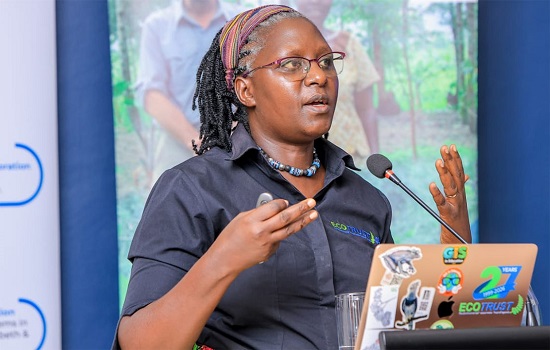
Pauline Nantongo Kalunda, ECOTRUST’s Executive Director
HABARI DAILY I Kampala, Uganda I Relevant training of biodiversity practitioners arm them with the critical skills needed to design effective conservation strategies, engage local communities, secure vital funding, and adapt to emerging ecological threats like climate change.
As biodiversity loss and environmental degradation continue to threaten livelihoods and ecosystems across Africa, building the capacity of conservation professionals and community leaders is increasingly being recognised as a crucial component of sustainable environmental management.
It is against this backdrop that the African CSOs Biodiversity Alliance (ACBA) has launched the ACBA Biodiversity Academy (ABA), a new learning platform designed to bring together biodiversity practitioners, community leaders, researchers and conservation organisations from across the continent. The initiative seeks to promote African-led learning, knowledge sharing and practical solutions to biodiversity loss and climate change.
African voices emerge
The Academy has been established as a shared learning space where African voices, experiences and innovations take centre stage. Its core objective is to strengthen conservation efforts by equipping practitioners with practical knowledge while creating opportunities for peer learning and collaboration across countries and sectors.
“Across the continent, there is a wealth of knowledge, innovation, and experience in biodiversity conservation. The Biodiversity Academy seeks to bring these voices together, creating a space where African practitioners can learn from one another and build a shared vision for a sustainable future,” said Yemi Katerere, Executive Director of ACBA.
The launch reflects a growing recognition that conservation solutions are most effective when they are informed by local realities and community experiences. While international expertise remains important, practitioners working directly with communities often possess valuable insights into the environmental challenges and opportunities unique to their regions.
Through webinars, peer-learning exchanges, case studies and practical training opportunities, the Academy aims to strengthen the capacity of biodiversity practitioners while amplifying African narratives and conservation success stories. The platform will provide participants with access to real-world experiences and tested approaches that can be adapted to different conservation contexts across the continent.
ECOTRUST pioneers
At the centre of the Academy’s inaugural learning programme is the Environmental Conservation Trust of Uganda (ECOTRUST), one of ACBA’s founding members and a long-standing leader in conservation finance and landscape restoration. For more than 27 years, ECOTRUST has developed practical conservation models that seek to balance environmental protection with economic development.
One of the organisation’s flagship approaches is its “Landscape Restoration as a Business” model. The concept encourages communities and stakeholders to view environmental restoration not only as a conservation obligation but also as an economic opportunity. Through investments in tree planting, forest restoration, sustainable agriculture and nature-based enterprises, communities can generate income while simultaneously restoring degraded ecosystems.
Following the launch of the Academy, ECOTRUST has begun leading a three-part webinar series aimed at sharing practical lessons from Uganda’s conservation journey. The first webinar introduced participants to the organisation’s conservation finance model and highlighted lessons learned from decades of implementing community-based environmental restoration programmes.
The session was led by ECOTRUST Executive Director Pauline Nantongo, who outlined how the organisation developed innovative conservation financing mechanisms and how these have enabled communities to benefit financially from environmental restoration activities.
A major focus of the webinar was demonstrating how conservation projects can be structured as sustainable investment opportunities. Participants were introduced to the concept of making nature investible by transforming biodiversity and climate challenges into projects capable of generating long-term financial, social and environmental returns.
“ECOTRUST treats every participating household as an individual economic unit,” Nantongo explained. “The financial incentives from carbon and biodiversity credits allow families to safely shift their financial planning away from short-term, degrading cycles like sugarcane or maize toward long-term, sustainable forestry.”
Environmental protection efforts relevant
Such practical training is increasingly important as conservation organisations seek innovative financing solutions to support environmental protection efforts. Understanding concepts such as carbon markets, biodiversity credits and conservation finance can help practitioners unlock new sources of funding while ensuring that local communities directly benefit from conservation initiatives.
The ongoing webinar series will delve deeper into technical topics including nature markets, conservation financing tools and community-owned investment models. Participants will also learn how ECOTRUST has successfully partnered with local communities to restore degraded landscapes while creating income-generating opportunities that improve livelihoods.
An important feature of the programme will be the sharing of real-life community experiences. Through case studies from farmers and local groups participating in restoration programmes in Uganda, attendees will gain practical insights into how conservation initiatives can simultaneously improve household incomes and protect natural resources.
As the first webinar series unfolds, the ACBA Biodiversity Academy is already positioning itself as an important platform for learning, collaboration and innovation. By investing in the training of biodiversity practitioners, community leaders, researchers and conservation organisations, the initiative is helping build a stronger foundation for effective conservation across Africa.
With ECOTRUST at the forefront of the learning process, the Academy demonstrates how African-led knowledge and practical experience can generate solutions that not only protect biodiversity but also create sustainable economic opportunities for communities, ultimately contributing to a more resilient and environmentally secure future for the continent.







About the Author