

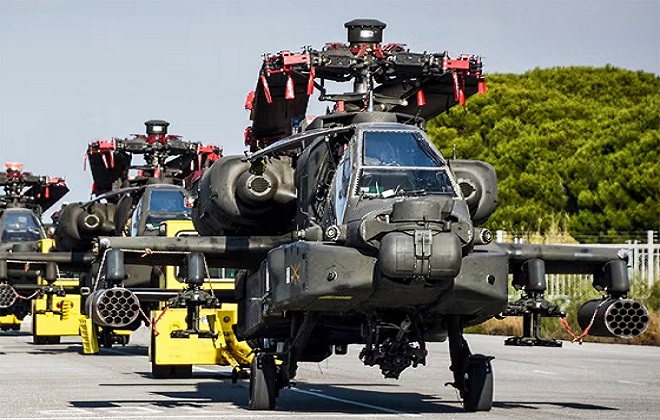
The U.S. Army AH-64 Apache attack helicopter
HABARI DAILY I Kampala, Uganda I The shooting down of a U.S. Army AH-64 Apache attack helicopter was the last straw that broke the camel’s back, triggering a dramatic escalation in hostilities between the United States and Iran and pushing fragile peace negotiations to the brink of collapse.
What had been a tense but manageable ceasefire process quickly deteriorated into one of the most dangerous confrontations in recent months after Iran’s Islamic Revolutionary Guard Corps (IRGC) downed the American helicopter near the strategically vital Strait of Hormuz. The incident unleashed a rapid cycle of military retaliation and counter-retaliation that spread across the Gulf region and threatened to derail efforts aimed at extending a 60-day ceasefire agreement.
According to reports, the Apache helicopter was conducting a patrol mission over the Strait of Hormuz when it was struck by a Shahed-series one-way attack drone. Military sources indicated that the aircraft may have unexpectedly entered an area covered by pre-programmed drone coordinates, leading to the fatal encounter.
Although the helicopter was destroyed, both crew members were successfully rescued, preventing a greater loss of life. However, the downing of the aircraft immediately inflamed tensions between Washington and Tehran at a time when mediators were attempting to secure a broader diplomatic breakthrough.
‘Iranian aggression’
The United States swiftly condemned the incident, describing it as an act of “unjustified Iranian aggression.” Within hours, U.S. Central Command (CENTCOM) launched what it termed proportional self-defense strikes against Iranian military infrastructure.
The retaliatory operation targeted Iranian air defense systems, radar installations, and drone command facilities located on Qeshm and Sirik Islands. The islands occupy a strategic position overlooking key shipping lanes through which a significant share of the world’s oil exports pass.
American officials said the strikes were designed to neutralize threats to U.S. forces and commercial maritime traffic operating in the region while avoiding broader escalation. However, the military action instead triggered an immediate response from Tehran.
In retaliation, the IRGC launched waves of drones and long-range ballistic missiles at military facilities hosting American forces across the Middle East. Targets included U.S. bases in Bahrain and Kuwait as well as an air base in Jordan used by American troops.
The attacks marked a significant expansion of the conflict beyond the waters of the Strait of Hormuz and raised fears of a wider regional confrontation. Bahrain, Kuwait and Jordan all found themselves under direct threat as Iranian missiles crossed regional airspace, highlighting the growing risks facing countries that host U.S. military installations.
The latest escalation represented the second major challenge to a two-month ceasefire this week. Earlier, Iran and Israel had exchanged attacks, adding further pressure to an already fragile security environment.
As the military exchanges intensified, diplomatic efforts suffered a major setback. Negotiators had reportedly been close to finalizing a 60-day ceasefire extension and broader memorandum of understanding intended to reduce tensions and create a pathway toward a more comprehensive settlement.
Instead, the outbreak of fighting brought discussions to a temporary standstill.
Iran suspend talks
Iran subsequently suspended its participation in the talks, citing the U.S. strikes as well as expanding Israeli military operations in Lebanon. Diplomats involved in the mediation process expressed concern that months of painstaking negotiations could unravel if hostilities continued.
The crisis deepened further when the United States launched additional airstrikes against Iranian targets on Wednesday. President Donald Trump signaled that Washington was prepared to intensify military operations if Tehran failed to return to the negotiating table.
Speaking at the White House, Trump warned that Iran would “pay the price” for stalled negotiations and vowed additional military action.
“We’re going to hit them again hard today,” Trump told reporters hours after the U.S. military confirmed strikes against Iranian military sites.
Shortly after the President’s remarks, the U.S. military announced that it had fired on an oil tanker allegedly transporting Iranian oil in violation of Washington’s blockade on Iranian ports. The incident added another layer of tension to an already volatile situation.
Critical infrastructure targeted
Trump stopped short of confirming whether he would follow through on earlier threats to target bridges, utility plants and other critical infrastructure inside Iran. Nevertheless, he renewed calls for Tehran to agree to a deal that would bring an end to the conflict.
With missiles flying, diplomatic channels frozen, and regional allies increasingly exposed to retaliation, the downing of the Apache helicopter has emerged as a pivotal moment in the crisis. What began as an isolated military incident has evolved into a confrontation that now threatens both regional stability and the future of ongoing peace efforts.
For now, the prospect of reviving ceasefire talks remains uncertain as both sides continue to exchange warnings and military strikes, raising fears that the region may be drifting further away from peace and closer to a broader conflict.







About the Author