
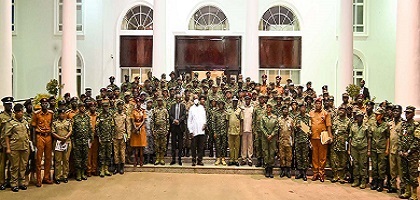
President Museveni (C) poses for a photo with Security officers from UPDF, UPF, Uganda Prisons, ISO and ESO after giving them an opportunity lecture and passing them out upon completion of an ideological course at Kyankwanzi
HABARI DAILY I Kampala, Uganda I President Yoweri Museveni has traced Uganda’s drive for socio-economic transformation to lessons he drew while mobilising communities in western Uganda during the 1960s, when he encouraged pastoralists to abandon nomadism and embrace commercial production.
Speaking during the pass-out ceremony for 106 senior security officers who completed the Advanced Joint Senior Political Education and Leadership Development Course at the National Leadership Institute (NALI), Kyankwanzi, the President said those early experiences shaped his conviction that prosperity depends on production and participation in the market economy rather than subsistence living.
Museveni explained that many cattle keepers in western Uganda possessed significant wealth in livestock and land but remained detached from the money economy.
“Those people had land and cattle but they were outside the money economy. We studied how Europe transformed itself and concluded that prosperity comes from production and participating in the market economy,” he said.
Commercial agriculture is the key
According to the President, the country’s transformation must begin with moving households away from subsistence production into commercial agriculture, manufacturing, information and communications technology (ICT), and services. He likened national development to biological metamorphosis, arguing that societies progress through carefully managed stages.
“Society transforms just like an insect changes from an egg to a caterpillar, then a pupa and finally a butterfly. Societies also transform in stages and must be guided correctly through those stages,” he said.
Museveni said one of the first policy shifts under the NRM government was to broaden the definition of commercial agriculture beyond the traditional export crops of coffee, cotton and tobacco.
“Long ago people only talked about cotton, coffee and tobacco. I wondered why we should emphasise beverages and ignore food. That is why when we came into government we said all food crops are cash crops. Maize, bananas and many other crops can generate wealth if produced commercially,” he said.
The Four-Acre Model
He urged government officials and security officers to continue educating communities on wealth creation through the effective use of small land holdings under the Four-Acre Model. The model recommends allocating one acre each to coffee, fruits, pasture and food crops while using backyard space for poultry or piggery.
To demonstrate the model’s potential, Museveni cited Richard Nyakana of Fort Portal, who reportedly earns about Shs1 million daily from integrated farming, and Joseph Ijala of Serere District, a former taxi conductor who transformed one and a half acres into a poultry and dairy enterprise said to generate more than Shs1 billion annually.
“When our people wake up and properly utilise their land, they create wealth not only for themselves but also jobs for others. Nyakana is employing about 15 people because he used his land correctly,” the President said.
He pledged that government would continue combining education with mass sensitisation campaigns to encourage more Ugandans to embrace commercial production and wealth creation.
Museveni also used the occasion to explain the ideological principles that have guided Uganda’s liberation struggle and post-war development. He said the movement first sought to answer whether Africans deserved prosperity before identifying its true source.
“When we were fighting for the freedom of Africa, we asked ourselves whether Africans deserve prosperity like other people. The answer was yes. Then we asked where prosperity comes from. Does it come from begging? The answer was no.”
Food knows no tribe
He argued that prosperity comes from producing goods and services that others are willing to buy, making patriotism an economic necessity rather than merely a political slogan.
“If I produce milk, beef or bananas, my prosperity does not come from my tribe because they produce the same things. My prosperity comes from other Ugandans who buy my products. That is why patriotism became our first ideological principle.”
The President warned against sectarian politics based on tribe or religion, saying such divisions undermine national prosperity. He further stressed that Uganda’s domestic market alone cannot absorb increasing production, making regional integration and Pan-Africanism essential for sustainable economic growth.
“When our people started producing more sugar, textiles, milk and maize, they discovered that Uganda alone was not enough. That is why Pan-Africanism is essential. East Africa and Africa provide the market for our surplus production,” he said.
Museveni reaffirmed that patriotism, Pan-Africanism, socio-economic transformation and democracy remain the four pillars of Uganda’s ideological orientation, while strategic security is necessary to safeguard economic gains. He argued that modern security now extends beyond land, sea and air into space, making continental political integration increasingly important.
Overcoming inferiority complex
He also challenged Africans to overcome what he described as an inferiority complex, pointing to Uganda’s growing capacity to process local raw materials, including cassava starch for pharmaceutical manufacturing, as evidence that Africa can compete globally.
The President further called for an education system that balances academic learning with practical skills and reiterated government’s commitment to addressing challenges such as human-wildlife conflict while expanding commercial agriculture.
The ceremony marked the completion of a 59-day course that began on May 26, 2026, to strengthen ideological grounding, leadership and strategic thinking among senior security officers. The graduates included 52 UPDF officers, with the remainder drawn from other security agencies, including 16 female officers serving mainly at battalion and brigade command level.
Speaking on behalf of the security agencies, ESO Director General Ambassador Joseph Ocwet described the President’s address as a “Lecture of Opportunity” that had deepened participants’ understanding of ideology, leadership and national transformation.
NALI Director Col. Okei Rukogota said the programme sought to reinforce the four ideological principles as the foundation for Uganda’s socio-economic transformation, while participants pledged to apply the lessons in strengthening national security and promoting productive citizenship.