
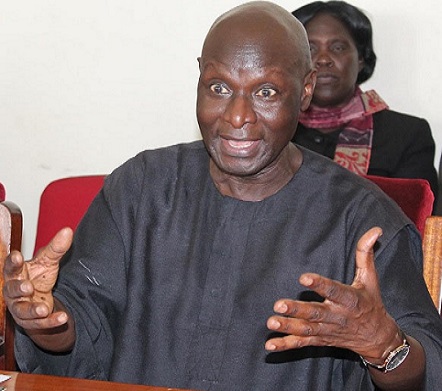
Dr Olara Otunnu
HABARI DAILY I Kampala, Uganda I The chances of Uganda’s Olara Otunnu becoming the next United Nations Secretary-General have gained fresh attention after he climbed to third position in the latest Security Council straw poll, although his level of positive support remained unchanged.
Otunnu received five “encourage” votes, seven “discourage” votes and three “no opinion” votes in the confidential ballot held on September 18, according to results obtained by PassBlue and verified by diplomatic sources.
His five “encourage” votes were the same number he received in the second poll on August 21. His rise from fifth to third position therefore reflects changes in the distribution of support and opposition among the other candidates rather than an increase in his own positive votes.
Otunnu still below threshold
Otunnu’s five positive votes leave him four votes short of the nine affirmative votes required for the Security Council to recommend a candidate to the 193-member General Assembly.
The latest poll was led by Costa Rica’s Rebeca Grynspan, who received nine “encourage” votes, followed by Guyana’s Carolyn Rodrigues Birkett with eight.
Otunnu was tied on five “encourage” votes with Rafael Grossi of Argentina and former Senegalese President Macky Sall. However, Grossi received eight “discourage” votes and Sall nine, compared with Otunnu’s seven, placing the Ugandan ahead of them in the latest distribution.
The figures nevertheless show that the race remains unsettled. Grynspan became the first candidate in the latest round to reach the nine-vote threshold, but she also received five “discourage” votes. The straw poll does not reveal whether any of those negative votes came from the five permanent members of the Security Council.
Those five countries — China, France, Russia, the United Kingdom and the United States — possess veto powers, meaning a candidate ultimately needs both sufficient support and acceptance by the permanent members.
From two votes to five
Otunnu’s campaign has made significant progress since the first straw poll on July 30.
He received only two “encourage” votes in that ballot before increasing his support to five in the August 21 poll. He has now maintained those five votes in the third round.
His latest position therefore demonstrates that his candidacy has retained a level of support within the Council, even as the wider contest continues to shift.
At the same time, the seven “discourage” votes show that there remains substantial opposition or reservations among Council members. The confidential nature of the voting makes it impossible to determine which individual countries supported or opposed his candidacy.
The “Otunnu Formula”
Otunnu has a particularly unusual connection to the process now being used to assess his own candidacy.
In 1981, while serving as Uganda’s ambassador to the United Nations and president of the Security Council, he introduced the informal straw-ballot mechanism used to gauge Council members’ preferences during the selection of a Secretary-General.
The system subsequently became associated with the “Otunnu Formula.” More than four decades later, the Ugandan diplomat is himself being assessed through the mechanism he helped establish.
Otunnu was formally nominated by Uganda this year. He previously served as UN Under-Secretary-General and Special Representative for Children and Armed Conflict from 1998 to 2005.
A race still wide open
The latest ballot also illustrated the difficulties facing several other candidates. María Fernanda Espinosa received three “encourage” votes, while former Chilean President Michelle Bachelet received one. Ivonne A-Baki received no “encourage” votes. Bachelet subsequently withdrew from the contest on September 20, leaving seven candidates in the race.
For Otunnu, the immediate challenge is to convert the five existing positive votes into broader Council support while securing acceptance from the permanent members.
The next straw poll could be held after the UN General Assembly’s high-level week ends on September 28. The Security Council will eventually recommend one candidate to the General Assembly, which will formally appoint the successor to António Guterres, whose second term ends on December 31, 2026.